Agricultural engineers and animal scientists have developed an automated dual-stream computer vision framework named DINOv3-DFR that estimates the live body weight of finishing pigs from top-down overhead visual and spatial imagery with unprecedented precision. Tested on thousands of paired colour and depth image pairs collected in commercial housing, the system achieved a mean absolute error of 2.96 kilograms, a mean absolute percentage error of 3.47 percent, a root mean square error of 3.79 kilograms, and a coefficient of determination of 0.927. Operating with a compact parameter footprint of only 29.6 million weights, the architecture outpaced existing dual-stream fusion baselines by 9.5 percent in mean absolute error and reduced estimation deviations relative to earlier cross-attention vision transformer benchmarks by nearly half. The findings demonstrate that pairing self-supervised visual representations with asymmetric cross-modal attention mechanisms and explicit temporal consistency constraints can successfully overcome long-standing performance ceilings in non-contact livestock phenotyping.
Accurate monitoring of live animal weight is a cornerstone of industrial pork production, providing farm managers with essential metrics for tracking growth trajectories, evaluating daily health, optimising feed conversion, and timing marketing decisions. Traditionally, livestock weighing requires personnel to herd animals onto mechanical or electronic platform scales. This manual process is exceptionally labour-intensive, disrupts barn routines, provokes acute physiological stress responses in growing animals, and increases the risk of disease transmission across pens. While early mechanical alternatives introduced manual body measurements to build predictive mathematical equations, these techniques still required physical contact. Image-based non-contact alternatives subsequently emerged, initially relying on two-dimensional morphological traits such as plan area, ham width, and body length mapped through linear regressions, polynomial equations, or spline fits. However, these traditional morphological regressions routinely hit an empirical ceiling, rarely exceeding a coefficient of determination between 0.50 and 0.60 because conventional curve fitting cannot capture the highly non-linear relationships linking animal posture, surface geometry, and true mass.
The advent of consumer depth cameras and deep convolutional architectures spurred rapid transitions toward non-contact three-dimensional weighing systems. Early spatial implementations calculated body volume directly from point clouds or extracted linear contours from segmented silhouettes, improving accuracy but failing to exploit the rich complementary properties inherent in visual colour imagery. While standard red-green-blue photographs capture fine-grained surface textures, illumination nuances, and boundary definitions, depth maps encode invariant spatial metrics and physical distances from overhead sensors to animal backs. Recent attempts to blend these two streams typically deployed symmetric dual-branch networks relying on backbones pre-trained on supervised classification tasks such as ImageNet. These symmetric architectures suffer from two structural shortcomings: supervised backbones frequently lack the generalised semantic richness needed for regression tasks, and equal-weight fusion modules fail to allow the semantically dominant colour stream to actively steer the extraction of geometric features from noisier, low-contrast depth frames.
To overcome these limitations, the researchers formulated DINOv3-DFR by adopting the self-supervised DINOv3-ViTS model as the backbone for the colour imaging stream. Unlike standard convolutional backbones trained under supervised label constraints, DINOv3 employs a self-distillation teacher-student framework incorporating Gram anchoring to prevent representation collapse during large-scale pre-training. This yields highly structured, dense semantic feature maps that excel at fine-grained visual localization. In the proposed framework, this pre-trained RGB backbone is kept frozen to provide stable, generalised visual anchors without incurring excessive computational burdens or requiring manual supervision labels. In parallel, the depth modality is processed through a dedicated, trainable multi-scale lightweight encoder that generates multi-resolution spatial feature maps, capturing geometric distance cues across distinct hierarchical scales while keeping total parameter counts modest.
The critical structural innovation linking these parallel encoders is the Gated Skip Fusion Attention Block, or GSF Attention Block, deployed across four distinct hierarchical feature levels. Recognizing that the semantic richness of the colour stream far exceeds that of the lightweight depth encoder, the module executes an asymmetric cross-attention operation. Flattened sequence representations from the colour backbone are projected through learnable linear transformations to serve as queries, while flattened spatial depth representations are projected into key and value spaces. The resulting scaled dot-product attention matrix computes dense spatial correlations, effectively allowing colour semantic cues to selectively interrogate, retrieve, and align the most relevant geometric depth features. To ensure structural stability during gradient updates, the reorganized depth features are scaled by a learnable gating parameter initialized to zero and merged residually into the original colour features, preventing capacity bottlenecks while dynamically calibrating geometric injection.
Downstream of the cross-modal attention blocks, the researchers introduced the Multi-level Feature Aggregator to systematically integrate the four sets of hybrid representations. Rather than channeling raw intermediate features directly into a terminal regression layer, the aggregator utilizes a bottom-up hierarchical decoder equipped with skip connections to progressively reconstruct high-resolution feature maps. The deepest fused feature map undergoes a initial one-by-one convolution to adjust its channel dimensionality from 384 to 512 before ascending through a succession of four specialized upsampling blocks. At each successive stage, shallower fused features from intermediate attention layers are spatially matched via bilinear interpolation and concatenated with the upsampled representations. This progressive fusion effectively marries high-level global semantics describing full body posture with low-level local boundaries such as dorsal contours. A final transposed convolution restores the representation to full input spatial resolution, followed by global average pooling and a fully connected layer that outputs the scalar weight prediction.
A further conceptual advancement in the training framework is the Individual-level Prediction Consistency Loss, designed to correct the blind spots of conventional image-level loss functions. Standard training objectives treat every collected photograph as an isolated instance, penalizing deviations from ground truth via absolute or squared error metrics. However, an individual pig’s biological weight remains effectively invariant across a single day, meaning multiple images of the same pig captured under varying postures or pen lighting within that window should yield identical model outputs. The proposed consistency loss explicitly enforces this physical reality by dynamically sorting each mini-batch into clusters defined by individual animal identification tags and capture dates. For every multi-sample group, the algorithm computes the intra-group variance across predicted values and incorporates this variance penalty into the objective. Weighted alongside the standard mean absolute error at a coefficient of 0.1, this loss dampens spurious fluctuations driven by transient posture shifts and reinforces robust feature stability.
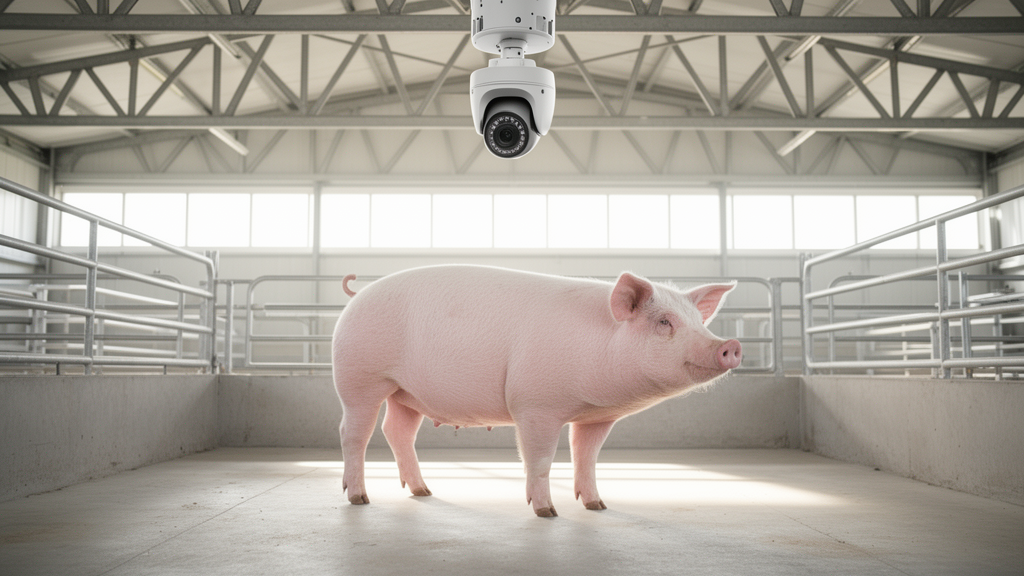
Empirical validation was conducted using an extensive experimental dataset gathered at a commercial finishing facility in Henan Province, China. Data collection spanned 55 consecutive days, tracking 28 finishing pigs as they progressed from approximately 100 to 155 days of age, covering a critical high-growth developmental window during which individual body masses ranged from 42.50 to 125.00 kilograms. The facility housed animals across two structurally identical units, each measuring 5 metres in length, 4 metres in width, and 2.4 metres in height, populated by 14 pigs per house representing Duroc, Landrace, and Large White breeds. Overhead Microsoft Kinect DK depth sensors were mounted at a standardized height of 2.3 metres, synchronized with automated Nedap Pig Performance Testing stations equipped with individual electronic ear tag sensors and integrated floor scales. This hardware pipeline yielded 12,355 verified foreground RGB-D image pairs paired with precise scale records, segregated strictly by individual animal identity so that all 8,162 pairs from the first house formed the training set while 4,193 pairs from the second house constituted the isolated testing set.
When benchmarked against competing methodologies on the independent test set, DINOv3-DFR established clear superiority across all statistical metrics. Traditional point-cloud body dimension models developed from manual annotation yielded poor accuracy, with multiple linear regression posting an error of 6.81 kilograms and second-order polynomial regression achieving 6.35 kilograms, both failing to exceed an R-squared of 0.55. Single-modality supervised deep learning baselines achieved modest improvements, with supervised RGB ResNet50 recording 4.80 kilograms and EfficientNet recording 3.91 kilograms. The isolated self-supervised DINOv3 model using only colour frames demonstrated the potency of self-supervised representations by reaching 3.67 kilograms. However, combining both modalities through the proposed architecture produced unmatched accuracy, reducing error to 2.96 kilograms and lifting the coefficient of determination to 0.927. By comparison, established dual-stream networks such as the ConvNeXtV2 fusion framework and a dual-stream Swin Transformer recorded significantly larger errors of 3.86 kilograms and 5.90 kilograms, respectively.
Systematic ablation trials documented the additive value of each architectural component within the complete predictive pipeline. Replacing the asymmetric GSF Attention Block with simple mathematical fusion operations proved detrimental: element-wise addition produced a test error of 7.01 kilograms, maximum value selection yielded 5.89 kilograms, and multiplication achieved 5.63 kilograms. Introducing the GSF Attention Block lowered the error sharply to 4.03 kilograms, confirming that semantic query guidance effectively unlocks spatial depth features. Incorporating the Multi-level Feature Aggregator provided an additional reduction to 3.28 kilograms by preserving edge detail during decoding. Finally, activating the Individual-level Prediction Consistency Loss during optimization delivered the final improvement to 2.96 kilograms. Secondary evaluations across genetic lines revealed consistent model robustness, with Large White subjects logging a 2.89-kilogram error, Duroc subjects recording 3.05 kilograms, and Landrace subjects reaching 3.15 kilograms, indicating minimal sensitivity to distinct breed conformations.
Despite these compelling results, the study authors outlined several physical and structural limitations that warrant careful consideration before widespread commercial deployment. Operating from a single overhead camera viewpoint inherently obscures lateral contours, such as the flank profile, making the model susceptible to occlusion during abrupt postural shifts. Error distribution analyses also revealed that prediction variance rose noticeably in the 80 to 90 kilogram weight category, where absolute deviations reached peak values likely due to complex morphological transitions and fewer training examples in intermediate ranges. Furthermore, the dataset relied on semi-automated preprocessing and interactive foreground segmentation, which could bottleneck high-throughput scaling in crowded pens where pigs frequently jostle around automated feeding stations. The researchers emphasized that while an average error of 2.96 kilograms is well suited for daily herd tracking and non-invasive feed monitoring, precision-critical interventions such as slaughter marketing sorting or individual medication administration will benefit from expanded multi-view sensing and broader multi-farm validation.
Subject of Research: Deep learning and dual-stream computer vision for non-contact pig weight estimation
Article Title: Self-supervised learning with RGB-guided attention and individual consistency for pig weight estimation
Article References: Li, S., Mi, Y., Huang, H., Ding, X., & Li, T. (2026). Self-supervised learning with RGB-guided attention and individual consistency for pig weight estimation. Smart Agricultural Technology, 15, Article 102717. https://doi.org/10.1016/j.atech.2026.102717
Image Credits: AI Generated
DOI: 10.1016/j.atech.2026.102717
Keywords: Pig Weight Estimation, Self-Supervised Learning, DINOv3, Computer Vision, Precision Livestock Farming, RGB-D Imaging, Gated Cross-Attention, Feature Aggregation, Individual Consistency Loss, Swine Phenotyping, Instance Segmentation, Depth Sensing, Multimodal Fusion, Weight Regression, Non-Contact Weighing, Growth Monitoring
News Source: Alan Morgan. (November 15, 2026). Self-Supervised Vision Model Estimates Live Pig Weight Within Three Kilograms. Scienmag.