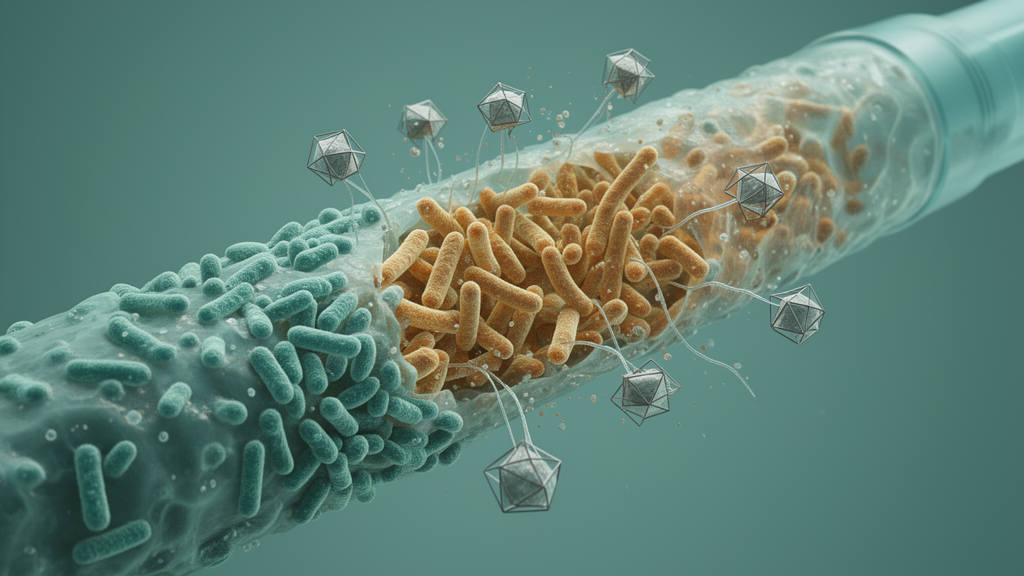
A novel bacteriophage isolated from hospital sewage has shown the ability to dismantle established biofilms of drug-resistant Klebsiella pneumoniae growing on urinary catheters in the laboratory, reducing viable bacteria by roughly 99 percent within four hours of treatment. The phage, named SAKp26.2, belongs to the Autographiviridae family and was characterized by a research team working with multidrug-resistant clinical isolates from a hospital in Chennai, India. The study, published in Discover Bacteria, combines genomic analysis, microscopy and in vitro infection models to evaluate whether the phage could serve as a candidate for treating catheter-associated infections that antibiotics struggle to clear.
The urgency behind the work stems from the clinical profile of K. pneumoniae, a Gram-negative member of the ESKAPE group of pathogens that acquires antibiotic resistance rapidly. The World Health Organization has classified carbapenem-resistant K. pneumoniae as a critical priority pathogen. Biofilm formation compounds the problem: bacteria embedded in a matrix of extracellular polysaccharides, proteins and DNA tolerate antibiotics far better than free-floating cells. On urinary catheters the risk escalates quickly, with the study’s authors citing prior work indicating that each day a catheter remains in place increases the chance of biofilm formation on its wall by 3.55 times, and that after three days the probability of urinary tract infection approaches 90 percent. Early catheter removal remains the most effective countermeasure, yet many patients cannot have their catheters withdrawn because of underlying complications.
SAKp26.2 was isolated from sewage water collected at the Madras Medical Mission Hospital using the hospital’s own multidrug-resistant clinical isolate U5877 as the propagation host. Transmission electron microscopy revealed an icosahedral head roughly 50 nanometres in diameter with a short, non-contractile tail, a morphology characteristic of Autographiviridae phages. On bacterial lawns the phage formed distinctive bull’s-eye plaques, a clear lysis core surrounded by a semi-transparent halo, which suggests depolymerase activity: enzymes that degrade the capsular polysaccharides coating the bacterial surface. Functional assays showed rapid adsorption, with nearly 95 percent of phage particles attached to host cells within five minutes, a short latent period of about 10 minutes, and a burst size of approximately 166 progeny virions per infected cell.
Whole-genome sequencing on an Illumina platform produced a 41,467-base-pair linear double-stranded DNA genome with a GC content of 52.99 percent and 50 predicted coding sequences, registered under GenBank accession PX974311. Annotation revealed the modular organisation typical of T7-like Autographiviridae phages, including DNA packaging genes, a phage-encoded single-subunit RNA polymerase, DNA replication machinery, structural proteins and a complete lysis cassette containing an endolysin, holins and an Rz-like protein. One coding sequence was predicted to encode a depolymerase, consistent with the halo-forming plaque morphology. Screening against the Virulence Factor Database and ResFinder found no virulence genes or antibiotic resistance determinants, and no integrases, repressors or other lysogeny markers were detected, supporting a strictly lytic lifestyle.
Comparative genomics placed SAKp26.2 among Klebsiella-infecting Autographiviridae phages but distinguished it as a novel species. Its closest whole-genome relative is Klebsiella phage RSU-F9L, with 93.30 percent nucleotide similarity, and its average nucleotide identity with both RSU-F9L and Klebsiella phage PEA128 was 91.35 percent, below the 95 percent threshold the ICTV uses for species demarcation. Stability testing showed the phage retained infectivity between pH 5 and roughly pH 10 and at temperatures up to 55 degrees Celsius, with complete inactivation at pH 1, 3 and 14 and at 100 degrees Celsius. It remained stable in 0.9 percent saline, phosphate-buffered saline and chloroform, a profile the authors note is compatible with the near-neutral pH and 37-degree conditions of the urinary tract.
Activity against a panel of sixteen clinical isolates revealed considerable strain-to-strain variation. Efficiency of plating, a measure of replication success relative to the reference host U5877, ranged from 12.0 in isolate O3933, exceeding the reference itself, down to 0.003 in U7224, with no detectable replication in U198, U6350 and P4272. Kill-kinetics experiments tracked by optical density showed four distinct patterns: classical lysis followed by resistant regrowth in five isolates at times ranging from 120 to 280 minutes post-infection; a rise-decline-rise pattern in five others that never reached control growth levels; parallel growth alongside untreated controls with resistance emerging within 40 minutes in four isolates; and near-complete lack of effect in two weakly susceptible strains. The authors highlight a correlation between efficiency of plating and kill-kinetics performance, arguing that spot-test clearing alone does not demonstrate productive phage infection, and that quantitative assays are needed to judge infectivity accurately.
In microtiter plate biofilm assays, phage treatment of 24-hour-old established biofilms cut viable cell counts by about 99 percent at four hours and about 95 percent at eight hours, with little further reduction at 12 hours. Crystal violet staining showed a roughly twofold decrease in biomass after eight and twelve hours, and live-dead fluorescence microscopy confirmed extensive killing within the matrix, with treated biofilms showing increased red staining of membrane-compromised cells and reduced green staining of viable ones. Three-dimensional reconstruction of fluorescence images showed flattened, disrupted biofilm architecture compared with the dense, elevated structure of untreated controls. The authors attribute the partial mismatch between biomass loss and bacterial killing to the persistence of the extracellular matrix after the cells within it die.
The catheter experiment used a continuous-flow model designed to mimic conditions inside a urinary catheter. Bacteria were allowed to adhere to the catheter lumen, biofilm was established over 24 hours of flow at 300 microlitres per minute, and phage was then introduced with an initial 30-minute static exposure intended to approximate a catheter-lock strategy before flow resumed. Viable counts of biofilm-associated bacteria fell by approximately 99 percent at four hours and 94 percent at eight hours. Scanning electron microscopy of untreated catheter segments showed dense multilayered bacterial colonization embedded in extracellular matrix, while phage-treated segments displayed disrupted architecture, scattered and distorted cells, and only a few bacteria remaining attached. The authors acknowledge that the initial static exposure does not fully reproduce the washing forces of the urinary tract in vivo, a limitation of the design.
Combination treatment with antibiotics showed some of the study’s most consequential results. Strain U5877 is resistant to both ceftazidime and gentamicin according to VITEK susceptibility testing. Ceftazidime alone allowed resistance to emerge at about 19 hours at the highest tested concentration, and gentamicin alone within about 4 hours. Phage alone delayed resistance emergence to roughly 5 to 6 hours. In combination, the highest ceftazidime concentration with the highest phage multiplicity prevented resistance for the entire 24-hour observation period, and three gentamicin-phage combinations, including 1.25 milligrams per millilitre with multiplicity 100, sustained suppression for 24 hours. The authors stress that the antibiotic concentrations were chosen to test severe resistance rather than to simulate therapeutic dosing, and that pharmacologically relevant studies are needed.
Resistance to the phage itself emerged in several contexts, including rising survival at later biofilm time points, which the authors interpret as evidence of phage-resistant subpopulations within biofilms. They suggest that engineered phages, phage cocktails and phage-antibiotic combinations will be needed to manage this. The study remains entirely in vitro, and the authors note that in vivo experiments are required to assess pharmacokinetics, immune interactions, safety and therapeutic efficacy before any clinical use. Within those limits, SAKp26.2 combines rapid infection kinetics, depolymerase-mediated biofilm disruption, a genome free of detectable virulence and resistance genes, and compatibility with two mechanistically distinct antibiotic classes, making it, in the authors’ assessment, a promising candidate for adjunctive strategies against device-associated infections caused by multidrug-resistant K. pneumoniae.
Subject of Research: Characterization of a novel Autographiviridae bacteriophage and its antibiofilm activity against drug-resistant Klebsiella pneumoniae in an in vitro urinary catheter model.
Article Title: Genomic characterization and evaluation of a novel Autographiviridae phage SAKp26.2 against in vitro urinary catheter-associated biofilms of drug-resistant Klebsiella pneumoniae
Article References: Aafreen, A., Chakraborty, S., Sangma, D. C., Jatley, A., Karan, R., & Chauhan, A. (2026). Genomic characterization and evaluation of a novel Autographiviridae phage SAKp26.2 against in vitro urinary catheter-associated biofilms of drug-resistant Klebsiella pneumoniae. Discover Bacteria, 3(1), Article 17. https://doi.org/10.1007/s44351-026-00054-w
Image Credits: AI Generated
DOI: 10.1007/s44351-026-00054-w
Keywords: bacteriophage, Klebsiella pneumoniae, SAKp26.2, Autographiviridae, biofilm, urinary catheter, antimicrobial resistance, phage-antibiotic combination, depolymerase, genomics, hospital-acquired infection, in vitro model
News Source: Kristina Jarvis. (October 29, 2026). Newly Found Phage SAKp26.2 Strips Drug-Resistant Klebsiella Biofilms from Catheters. Scienmag.