Biodegradable films made by blending two polyesters, polybutylene succinate (PBS) and polybutylene adipate-co-terephthalate (PBAT), can be tuned across a wide range of packaging-relevant properties simply by changing the mixing ratio, according to a new open-access study published in Discover Polymers. Researchers cast films at seven PBS/PBAT compositions, from pure PBS to pure PBAT, under identical laboratory conditions and systematically measured their mechanical, barrier, thermal, optical, surface and morphological characteristics. Their central finding is that blend composition alone, without any external compatibilizer, controls the balance between stiffness, ductility, moisture resistance, hydrophobicity, UV shielding and transparency.
The motivation stems from the environmental persistence of conventional petroleum-based packaging plastics such as polyethylene, polypropylene and polyethylene terephthalate, which accumulate in landfills and marine ecosystems. PBS, an aliphatic polyester, offers thermal stability, good mechanical strength and barrier properties resembling polyethylene and polypropylene, but it is brittle and costly. PBAT, an aromatic-aliphatic copolyester, delivers outstanding flexibility and elongation at break that make it an attractive low-density polyethylene alternative, yet it suffers from low modulus, a weak moisture barrier and limited thermal resistance. Blending the two is a strategy to balance cost and performance, with PBS contributing rigidity and barrier function while PBAT contributes toughness and stretchability.
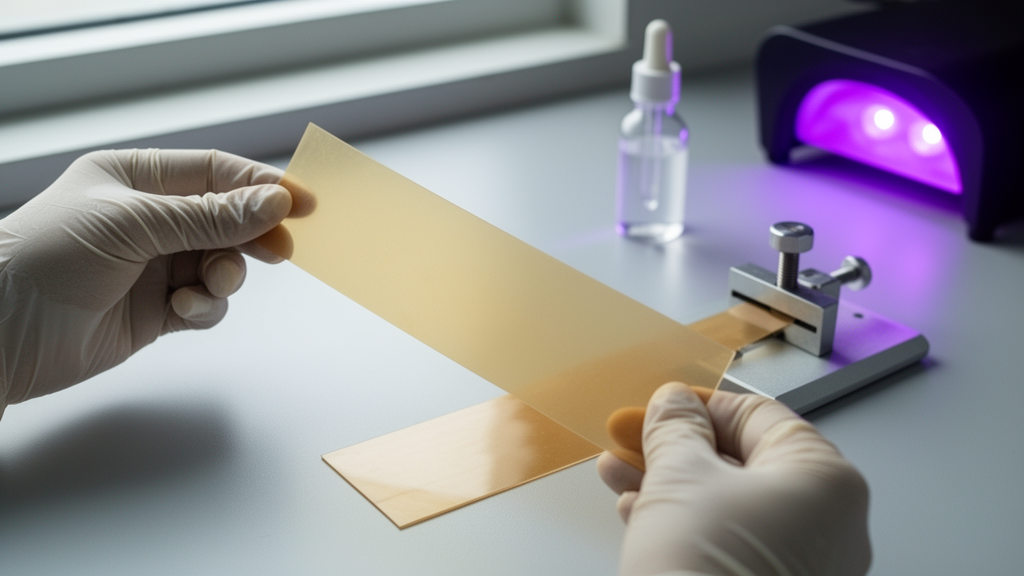
The team prepared films by solution casting, dissolving 5 grams of polymer in 150 millilitres of dichloromethane, casting onto Teflon molds and drying at 50 °C for 5 hours. Compositions spanned 100/0, 95/5, 90/10, 85/15, 80/20, 50/50 and 0/100 wt% PBS/PBAT. Film thickness ranged from roughly 130 micrometres for neat PBS to about 150 micrometres as PBAT content increased, an effect attributed to changes in solution viscosity and chain packing during solvent evaporation rather than processing differences, since all films were made under the same conditions.
Tensile testing to the ASTM D882 standard revealed a strong compositional dependence. Neat PBS showed the highest tensile strength at 38.66 megapascals. Adding 5 wt% PBAT dropped strength to 27.84 MPa while elastic modulus rose to 273.24 MPa, and elongation at break fell sharply, a behaviour the authors link to a compatibilizing and nucleating effect of PBAT in the PBS matrix. At 10 wt% PBAT the strength recovered slightly to 29.11 MPa, suggesting a synergistic interaction at this composition. The 50/50 blend showed a marked reduction in tensile strength to 7.35 MPa and modulus to 88.11 MPa, but with notably improved elongation. Neat PBAT exhibited only 2.86 MPa tensile strength and an 8.70 MPa modulus, compensated by high elongation. Stress-strain curves showed the 50/50 blend had about 60% lower elongation than neat PBAT but roughly 40% more elongation at break than neat PBS, and the steep strength decline at high PBAT loadings indicated the components are not fully miscible.
Fourier transform infrared spectroscopy in attenuated total reflection mode found the characteristic absorption bands of both polymers, including the ester carbonyl stretch near 1718 cm−1 for PBS and aromatic terephthalate bands between 870 and 730 cm−1 for PBAT, without new peaks or significant shifts. The authors interpret this as physical blending without chemical reaction, supporting partial miscibility rather than molecular-level compatibility. Scanning electron microscopy reinforced this picture: PBS-rich blends at 95/5 and 90/10 showed relatively fine, well-dispersed PBAT domains within a continuous PBS matrix, while 20 wt% PBAT brought larger domains and greater heterogeneity, and the 50/50 blend displayed coarse phase boundaries and localized interfacial voids consistent with its reduced strength and increased ductility.
Surface wettability, measured by static water contact angle, climbed progressively from 82.25 degrees for neat PBAT to 102.14 degrees for neat PBS, showing that higher PBS content makes the film surface more hydrophobic. Notably, the maximum contact angle belonged to neat PBS itself, so no blend ratio optimized water repellency within the studied range. The authors caution that contact angle reflects only surface wettability, and attribute the variation to the combined effect of surface chemistry and morphology rather than morphology alone.
Moisture barrier performance, quantified by water vapor transmission rate and permeability under ASTM E96/E96M-16 conditions of 38 °C and 90% relative humidity, followed the same compositional logic. Neat PBS achieved the lowest WVTR at 35.12 grams per square metre per hour and a permeability of 0.883 × 10⁻⁶ g m−1 h−1 Pa−1, credited to its high crystallinity restricting water diffusion. Neat PBAT was worst, at 120.48 g m−2 h−1 and 2.624 × 10⁻⁶ g m−1 h−1 Pa−1. Among blends, the intermediate 80/20 and 85/15 compositions outperformed both the 90/10 and 50/50 blends, which the authors attribute to compact morphology and more tortuous diffusion pathways, while the 50/50 blend’s slightly higher permeability matches the phase heterogeneity seen by SEM. Since thicknesses were similar at 130 to 150 micrometres, the differences reflect composition and microstructure rather than film thickness.
Thermal analysis added nuance. Thermogravimetric analysis showed all samples degrading mainly in a single stage between 300 and 450 °C, but the authors stress this overlap should not be read as evidence of compatibility. Neat PBAT was most thermally stable, with a 5% weight-loss temperature of 354.03 °C versus 324.26 °C for neat PBS, owing to its aromatic terephthalate units. The 50/50 blend actually began degrading earlier, at 297.49 °C, though its maximum degradation rate temperature of 408.05 °C exceeded either neat polymer, reflecting broadened, overlapping decomposition rather than a new thermally stable phase. Differential scanning calorimetry showed both polymers retaining their distinct glass transition temperatures near −46 and −45 °C and their melting peaks, with PBS melting at about 119 to 121 °C and PBAT at 124 to 126 °C. Increasing PBAT broadened and weakened the PBS melting and crystallization peaks, indicating declining crystalline perfection and limited miscibility.
Optically, the trade-off was explicit. Neat PBS transmitted 72.11% at 280 nm and 91.41% at 660 nm, confirming poor UV shielding but excellent transparency, while neat PBAT blocked UV strongly with transmittance of only 2.69% at 280 nm and 22.65% at 660 nm, thanks to its aromatic units. Blends showed progressively decreasing transmittance at both wavelengths as PBAT increased: UV transmittance at 280 nm fell from 3.12% at 95/5 to 0.50% at 50/50, while visible transmittance at 660 nm dropped from 25.06% to 10.96%. More UV protection therefore comes at the cost of visible transparency, letting formulators choose the balance a given product needs.
The authors conclude that the 90/10 PBS/PBAT blend offered the most balanced overall performance, combining high tensile strength with improved elongation, compact morphology, enhanced UV blocking, satisfactory thermal stability and good moisture barrier, all without external compatibilizers. They are equally clear about the limits: the study covered only solution-cast films characterized at laboratory scale, and oxygen barrier performance, migration behaviour, food-contact safety, long-term storage stability, biodegradation under practical conditions and validation with real food systems were not investigated. Further work on these aspects, along with functional additives or compatibilization strategies, is needed before such films can be considered for practical food packaging.
Subject of Research: Composition-dependent mechanical, barrier, thermal, optical and morphological properties of solution-cast PBS/PBAT biodegradable blend films for food packaging
Article Title: Development and characterization of PBS and PBAT blend based sustainable films for food packaging applications
Article References: Adeebpasha, A., Hemavathi, A. B., Hebbar, H. U., Babu, A., & Bindya, S. (2026). Development and characterization of PBS and PBAT blend based sustainable films for food packaging applications. Discover Polymers, 3(1), Article 21. https://doi.org/10.1007/s44347-026-00061-9
Image Credits: AI Generated
DOI: 10.1007/s44347-026-00061-9
Keywords: PBS, PBAT, biodegradable polymers, food packaging, polymer blends, water vapor transmission rate, UV shielding, tensile properties, solution casting, contact angle, DSC, FTIR
News Source: Bethany Barker. (October 29, 2026). PBS-PBAT Blend Films Tune Strength, Moisture Barrier and UV Shielding for Biodegradable Packaging. Scienmag.