


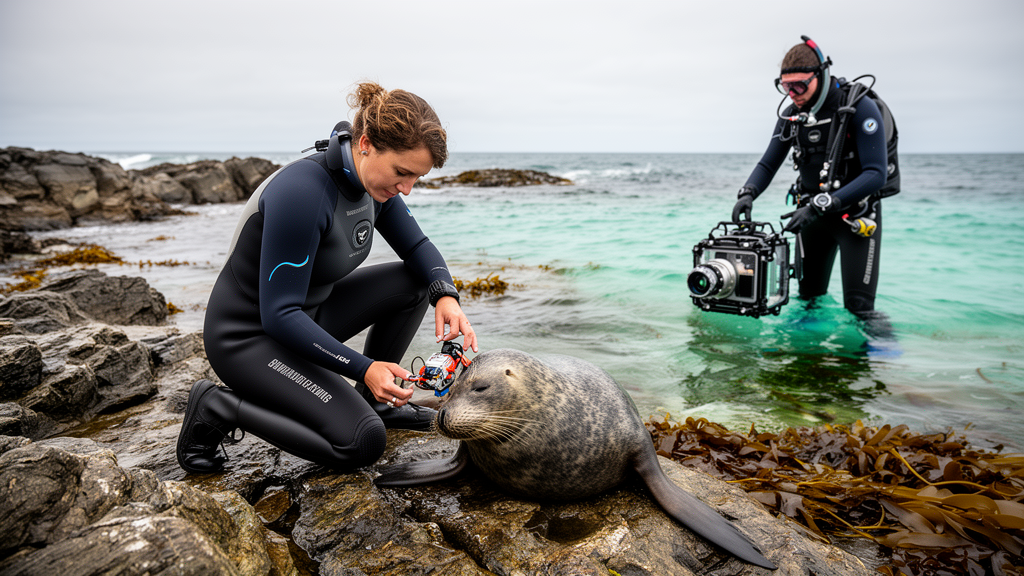
Aquatic researchers now have access to an impressive arsenal of electronic tools: tags that log an animal’s position, depth and temperature, cameras that record what the animal actually sees and does, and biosensors that capture physiological signals. Yet as a new review published in the journal Animal Biotelemetry makes clear, no single device can fully capture everything needed to characterize the spatial and behavioural ecology of species living in marine, estuarine and freshwater environments. The paper, authored by Kristen Cyr, Fielding Montgomery and Christina A. D. Semeniuk, examines what happens when scientists stop relying on one instrument and instead pair tracking technology with underwater video and camera imaging.
The core problem the review addresses is one of interpretation. Electronic tags excel at describing where an animal goes and what conditions it encounters along the way, and decades of technological improvement have made devices smaller, longer-lasting and more capable. But movement data alone often cannot explain why an animal behaved as it did.
According to the authors, pairing these technologies delivers three principal benefits. First, it allows researchers to collect diverse datasets across different environmental conditions, which can help reveal multiple drivers of movement and behaviour. Second, it improves the interpretability of results through verification or ground truthing: imagery can confirm what inferred behaviours from tag data actually represent, reducing the risk of misclassifying activities such as feeding or resting. Third, combining tools can support more strategic sampling with the electronic devices themselves, since visual information can guide when and where tags are deployed or how their outputs are analysed.
The review synthesizes studies that have previously combined tracking and imaging tools, spanning a range of species, environmental conditions and study objectives. By summarizing how these devices have been deployed together in practice, the authors aim to give researchers practical insights into deployment contexts rather than abstract arguments for multi-tool approaches. The environments covered extend across saltwater, estuarine and freshwater systems, reflecting the breadth of contexts in which paired deployments have already proven useful.
Despite the growing popularity of both device families, the authors note that the extent to which tracking and imaging technologies have been paired in aquatic research remains underexplored. Several existing articles have peer-reviewed these devices either independently or in combination with other tools, but a dedicated overview of paired tracking-and-imaging applications has been lacking. The new paper is positioned to fill that gap and to serve as a foundation for applying the paired approach in future research.
The timing reflects broader trends in biotelemetry and bio-logging. At the same time, video quality has improved markedly, making animal-borne and remotely deployed cameras far more informative than earlier generations. The review argues that these parallel advances make integration not only feasible but increasingly valuable, because complementary datasets collected simultaneously can answer questions that neither technology could resolve alone.
The authors also emphasize the conceptual payoff of combining data streams. Movement patterns, behaviour, physiology and environmental conditions are all captured by different types of technology, from electronic tags to video cameras to biosensors.
Ultimately, the paper is framed as a resource for study design rather than a report of new field findings. It offers an overview of how pairing tracking technology with underwater video and camera imaging has been applied, and it encourages researchers to recognize the value of using multiple electronic tools together. For ecologists planning future deployments, the message is that combining instruments can improve both the precision and the depth of their studies, turning isolated data streams into a more complete picture of animal lives beneath the water’s surface.
Subject of Research: A review of paired animal tracking and underwater imaging technologies for studying aquatic species ecology
Article Title: Submerging technologies in aquatic systems: exploring the application of paired tracking and imaging tools for investigating species ecology
Article References: Cyr, K., Montgomery, F., & Semeniuk, C. A. D. (2026). Submerging technologies in aquatic systems: exploring the application of paired tracking and imaging tools for investigating species ecology. Animal Biotelemetry. https://doi.org/10.1186/s40317-026-00489-7
Image Credits: AI Generated
DOI: 10.1186/s40317-026-00489-7
Keywords: biotelemetry, animal tracking, underwater imaging, aquatic ecology, electronic tags, animal-borne video, behaviour, movement ecology, review, freshwater, marine, research methods
News Source: Gavin Prescott. (October 29, 2026). Pairing Animal Trackers with Underwater Cameras Reveals Hidden Ecology. Scienmag.



