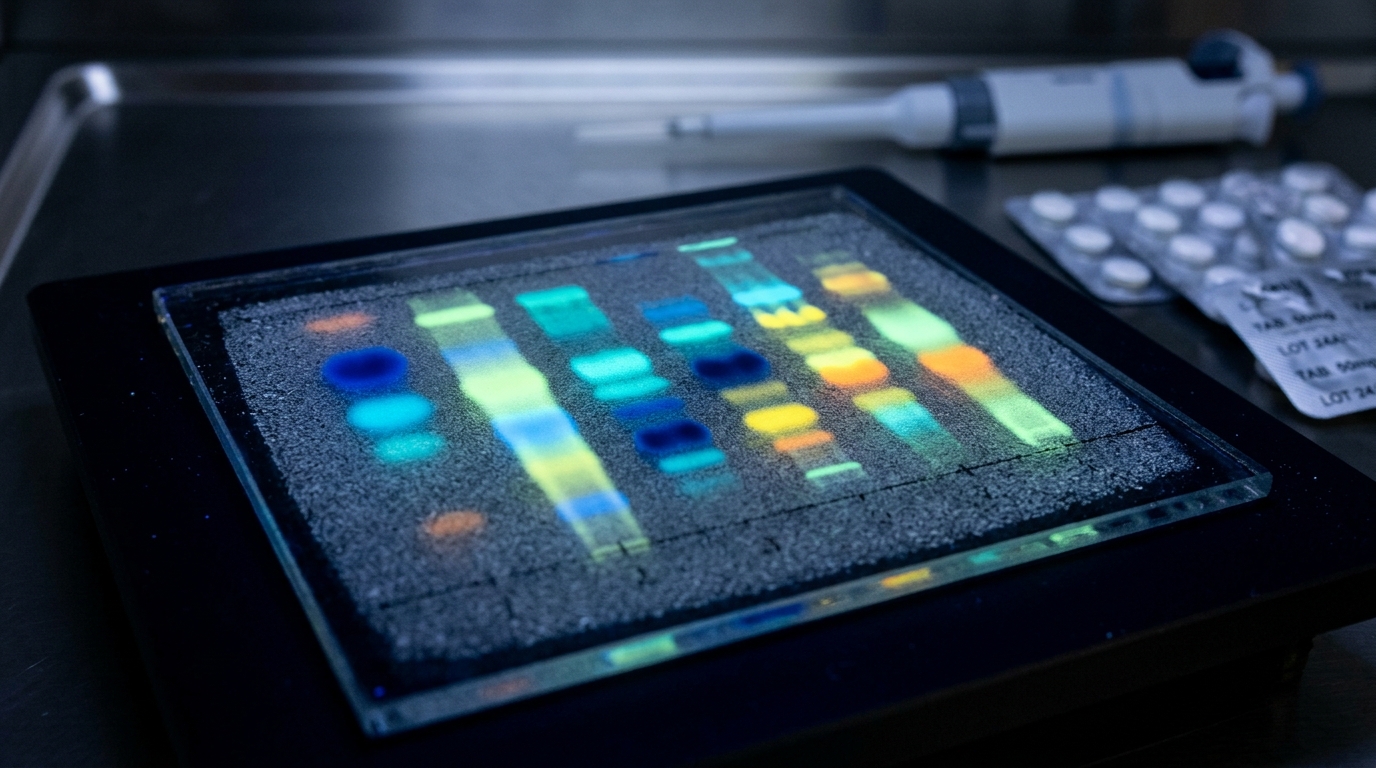
A newly validated high-performance thin-layer chromatography (HPTLC) method can quantify metformin hydrochloride, dapagliflozin propanediol monohydrate, and glimepiride at the same time in a single fixed-dose tablet, while also revealing how each drug breaks down under six different stress conditions. The method, developed by researchers at institutions in India and reported in Future Journal of Pharmaceutical Sciences, was optimized with an analytical quality by design (AQbD) approach and benchmarked against published reversed-phase HPLC methods using the RGB12 framework of white analytical chemistry, which scores analytical quality, environmental sustainability, and operational practicality together.
The triple combination of metformin (500 mg), dapagliflozin (10 mg), and glimepiride (2 mg) is a recently approved fixed-dose therapy for type 2 diabetes mellitus, a condition affecting more than 537 million adults worldwide as of 2021. Metformin, a biguanide insulin sensitizer, remains the first-line drug for the disease, while dapagliflozin, a sodium-glucose cotransporter-2 inhibitor, and glimepiride, a third-generation sulfonylurea, are commonly co-prescribed to exploit complementary mechanisms of action. Until now, the authors report, no stability-indicating HPTLC method had been published for the concurrent estimation of all three drugs in their combined dosage form.
Existing reversed-phase HPLC approaches carry notable drawbacks. Most consume large volumes of organic solvents, frequently exceeding 100 mL per analytical run, and rely on Class 2 toxic solvents such as acetonitrile and formic acid, raising environmental and occupational health concerns. Moreover, no single published RP-HPLC method has demonstrated the ability to simultaneously resolve all three drugs and their respective degradation products under one isocratic or gradient condition, forcing analysts to run separate analyses for each drug or binary combination. That increases analysis time, solvent consumption, operational cost, and the demand for skilled analyst intervention.
HPTLC sidesteps many of these limitations. The open-bed planar format allows multiple samples, including reference standards, test samples, blank matrices, and forced degradation preparations, to be processed simultaneously on a single plate under identical conditions, boosting throughput, reproducibility, and cost-efficiency. Solvent consumption is typically less than 10 mL per sample analysis, a 10- to 20-fold reduction compared with conventional RP-HPLC, and the less toxic solvents employed, such as ethyl acetate, methanol, and toluene in judicious proportions, further improve environmental compatibility. The technique also permits direct visual inspection of the chromatogram before densitometric evaluation, an analytical transparency unavailable in column-based methods.
To build the method, the team first used a Plackett–Burman screening design with thirteen experimental runs to sift through eleven analytical procedure variables, including the ratio of toluene to ammonium acetate, the percentage of ammonium acetate in methanol, the volume of modifier, and various chromatographic parameters. The screening revealed that the wavelength of detection had the most substantial positive impact on the resolution between metformin and dapagliflozin, while the ratio of toluene to ammonium acetate most strongly favored resolution between dapagliflozin and glimepiride. Bandwidth, modifier amount, and the toluene-to-ammonium acetate ratio also emerged as important factors.
A minimum run resolution IV factorial design with 17 runs and 3 center points then refined six critical factors: the toluene-to-ammonium acetate ratio, modifier volume, mobile phase volume, saturation time, bandwidth, and wavelength. The resulting models for all five responses, the two inter-drug resolutions and the retardation factors of the individual drugs, were statistically significant, with F-values ranging from 7.47 to 280.52 and p-values below 0.0001. R² values between 0.9625 and 0.9845 indicated strong fit, predicted R² values closely matched adjusted R² values, and adequate precision ratios of 27.3665 to 38.6117 far exceeded the desirable threshold of 4. Numerical optimization identified a 5:3 (v/v) toluene-to-ammonium acetate ratio and a modifier volume of 0.55 mL as the best solution, achieving a desirability value of 1.
Under the optimized conditions, the retardation factors were 0.20 for metformin, 0.61 for dapagliflozin, and 0.73 for glimepiride, with resolutions of 4.23 between metformin and dapagliflozin and 1.58 between dapagliflozin and glimepiride, both above the target of 1.5. The mobile phase consisted of toluene, ethyl acetate, ammonia, and 5% w/v ammonium acetate in methanol in the ratio 5:3:2:0.5 (v/v/v/v), with migration fixed at 80 mm after a 20-minute chamber saturation. Densitometric scanning used a TLC Scanner IV at 236 nm in absorbance/reflectance mode with a deuterium lamp. A control strategy keeps the toluene-to-ammonium acetate ratio between 5:3 and 4:4 (v/v) and allows ammonia volumes of 0.1 to 1.0 mL, ensuring consistent performance across the method operable design region.
Validation followed ICH Q2(R2) guidelines. The method showed linearity for metformin over 20,000 to 100,000 ng/band, for dapagliflozin over 400 to 2000 ng/band, and for glimepiride over 80 to 400 ng/band, ranges that mirror the clinical dose ratio of 500:10:2 mg. Repeatability, intra-day, and inter-day precision all produced %RSD values below 2%, and recovery rates for all three drugs fell between 98% and 102%. Limits of detection were 674.34 ng/band for metformin, 13.56 ng/band for dapagliflozin, and 12.54 ng/band for glimepiride, with limits of quantitation of 2043.46, 41.09, and 37.99 ng/band respectively. Robustness testing with minor deliberate variations in mobile phase composition, detection wavelength, and saturation time left %RSD values below 2%, and solution stability held over 72 hours of storage.
Forced degradation studies exposed the drug mixture to acidic (2 N HCl at 80 °C for 3 hours), alkaline (1 N NaOH), neutral hydrolysis, oxidative (3% H2O2), thermal (80 °C), and photolytic (sunlight for 5 hours) stress. Glimepiride suffered the highest single-condition degradation, 28.42% under acid, consistent with the acid-catalyzed hydrolytic cleavage of its sulfonylurea urea linkage. Dapagliflozin proved most vulnerable to heat, degrading 22.74% thermally and 18.91% under alkaline conditions, with additional losses of 11.04% under neutral hydrolysis, 8.01% under oxidation, and 13.05% under light. Metformin was the most stable overall, degrading only 3.22% in acid, 2.51% in base, 2.05% in neutral hydrolysis, 2.56% in oxidation, 3.21% thermally, and 8.09% under photolytic stress. The method resolved all degradation products from the parent peaks in every condition, confirming its stability-indicating capability.
When applied to marketed formulations, the assay returned 100.25% for metformin, 98.3% for dapagliflozin, and 97.5% for glimepiride relative to label claims for the triple-combination tablet, with densitogram peaks at Rf 0.19, 0.61, and 0.73 and no interfering excipient peaks. Among three evaluated products, Daxigo GM 2 showed the closest simultaneous concordance for all three analytes, while Gluconorm-G2 and Glucreta-M were assessed only as binary formulations for their respective drug pairs. In the RGB12 benchmarking, the HPTLC method scored 85 for redness (analytical quality), 70 for greenness (environmental sustainability), and 90 for blueness (operational practicality), averaging 81.66 out of 100 for whiteness, classified as excellent white and green, compared with 73.33 for the published RP-HPLC methods. The authors position the platform as a robust, environmentally responsible tool for quality control and stability testing of this antidiabetic triple-drug combination.
Subject of Research: Development and validation of a stability-indicating HPTLC method for simultaneous analysis of metformin, dapagliflozin, and glimepiride in a fixed-dose antidiabetic combination
Article Title: Multipurpose chromatographic method for concurrent stability study of metformin, dapagliflozin, and glimepiride using integrated principles of RGB12 and white analytical chemistry
Article References: Prajapati, P., Rana, U., Pulusu, V., Haque, A., Ahmad, S., & Shah, S. (2026). Multipurpose chromatographic method for concurrent stability study of metformin, dapagliflozin, and glimepiride using integrated principles of RGB12 and white analytical chemistry. Future Journal of Pharmaceutical Sciences, 12(1), Article 76. https://doi.org/10.1186/s43094-026-01008-4
Image Credits: AI Generated
DOI: 10.1186/s43094-026-01008-4
Keywords: HPTLC, metformin, dapagliflozin, glimepiride, stability-indicating method, analytical quality by design, white analytical chemistry, RGB12, forced degradation, type 2 diabetes, pharmaceutical analysis, green chemistry
News Source: Ophelia Keating. (November 5, 2026). New HPTLC Method Simultaneously Tracks Stability of Three Diabetes Drugs. Scienmag.