Across thirteen studies spanning ten Sub-Saharan African countries, antimicrobial self-medication among children and adolescents ranged from 21.9% in Uganda to 92% in Nigeria, according to a systematic review published in the Egyptian Pediatric Association Gazette. The review, which followed PRISMA 2020 guidelines and searched four databases for studies published between January 2015 and June 30, 2025, is the first synthesis restricted exclusively to people under 18 years in the region. Its authors, led by Damilare Michael Akintunde, screened 2,888 records and included thirteen studies after quality appraisal with the Joanna Briggs Institute checklist for cross-sectional research and the CASP checklist for the single qualitative study.
The practice the review examined is defined by the World Health Organization as the use of drugs to treat self-diagnosed disorders or symptoms, or the intermittent or continued use of a prescribed drug. Applied to antimicrobials, it means giving antibiotics or antimalarials to a child without medical supervision. The included studies surveyed different respondents: eight surveyed caregivers of children under five, two surveyed adolescents, two surveyed parents, and one surveyed pharmacy customers. Definitions also differed, with six studies focusing only on antibiotics, two only on antimalarials, and five combining both, while recall periods ranged from two weeks to six months. These differences, the authors report, precluded a meta-analysis and forced a narrative synthesis.
The prevalence figures varied widely by setting and population. Beyond the extremes of 21.9% and 92%, the review catalogued intermediate estimates: 24.4% and 88.6% in two other Nigerian studies, 39.5% pre-hospital antibiotic exposure in Uganda, 43% for acute respiratory infections in Uganda, 47.7% in Tanzania, 61% in Cameroon, 80.4% among Nigerian secondary school students, 85.8% in Togo, and 90% for malaria self-medication in Nigeria. In the Democratic Republic of the Congo, one study reported a prevalence of 45.5% among adolescents with suspected sexually transmitted infection symptoms. The authors caution that estimates from smaller, facility-based or pharmacy-based studies may be inflated by selection bias, while the most conservative and generalizable figures likely come from large population-based surveys.
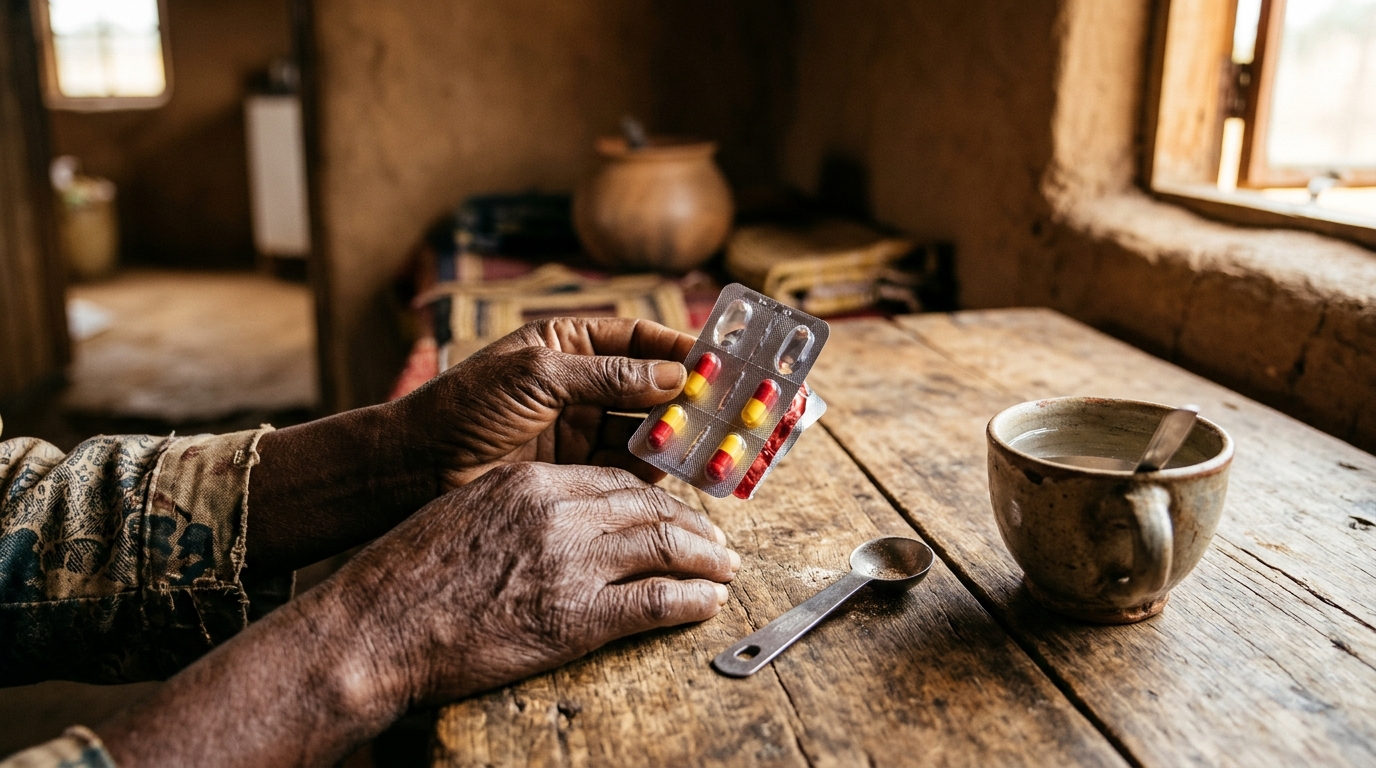
Which drugs children received without supervision is a central technical detail of the review. Amoxicillin was the most frequently reported antibiotic, with usage ranging from 11.4% in Togo to 80.6% in another study. Ampicillin-cloxacillin ranged from 10.3% to 50.9%, cotrimoxazole from 12.3% to 31%, erythromycin from 9.8% to 21.7%, ciprofloxacin from 7.6% to 25%, and metronidazole from 10% to 16.9%. One Democratic Republic of the Congo study reported penicillin at 25% and tetracycline at roughly 20%. Among antimalarials, chloroquine dominated at 78% in one Nigerian study, followed by quinine at 15% and halfan at 3%. The authors flag that chloroquine and quinine are older, non-recommended agents that are ineffective against current Plasmodium falciparum strains in most of the region, despite World Health Organization recommendations for artemisinin-based combination therapies.
Where families obtained these drugs emerged as a consistent pattern. Drug stores and pharmacies were the most commonly reported sources: in Tanzania, 99.7% of parents obtained antibiotics from drug stores, while in Togo 60% obtained drugs from pharmacies and 49.7% from itinerant sellers. Leftover medications accounted for 12% to 21.1% of sources across studies. In the Democratic Republic of the Congo, pharmacy staff were the primary source of information for 70% of adolescents, with 29% obtaining information from the community and 23% from healthcare providers. Other reported sources included neighbors at 7.2%, clinics at 33.7%, and patent medicine sellers at 48.9%. A multi-country study covering 19 low- and middle-income countries with 106,265 participants found that 87.1% of antimalarials were obtained from unqualified sources, with country-specific figures of 59.9% for Tanzania, 60.0% for Nigeria, and 61.1% for Ghana.
The determinants the review identified cluster around symptoms, caregiver characteristics, and healthcare access. Febrile illness was the most common trigger: in Togo, fever was present in 85.1% of self-medication cases, while in Tanzania cough at 80.5% and fever at 52.4% were the most common symptoms prompting the practice. Diarrhea appeared in 11.3% to 12.6% of cases. On the caregiver side, one Nigerian study found that mothers with tertiary education had lower self-medication rates, 44.6% compared with 60.1% for those with secondary education, but a Cameroonian study reported that low knowledge about antibiotics, rather than formal education level, was associated with higher self-medication. Distance greater than 5 kilometers from a health facility was reported as a factor in two studies, and low household income in one. Unrestricted access to informal vendors and lack of awareness of prescription-only medicines were reported in two studies.
Adolescent-specific findings add a behavioral dimension. In the Democratic Republic of the Congo, attending school at 70% and female gender at 53% were associated with higher self-medication among adolescents. A Nigerian study of secondary school students found no significant gender difference but a significant age difference between groups, with 60.5% of students expressing confidence in their ability to self-medicate, saying they knew what to do always or sometimes. The authors interpret this perceived competence as a factor that may reduce receptivity to health education, and they note that only two of the thirteen included studies focused on adolescents, limiting conclusions for that age group.
The consequences documented in the primary studies were clinical rather than microbiological. In Togo, nausea and vomiting at 89.7%, anemia requiring transfusion at 39.9%, and allergic skin reactions were reported following self-medication. Critically, no primary study in the review directly measured antimicrobial resistance outcomes attributable to self-medication; all consequence data were reported as associations or drawn from external sources. The authors state that the link between self-medication and resistance in this population remains inferential, supported by the broader literature associating antimicrobial exposure with resistance, but not demonstrated within the included studies themselves. They also note that underreporting of mild adverse reactions is likely because such reactions are not brought to health facilities.
The review’s interpretation frames the practice as a rational response to systemic barriers rather than mere ignorance. Fever is culturally and clinically equated with malaria or pneumonia in the region, conditions for which caregivers believe antimicrobials are necessary and effective, a perception reinforced by previous successful experiences with leftover antibiotics and by social networks of family, friends, and peers who recommend specific drugs. Family influence was reported at 45.2%, friends at 38%, and peers at 6.8% in one Nigerian study. The authors describe a self-perpetuating cycle in which easy access reinforces perceived efficacy, which drives further self-medication, and they characterize the reliance on local drug stores and itinerant sellers when a child has fever at night or in a remote village as a coping mechanism for system failure.
Methodological limitations temper the findings. All primary studies were cross-sectional or qualitative, so causality cannot be inferred, and reliance on caregiver self-report introduces recall and social desirability bias. Restricting the search to English-language publications may have excluded relevant studies in French and Portuguese from West and Central African countries where self-medication is also prevalent, introducing potential language bias. The review was not registered in PROSPERO, and five of the twelve cross-sectional studies scored 7 of 8 on the Joanna Briggs checklist, with the most common limitation being failure to identify or adjust for confounding factors. Based on their findings, the authors propose three priority actions: stricter enforcement of prescription-only laws at drug stores and itinerant sellers, community-based education targeting specific misconceptions such as the belief that antibiotics cure fevers of viral origin, and improved access to formal healthcare through measures like mobile clinics, telemedicine, and elimination of out-of-pocket costs for child consultations. They also call for longitudinal studies tracking self-medication practices and their direct impact on resistance in the same children, and for surveillance comparing communities with high and low prevalence to quantify attributable risk.
Subject of Research: Prevalence, determinants, and sources of antimicrobial self-medication among children and adolescents in Sub-Saharan Africa
Article Title: Antimicrobial self‑medication among children and adolescents in Sub‑Saharan Africa: a systematic review
Article References: Akintunde, D. M., Reddy Narla, S. J. S., Baltodano, D., Mekala, S. C., Srinivasan, S., Maharjan, R., & Malasevskaia, I. (2026). Antimicrobial self‑medication among children and adolescents in Sub‑Saharan Africa: a systematic review. Egyptian Pediatric Association Gazette, 74(1), Article 135. https://doi.org/10.1186/s43054-026-00638-w
Image Credits: AI Generated
DOI: 10.1186/s43054-026-00638-w
Keywords: antimicrobial self-medication, children, adolescents, Sub-Saharan Africa, antibiotics, antimalarials, amoxicillin, chloroquine, antimicrobial resistance, drugstores, systematic review, healthcare access
News Source: Harold Sullivan. (November 6, 2026). Self-medication with antibiotics reaches up to 92% of children in Sub-Saharan Africa. Scienmag.