• HOME
  • NEWS
  • EXPLORE
    • CAREER
      • Companies
      • Jobs
    • EVENTS
    • iGEM
      • News
      • Team
    • PHOTOS
    • VIDEO
    • WIKI
  • BLOG
  • COMMUNITY
    • FACEBOOK
    • INSTAGRAM
    • TWITTER
Friday, May 15, 2026
BIOENGINEER.ORG
No Result
View All Result
  • Login
  • HOME
  • NEWS
  • EXPLORE
    • CAREER
      • Companies
      • Jobs
        • Lecturer
        • PhD Studentship
        • Postdoc
        • Research Assistant
    • EVENTS
    • iGEM
      • News
      • Team
    • PHOTOS
    • VIDEO
    • WIKI
  • BLOG
  • COMMUNITY
    • FACEBOOK
    • INSTAGRAM
    • TWITTER
  • HOME
  • NEWS
  • EXPLORE
    • CAREER
      • Companies
      • Jobs
        • Lecturer
        • PhD Studentship
        • Postdoc
        • Research Assistant
    • EVENTS
    • iGEM
      • News
      • Team
    • PHOTOS
    • VIDEO
    • WIKI
  • BLOG
  • COMMUNITY
    • FACEBOOK
    • INSTAGRAM
    • TWITTER
No Result
View All Result
Bioengineer.org
No Result
View All Result
Home NEWS Science News

New ecological process for producing cheaper biofuel

Bioengineer by Bioengineer
February 27, 2020
in Science News
Reading Time: 3 mins read
0
IMAGE
Share on FacebookShare on TwitterShare on LinkedinShare on RedditShare on Telegram

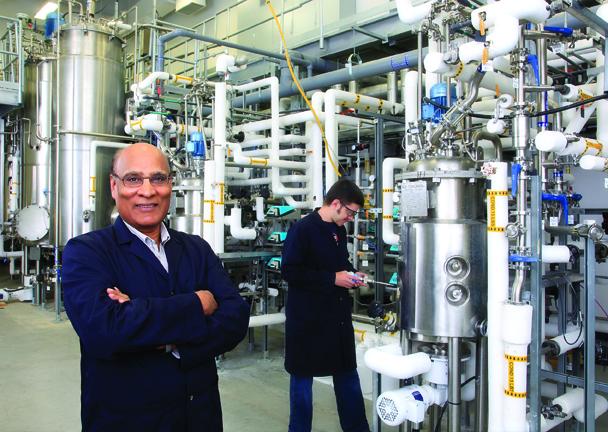
Canadian researchers make biodiesel from sewage sludge and glycerol
IMAGE

Credit: INRS


Professors Rajeshwar Dayal Tyagi and Patrick Drogui, researchers at the Institut National de la Recherche Scientifique (INRS), have developed a new approach to biodiesel production that uses microbes, sewage sludge, and a biofuel byproduct.

Biodiesel has multiple environmental benefits, but the use of vegetable or animal oils raises the food vs. fuel dilemma, the risk of diverting farmland or crops for biofuels production to the detriment of the food supply. Plants have been turning to microbial biodiesel, which can be made out of glucose using microorganisms. But at $6.78/L, the conventional production process is quite expensive.

Professors Tyagi and Drogui have brought the production cost down to $0.72/L with an innovative new process. Their findings – in order to assess the costs, energy, and greenhouse gas emissions (GHG) – were published in the journal Bioresource Technology, in Feburary

The process uses sewage sludge and glycerol, a byproduct of biodiesel. Processing sludge reduces GHG. “It keeps sludge out of landfills, where it releases methane. When it’s used to produce biodiesel, most of the carbon is transformed into lipids by the microorganisms,” said Professor Tyagi. The process also makes it possible to reuse the glycerol without having to purify it.

From microbes to biofuel

In the first stage of fermentation, the microorganisms eat the glycerol and the sewage sludge. They accumulate oil in their bodies in the form of lipids. The INRS researchers use a bioflocculant–an organic polymer secreted by organisms–to separate the cells from the mixture and extract the lipids. That eliminates the need for centrifuges or chemical products.

In order to recover the lipids extracted from the cells, Professors Tyagi and Drogui replaced those toxic chemical products with gas. “I was filling up my car and I asked myself why not use gas to separate the lipids. We tried it in the laboratory and it worked really well. The mixture of gas and lipids floated on top of the rest of the mixture,” said Professor Tyagi. The gas added for separation is also part of the final product. “Biodiesel isn’t entirely composed of oil. For type B10, 10 percent of the fuel is organic and the rest is gas,” he said.

The process produces biodiesel and glycerol, which could in turn be used to produce more fuel. But plants don’t necessarily use the same production processes, so the glycerol, and its efficiency, may vary. Professors Tyagi and Drogui are looking to figure out how to combine these different byproducts to make the process even more cost effective.

Two post-doctoral fellows, four doctoral students, and one master’s student worked on the project. Ph.D. student Lalit R. Kumar is doing his doctorate on the project, which was awarded the 2018 Project Innovation Award in the Breakthroughs in Research and Development category by the International Water Association in Tokyo.

###

Media Contact
Audrey-Maude Vézina
[email protected]
418-254-2156

Original Source

http://www.inrs.ca/english/actualites/new-greener-process-producing-cheaper-biofuel

Related Journal Article

http://dx.doi.org/10.1016/j.biortech.2019.122404

Tags: BiochemistryBiologyBiomedical/Environmental/Chemical EngineeringBiotechnologyBusiness/EconomicsEcology/EnvironmentEnergy/Fuel (non-petroleum)Industrial Engineering/ChemistryMicrobiology
Share12Tweet8Share2ShareShareShare2

Related Posts

Single-Cell Atlas Reveals CD55+ Stem Cells’ Role in Atherosclerosis

May 15, 2026

Immune Changes Detected After Ohio Train Derailment

May 15, 2026

Leptin Epigenetics in Preterm Cord Blood Predict Obesity

May 15, 2026

Caregiving Insights: Supporting Individuals with Vascular Dementia

May 15, 2026
Please login to join discussion

POPULAR NEWS

  • Research Indicates Potential Connection Between Prenatal Medication Exposure and Elevated Autism Risk

    843 shares
    Share 337 Tweet 211
  • New Study Reveals Plants Can Detect the Sound of Rain

    730 shares
    Share 291 Tweet 182
  • Salmonella Haem Blocks Macrophages, Boosts Infection

    62 shares
    Share 25 Tweet 16
  • Breastmilk Balances E. coli and Beneficial Bacteria in Infant Gut Microbiomes

    58 shares
    Share 23 Tweet 15

About

We bring you the latest biotechnology news from best research centers and universities around the world. Check our website.

Follow us

Recent News

Single-Cell Atlas Reveals CD55+ Stem Cells’ Role in Atherosclerosis

Immune Changes Detected After Ohio Train Derailment

Leptin Epigenetics in Preterm Cord Blood Predict Obesity

Subscribe to Blog via Email

Enter your email address to subscribe to this blog and receive notifications of new posts by email.

Join 82 other subscribers
  • Contact Us

Bioengineer.org © Copyright 2023 All Rights Reserved.

Welcome Back!

Login to your account below

Forgotten Password?

Retrieve your password

Please enter your username or email address to reset your password.

Log In
No Result
View All Result
  • Homepages
    • Home Page 1
    • Home Page 2
  • News
  • National
  • Business
  • Health
  • Lifestyle
  • Science

Bioengineer.org © Copyright 2023 All Rights Reserved.