Cadmium is one of the most troublesome heavy metal contaminants in agricultural and natural soils: it is highly toxic, mobile in the soil-plant system, and persistent, and it accumulates through the food chain where it threatens both ecosystem stability and human health. A new study published in Botanical Studies examines whether a common arbuscular mycorrhizal fungus, Funneliformis mosseae, can help three closely related plants of the genus Sphagneticola tolerate cadmium-polluted soil, and how the fungus does so through changes in the rhizosphere, the narrow zone of soil immediately surrounding plant roots.
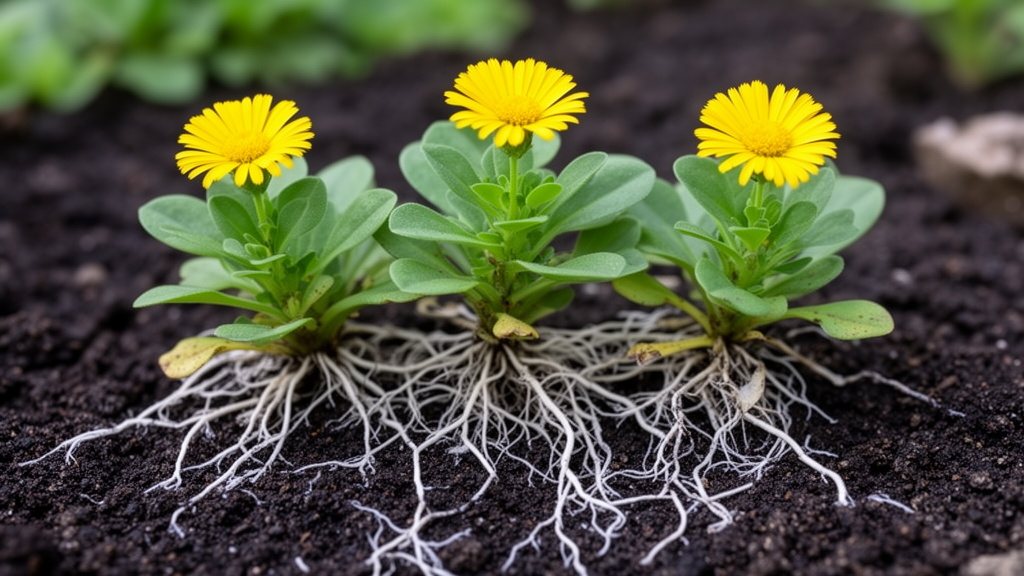
The research team, led by ZhengChao Yu, RuiRui Lu, QiLei Zhang, YuanXiao Jing and ChangLian Peng, worked with three plant materials from the same genus: Sphagneticola calendulacea, a native species; Sphagneticola trilobata, an invasive species; and a hybrid derived from crosses between the two. Plants in the Asteraceae family genus Sphagneticola are considered candidates for ecological restoration of heavy-metal-contaminated soils because they grow rapidly, produce high biomass, and adapt readily to difficult conditions. The team’s earlier work had already shown that hybrids of these two species can tolerate high cadmium environments, but no previous study had examined how arbuscular mycorrhizal inoculation changes that tolerance.
The experiment was conducted in a greenhouse with potted plants grown in soil collected from the Biological Garden of South China Normal University, a soil with a pH of 6.49, organic matter content of 1.75%, and a background cadmium concentration of only 0.05 mg per kg. The researchers sterilized the soil and then added cadmium chloride to create four treatment levels: nominal concentrations of 0, 25, 50, and 100 mg Cd per kg of soil, with final measured total concentrations of 0.04, 25.02, 50.03, and 100.01 mg per kg after repeated wetting and drying cycles to ensure uniform distribution. The fungal inoculum, obtained from the International Culture Collection of Vesicular Arbuscular Mycorrhizal Fungi and previously reported to show strong resistance to cadmium, was propagated on corn and mixed into the soil at 5% by weight. Sterile, autoclaved inoculum served as the uninoculated control, and a filtrate of non-sterilized soil was added to control pots to compensate for bacteria lost during sterilization.
Uniform seedlings of each of the three Sphagneticola plants, 15 to 20 cm tall with five to six pairs of leaves, were planted one per pot with five biological replicates per treatment, and the pots were randomly arranged and rotated weekly in a greenhouse maintained at 21 to 29 degrees Celsius with 14 hours of daily light. After three months of cultivation, the plants were harvested and separated into leaves, stems, and roots. Roots were immersed in EDTA to remove metals adsorbed on the root surface before analysis. The researchers then measured mycorrhizal colonization rates by staining root segments with trypan blue and examining them microscopically, determined phosphorus and other element concentrations by microwave digestion followed by inductively coupled plasma mass spectrometry, assessed acid and alkaline phosphatase activity in rhizosphere soil, measured soil pH in a calcium chloride extraction, and quantified plant-available cadmium using the DTPA extraction method.
The results showed that cadmium stress significantly reduced rhizosphere soil pH in all three species, with the largest decline in the hybrid, an intermediate decline in S. calendulacea, and the smallest in S. trilobata. Inoculation with the fungus did not reverse this cadmium-induced acidification; pH still declined as cadmium concentration rose in the inoculated plants, following the same overall pattern as in the uninoculated controls. Instead, the fungus modified the magnitude and direction of pH change in a species-specific way. Without cadmium, inoculation raised rhizosphere pH in S. calendulacea and S. trilobata but lowered it in the hybrid, and under the highest cadmium treatment the fungus increased pH in S. trilobata while decreasing it in the other two plants. The authors interpret this as the fungus buffering and reshaping the rhizosphere environment rather than fundamentally altering the acidification trend, likely through species-dependent differences in root exudates and in the ion exchange activity of fungal hyphae, which can themselves secrete protons and organic anions.
Notably, inoculation did not generally change the DTPA-extractable, plant-available cadmium concentration in the rhizosphere soil. Extractable cadmium rose significantly with increasing soil cadmium in all plants regardless of inoculation, and only two specific contrasts stood out: at 25 mg per kg, the inoculated hybrid showed significantly lower extractable cadmium than its uninoculated control, while at 100 mg per kg, inoculated S. trilobata showed significantly higher extractable cadmium than its control. The authors therefore conclude that the fungus does not primarily enhance cadmium tolerance by changing cadmium bioavailability in the soil, but rather by strengthening the plants’ own physiological tolerance mechanisms. Mycorrhizal colonization rates themselves declined significantly as soil cadmium concentration increased, though the pattern differed by species: colonization in S. calendulacea was highest at 0 and 25 mg per kg and dropped sharply at 50 and 100 mg per kg, S. trilobata showed a continuous decline, and the hybrid maintained stable colonization up to 50 mg per kg before a significant drop at the highest treatment.
The most striking finding of the study is the effect on phosphorus nutrition. Cadmium stress typically damages root structure and function, suppressing the plant’s own phosphorus uptake and inducing physiological phosphorus starvation. In this experiment, fungal inoculation substantially increased phosphorus content in both shoots and roots of all three species, with increases generally exceeding 50%. Under the four cadmium levels, shoot phosphorus in S. calendulacea rose by 77.14%, 69.76%, 163.56%, and 109.81% relative to uninoculated controls, and root phosphorus rose by 183.89%, 74.92%, 82.99%, and 110.64%. In S. trilobata, shoot phosphorus increased by 51.06%, 24.70%, 234.82%, and 164.40%, and root phosphorus by 158.82%, 26.74%, 34.97%, and 156.80%. In the hybrid, shoot phosphorus rose by 105.89%, 55.45%, 87.68%, and 335.31%, and root phosphorus by 235.01%, 55.49%, 46.17%, and 133.33%. The effect was particularly pronounced under high cadmium stress, supporting the idea that the fungal symbiosis helps plants cope with cadmium-induced phosphorus limitation.
The mechanism behind this phosphorus boost appears to lie in the rhizosphere enzymes. Inoculation universally increased acid phosphatase activity in the rhizosphere soil of all three species, and in S. calendulacea and the hybrid this activity rose further as cadmium concentration increased. Under the zero and 50 mg per kg treatments, acid phosphatase activity increased by 14.32% and 23.80% in S. calendulacea, 19.75% and 15.23% in S. trilobata, and 6.03% and 21.33% in the hybrid compared with uninoculated controls. Because acid phosphatases liberate phosphate from organic matter in soil, the authors argue that the fungus accelerates the mineralization of the organic phosphorus pool, enlarging the supply of available phosphorus precisely when cadmium stress has crippled the plants’ own uptake capacity. In contrast, alkaline phosphatase activity showed no consistent response to inoculation, a pattern the authors attribute in part to the acidic pH of the experimental soil, which favors acid phosphatase activity. The enhancement of acid phosphatase activity was strongly positively correlated with the increase in plant phosphorus content, confirming the link between rhizosphere enzyme activation and improved plant phosphorus nutrition.
Beyond phosphorus, the fungus comprehensively reshaped the plants’ mineral element profiles. It generally promoted the accumulation of sodium, magnesium, and calcium in roots, while shifting potassium toward the shoots: potassium increased in shoots and decreased in roots across most treatments. The authors explain these shifts in functional terms. Calcium ions act as a crucial second messenger in cadmium stress perception and signaling, help stabilize cell walls and membranes, and compete with cadmium for binding sites. Potassium ions also compete with cadmium for binding sites, and potassium is essential for maintaining cellular osmotic pressure and enzyme activity, so its preferential allocation to shoots helps sustain photosynthesis and metabolism. Magnesium is a core component of chlorophyll, making its reliable supply important for photosynthetic capacity. Among micronutrients, the fungus promoted copper uptake in shoots and roots of all three species and increased zinc uptake in a similar pattern, except under the highest cadmium treatment. Because zinc and cadmium share similar chemical properties and uptake transport pathways, the fungus-induced rise in zinc may competitively inhibit cadmium entry and upward transport. The fungus also reduced manganese uptake in shoots while increasing it in roots, and promoted iron accumulation in roots of all three species, with no consistent shoot pattern; the authors note that iron and manganese oxides are important cadmium adsorbents in soil.
Taken together, the study outlines a multi-layered mechanism by which the plant-fungus symbiosis builds cadmium tolerance: species-specific regulation of rhizosphere pH, activation of the organic phosphorus pool through elevated acid phosphatase activity, direct enhancement of phosphorus uptake, and a coordinated reorganization of mineral element uptake and allocation that combines nutritional support, competitive inhibition of cadmium entry, and maintenance of ion balance. Although the three Sphagneticola species differed in their specific responses, reflecting the influence of their native, invasive, and hybrid genetic backgrounds on symbiotic function, the positive effects on phosphorus uptake, acid phosphatase activity, and element profiles were consistent across all three. The authors present these findings as a theoretical foundation and a germplasm selection reference for using ecologically distinct Sphagneticola species paired with suitable fungal partners in phytostabilization or assisted phytoremediation of cadmium-contaminated soils, while emphasizing that the effects of mycorrhizal fungi on heavy metal dynamics remain highly context-dependent and that optimal fungus-plant pairings must be chosen for each target species.
Subject of Research: How the arbuscular mycorrhizal fungus Funneliformis mosseae alters rhizosphere pH, phosphatase activity and mineral nutrient uptake in three Sphagneticola plants under cadmium stress
Article Title: Colonization of three Sphagneticola species by Funneliformis mosseae under cadmium stress is beneficial to phosphatase activity and nutrient uptake in rhizosphere soil
Article References: Yu, Z., Lu, R., Zhang, Q., Jing, Y., & Peng, C. (2026). Colonization of three Sphagneticola species by Funneliformis mosseae under cadmium stress is beneficial to phosphatase activity and nutrient uptake in rhizosphere soil. Botanical Studies, 67(1), Article 7. https://doi.org/10.1186/s40529-026-00494-2
Image Credits: AI Generated
DOI: 10.1186/s40529-026-00494-2
Keywords: arbuscular mycorrhizal fungi, Funneliformis mosseae, Sphagneticola, cadmium contamination, rhizosphere, phosphatase activity, phosphorus uptake, phytoremediation, mineral nutrition, soil pH, plant tolerance, greenhouse experiment
News Source: Roger Howard. (October 28, 2026). Mycorrhizal fungus helps three Sphagneticola plants cope with cadmium stress. Scienmag.