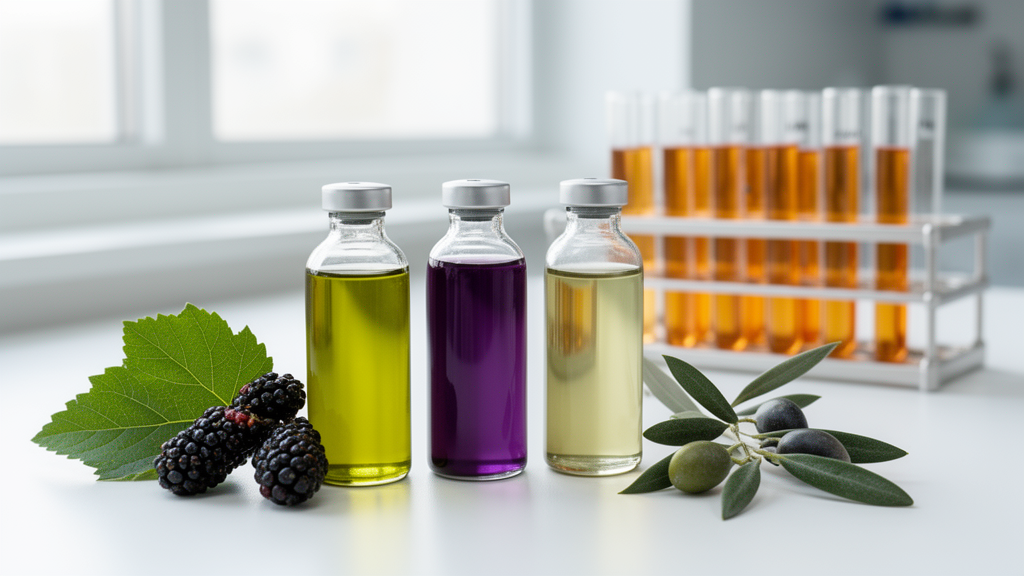
Combining freeze-dried leaf extracts from mulberry, grape and olive can inhibit the starch-digesting enzyme α-amylase more powerfully than any of the extracts alone, according to a laboratory study published in Food Production, Processing and Nutrition. Researchers in Egypt found that a two-part blend of grape and olive leaf extracts acted synergistically at every ratio tested, with the strongest mixture blocking 97.77 percent of enzyme activity at a combination index of 0.16, a value far below the 0.8 threshold that defines true synergy. A three-way mixture containing mulberry, grape and olive extracts also showed synergy, inhibiting 81.77 percent of the enzyme at a combination index of 0.51. The work, led by Tarek S. Mohamed, Samy M. Galal, Ayman A. Mohammad and Karima S. M. Hammad, is entirely in vitro, meaning the effects were measured in test tubes with porcine pancreatic α-amylase rather than in animals or people.
The rationale behind the study lies in how type 2 diabetes is managed. A key therapeutic strategy for controlling postprandial hyperglycemia, the spike in blood glucose after meals, involves slowing the digestion of complex carbohydrates. α-amylase hydrolyzes the α-1,4 glycosidic linkages in starch and glycogen, breaking them into oligosaccharides that α-glucosidase then processes into absorbable glucose. Blocking α-amylase reduces the rate at which glucose enters the bloodstream. Pharmaceutical inhibitors such as acarbose and miglitol do this effectively, but they carry gastrointestinal side effects: undigested starch passes into the lower intestinal tract, where microbiota ferment it abnormally, producing diarrhea and abdominal pain. The FDA has also included acarbose in its dataset of drug-induced liver injury toxicity and severity. These drawbacks have pushed research toward natural alternatives from medicinal plants.
The team selected three plants with distinct phytochemical profiles. Mulberry (Morus alba) leaves contain rutin and chlorogenic acids, both documented α-amylase inhibitors. Grape (Vitis vinifera) leaves are a rich source of catechin, which binds to the α-amylase active site and interacts with catalytic residues through hydrogen bonding. Olive (Olea europaea) leaves contain high levels of oleuropein, which shows a distinct inhibition pattern also involving hydrogen bonding. By integrating these polyphenol sources, the researchers aimed to target a wider variety of enzyme binding sites than any single extract could reach, testing whether complementary mechanisms of action might enhance inhibitory efficacy.
Leaves of all three plants were collected from a farm in Giza, Egypt, authenticated by a senior botanist and verified against herbarium specimens. The leaves were dried at 40 degrees Celsius, ground and sieved to a particle size of 0.29 millimeters. The powdered material was extracted with aqueous ethanol at two ratios, 60:40 and 80:20 ethanol to water, using a solid-to-solvent ratio of 1:20 under stirring for one hour. Because the 80 percent ethanol extracts contained significantly higher levels of total phenolics and flavonoids than the 60 percent extracts, they were chosen for freeze-drying, and the resulting freeze-dried extracts were used for all subsequent analyses.
The phytochemical measurements revealed a wide spread in polyphenol content. In the ethanolic extracts, total phenolic content ranged from 18.26 milligrams of gallic acid equivalents per gram of dried mulberry leaf in the 60 percent ethanol extract to 103.98 milligrams per gram of dried olive leaf in the 80 percent ethanol extract. Total flavonoids ranged from 6.71 to 84.88 milligrams of quercetin equivalents per gram across the same span. Antioxidant activity, measured with DPPH radical scavenging and ferric reducing antioxidant power assays, followed the same ranking in every case: olive leaf extracts were strongest, grape leaf extracts second, and mulberry leaf extracts weakest. The olive freeze-dried extract showed roughly ten-fold higher antioxidant activity than the synthetic standard BHT, based on its significantly lower IC50 value. The grape and olive ethanolic extracts significantly outperformed BHT in both assays regardless of ethanol concentration.
High-performance liquid chromatography identified and quantified fourteen phenolic compounds and seven flavonoids in the freeze-dried extracts, and the profiles differed sharply among the plants. The mulberry extract contained significantly higher levels of protocatechuic acid, chlorogenic acid, syringic acid, ferulic acid, sinapic acid and rutin than the other two. Chlorogenic acid there was about eight times more concentrated than in the grape extract and roughly thirty times more than in the olive extract; chlorogenic and caffeic acids were the main phenolic acids and rutin the major flavonoid in mulberry. The grape extract stood out for gallic acid, p-hydroxybenzoic acid, rosmarinic acid and catechin, with catechin levels about thirty-seven times higher than in olive. The olive extract recorded the highest concentrations of vanillic acid, cinnamic acid, oleuropein, apigenin-7-glucoside, kaempferol and chrysin, with oleuropein as its principal phenolic compound.
When the freeze-dried extracts were tested against α-amylase using the 3,5-dinitrosalicylic acid colorimetric assay, mulberry proved the most potent single extract, with an IC50 of 4.53 milligrams per milliliter, a potency the authors attribute to its rutin and chlorogenic acid content. Olive followed with an IC50 of 6.42 milligrams per milliliter, and grape was weakest at 7.44 milligrams per milliliter. The synthetic drug acarbose remained far ahead of all three, with an IC50 of 0.029 milligrams per milliliter, meaning its efficiency was at least two hundred times greater than that of the plant extracts. This gap matters: the study positions the extracts as candidates for milder, food-based enzyme modulation rather than as replacements for pharmaceutical inhibitors.
Kinetic analysis using Lineweaver-Burk plots uncovered a mechanistic surprise. In the uninhibited control, α-amylase showed a Vmax of 0.73 millimolar per minute and a Michaelis-Menten constant of 2.00 milligrams per milliliter. Adding any of the three plant extracts lowered both the apparent Vmax, to roughly 0.22 to 0.24 millimolar per minute, and the apparent Km, to roughly 0.61 to 0.69 milligrams per milliliter. A parallel decrease in both parameters is the diagnostic signature of uncompetitive inhibition, in which the inhibitor binds only to the enzyme-substrate complex and forms an inactive intermediate. Acarbose behaved differently, raising the apparent Km to 3.58 milligrams per milliliter while leaving Vmax unchanged, the classic pattern of competitive inhibition at the active site. The plant polyphenols therefore attack the enzyme through a fundamentally different route than the standard drug.
The combination experiments, analyzed with the Combination Index method derived from the median-effect principle, produced a clear hierarchy of interactions. Mulberry and grape combinations ranged from additive to mildly antagonistic, with additivity at a 75:25 ratio and antagonism at 25:75 and 50:50 ratios. Mulberry and olive combinations were antagonistic at every ratio tested, which the authors suggest may reflect phytochemical competition for the same target sites or metabolic interference between active components. In contrast, grape and olive extracts were synergistic across all mixing ratios, with combination index values from 0.16 to 0.55. The strongest synergy appeared at a 75:25 blend of the two extracts’ IC50 values, where inhibition reached 97.77 percent. Among ternary mixtures, results spanned from synergy to antagonism depending on proportions: raising the grape fraction to half the mixture produced 81.77 percent inhibition with a combination index of 0.51, while a mulberry-heavy 50:25:25 blend was antagonistic with a combination index of 1.39 and only 30.81 percent inhibition. The authors propose that multi-site binding of complementary polyphenols may underlie the synergistic onset.
The researchers are careful about the limits of what these results mean. The study’s primary limitation, they state, is the absence of in vivo data to corroborate the observed antioxidant and antidiabetic activities, and an in vitro system cannot replicate the complexity of the human gut or the bioavailability of the compounds. Molecular docking studies, which could clarify the mechanistic interactions at the enzyme level, were also not performed. Nevertheless, the authors suggest the findings could inform the development of functional foods designed to enhance α-amylase inhibitory activity, with the grape-olive pairing standing out as the most promising combination for future investigation.
Subject of Research: In vitro phytochemical characterization and synergistic α-amylase inhibition of combined mulberry, grape and olive leaf freeze-dried extracts
Article Title: In vitro evaluation of the phytochemical composition, antioxidant potential, and synergistic α-amylase inhibition kinetics of combined plant leaf freeze-dried extracts
Article References: Mohamed, T. S., Galal, S. M., Mohammad, A. A., & Hammad, K. S. M. (2026). In vitro evaluation of the phytochemical composition, antioxidant potential, and synergistic α-amylase inhibition kinetics of combined plant leaf freeze-dried extracts. Food Production, Processing and Nutrition, 8(1), Article 76. https://doi.org/10.1186/s43014-026-00429-1
Image Credits: AI Generated
DOI: 10.1186/s43014-026-00429-1
Keywords: α-amylase inhibition, type 2 diabetes, mulberry leaf extract, grape leaf extract, olive leaf extract, polyphenols, synergy, combination index, uncompetitive inhibition, freeze-dried extracts, antioxidant activity, in vitro study
News Source: Alan Morgan. (October 28, 2026). Mulberry, Grape and Olive Leaf Extracts Show Synergistic α-Amylase Inhibition in Vitro. Scienmag.