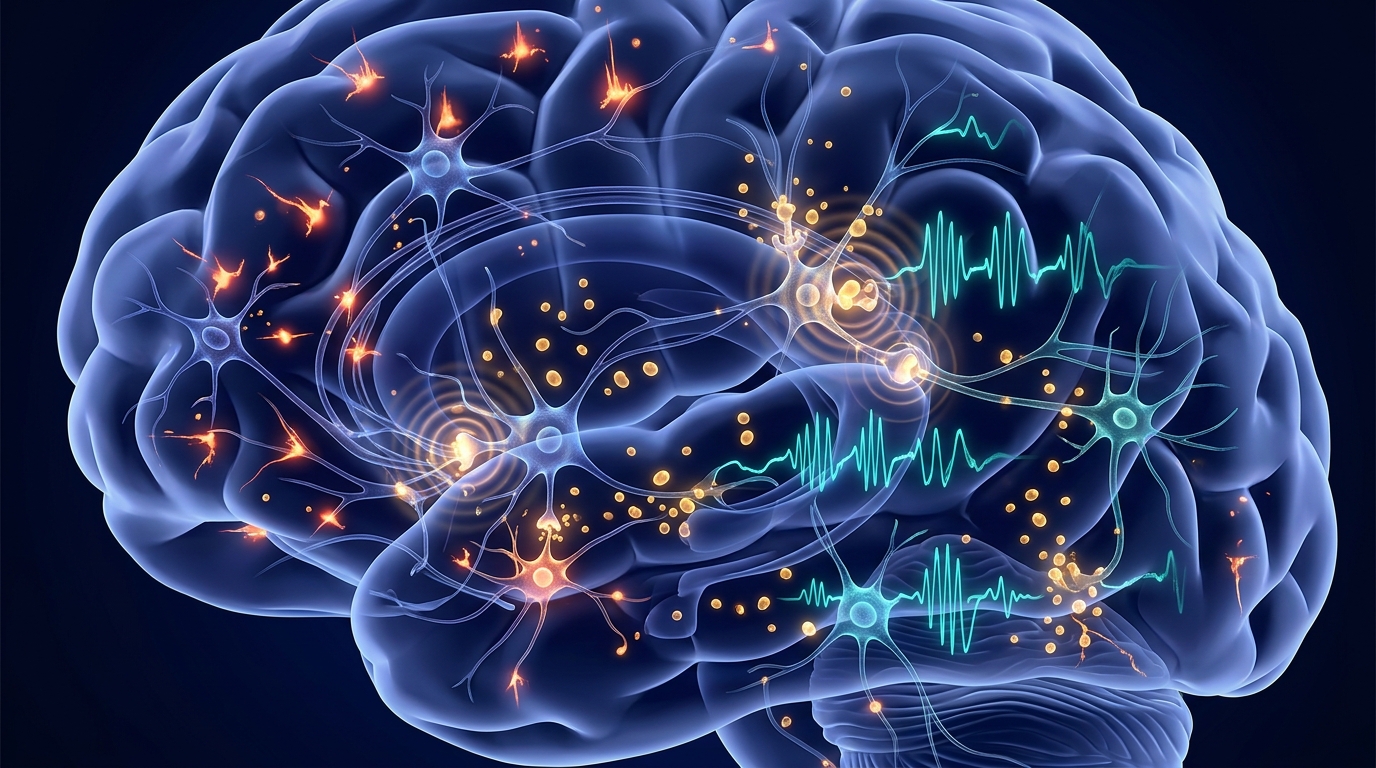
Lactate, the molecule long dismissed as a mere waste product of oxygen-starved tissue, is now at the center of one of neuroscience’s most intriguing stories. A new mini review published in Frontiers in Cellular Neuroscience synthesizes a decade of evidence showing that lactate acts as a bona fide signaling molecule in the brain, binding to a specific receptor called HCAR1 and thereby modulating how neurons fire across the cortex, hippocampus, hypothalamus and cerebellum. The picture that emerges is strikingly complex: depending on the brain region, the concentration of lactate, the type of G protein engaged and even the cellular compartment where the receptor sits, the same molecule can either dampen neuronal activity or rev it up.
The review, authored by Francesca Binda and Jean-Yves Chatton of the University of Lausanne, traces how the field’s understanding of lactate has been transformed. Once considered mostly a hallmark of oxygen deprivation, lactate gained prominence when researchers discovered that glutamate, the brain’s main excitatory neurotransmitter, stimulates aerobic glycolysis in astrocytes, the star-shaped glial cells that wrap around synapses. This observation gave rise to the astrocyte-neuron lactate shuttle hypothesis, which proposes that neuronal activity drives glucose uptake from the blood into astrocytes, where it is fermented into lactate that is then shuttled to neurons to fuel their oxidative metabolism and sustain firing.
But metabolism is only half the story. The real game-changer came with the discovery that lactate is the endogenous ligand of HCAR1, formerly known as GPR81, a G protein-coupled receptor first characterized in adipose tissue, where it inhibits lipolysis. When HCAR1 was found in the nervous system, lactate was promoted from metabolite to signaling molecule. The receptor has since been detected in several brain regions, including the cortex, hippocampus, hypothalamus and cerebellum, using quantitative PCR and a reporter mouse in which HCAR1-expressing cells carry a fluorescent tag. Morphological, electrophysiological and pharmacological evidence supports both pre- and post-synaptic localization of the receptor on neurons, and it is also expressed in astrocytes, where its function has been extensively characterized in the hypothalamus.
HCAR1’s affinity for lactate is relatively low, with an EC50 of about 4.8 millimolar measured in receptor-expressing CHO cells and a similar value of 4.2 millimolar for the receptor-mediated inhibition of neuronal activity. This means the receptor is not fully activated at rest and can respond across the full range of lactate fluctuations the brain experiences. To dissect the receptor’s signaling without the confounding metabolic effects of lactate itself, researchers have developed non-metabolized agonists such as 3,5-DHBA and the far more potent 3Cl-HBA, which has an EC50 of 16 micromolar at the human receptor and inhibits spontaneous neuronal spiking in culture with an IC50 of 22 micromolar. Both agonists show negligible affinity for the related receptor HCAR2.
Downstream, HCAR1 is canonically coupled to Gi proteins, which inhibit adenyl cyclase and lower intracellular cyclic AMP. A recent bioluminescence resonance energy transfer study confirmed Gi coupling and revealed that the receptor can also engage Go and Gs proteins, while showing no recruitment of beta-arrestin in that assay, although beta-arrestin-dependent signaling had been described earlier in inflammatory contexts. This signaling flexibility may underlie the receptor’s eclectic portfolio: HCAR1 participates in axonal development, induces exercise-mediated angiogenesis, supports neurogenesis after hypoxia-ischemia, modulates synaptic transmission and plasticity, stimulates calcium increases and glutamate release from hypothalamic astrocytes, and is required for gait stability and motor learning.
The receptor’s first identified role in the brain was as a modulator of neuronal firing, and the review details how this control plays out differently across regions. In the cortex, imaging of spontaneous calcium transients in primary neuronal cultures initially revealed a concentration-dependent, lactate-mediated inhibition of firing that required active Gi/o proteins. The non-metabolized agonist 3Cl-HBA reproduced this effect, and the effect vanished in neurons from HCAR1 knockout mice, establishing the receptor as the necessary mediator. HCAR1 activation also hyperpolarized the resting membrane potential, decreased input resistance, raised the rheobase, the minimal current needed to trigger a spike, and reduced the frequency of depolarization-induced firing. Notably, 3Cl-HBA similarly suppressed firing in human cortical tissue resected from epileptic patients, underscoring the translational relevance of the rodent work.
Cortical experiments also uncovered a surprising twist rooted in GPCR crosstalk. When HCAR1 was activated first and a second Gi-coupled receptor such as the GABAB or alpha2A receptor was stimulated afterward, the inhibitory effects on cortical activity were additive. But when the order was reversed, HCAR1 actually increased spiking frequency that had been depressed by the other receptors, revealing a stimulatory face of the receptor. This suggests that lactate’s effect through HCAR1 depends heavily on the surrounding cellular environment and the recent activation history of the neuronal network.
In the hippocampus, the story becomes even more nuanced. In the CA1 region, a physiological lactate concentration of 5 millimolar or a low dose of 3,5-DHBA inhibited the firing of pyramidal neurons, accompanied by significant hyperpolarization, increased rheobase and a raised firing threshold, all pointing to reduced excitability. Yet raising the lactate concentration to 30 millimolar, or the synthetic agonist to 3.1 millimolar, produced a net increase in firing frequency, hinting that HCAR1 signaling can flip to an excitatory mode under specific conditions. In the CA3 region, a physiological lactate concentration of 2 millimolar actually increased the firing rate of pyramidal neurons in a Gs protein-dependent manner, and the recent demonstration that HCAR1 can recruit Gs supports the receptor as the mediator of this positive modulation. In the cerebellum, HCAR1 modulates the spontaneous firing of Purkinje cells, which fire independently of synaptic input, with inhibitory and excitatory actions coexisting in the same neurons depending on whether the receptor is recruited at the dendrites or the axon initial segment. And in the arcuate nucleus of the hypothalamus, HCAR1 activation in astrocytes raises intracellular calcium, enhances glutamate release and thereby depolarizes POMC neurons into repetitive firing, an indirect, glia-mediated route to increased neuronal activity.
The molecular targets of this modulation are coming into focus. In CA1 pyramidal neurons, the decrease in excitability was independent of neuronal lactate uptake via the monocarboxylate transporter 2, indicating a metabolism-independent effect, and the non-metabolized agonist 3,5-DHBA produced the same changes, pointing to HCAR1 signaling as the main effector. HCAR1 activation reduced the amplitude of action potentials and slowed their rising phase, and it significantly reduced the current of fast-inactivating voltage-gated sodium channels while increasing the time needed to recover from inactivation, without altering activation kinetics. In the subiculum, by contrast, lactate had a negligible effect on action potential shape, suggesting that sodium channel modulation may be selective for particular channel subtypes and tuned by region. In the subiculum, lactate also produced a small outward current partially blocked by the GIRK channel blocker tertiapin-Q, implicating G protein-coupled inwardly rectifying potassium channels, whose gating by the Gbeta-gamma subunit may explain the receptor’s ability to dampen epileptic-like discharge in that region. In cerebellar Purkinje cells from HCAR1 knockout mice, spontaneous firing increased, and blocking hyperpolarization-activated cyclic nucleotide-modulated channels restored a normal firing rate, supporting a model in which HCAR1, via the Gi-adenyl cyclase-cAMP axis, negatively regulates HCN channel conductivity.
Because sodium, GIRK and HCN channels have all been genetically linked to epilepsy, HCAR1’s grip on them makes the lactate receptor a candidate seizures gatekeeper. During seizures, brain lactate rises to levels suitable for HCAR1 activation, and knockout mice lacking the receptor show a higher propensity to develop seizures in two models of temporal lobe epilepsy, with longer and more severe events, consistent with a protective role. HCAR1 knockout mice also display autistic-like social behavior defects and anxiety-like behavior in the elevated plus maze, hinting at a broader protective role in neurodevelopmental and psychiatric conditions. The authors caution, however, that the excitatory pathway requiring 30 millimolar lactate has questionable physiological relevance, since such concentrations have not been detected in the brain even during seizures or after ischemic injury, and better spatial-resolution methods are needed to test whether local microdomains could reach that threshold. With no reliable antagonists yet available, most of what is known comes from pharmacological activation or knockout studies, and the authors argue that future work must embrace the glial side of the story, since HCAR1 sits at the intersection where neurons and glia converge to tune brain activity.
Subject of Research: The role of the lactate receptor HCAR1 in modulating neuronal excitability and brain function
Article Title: HCAR1-mediated lactate signaling: implications for neuronal excitability and nervous system function
Article References: Binda, F., & Chatton, J.-Y. (2026). HCAR1-mediated lactate signaling: implications for neuronal excitability and nervous system function. Frontiers in Cellular Neuroscience, 20, Article 1953701. https://doi.org/10.3389/fncel.2026.1953701
Image Credits: AI Generated
DOI: 10.3389/fncel.2026.1953701
Keywords: lactate, HCAR1, GPR81, neuronal excitability, astrocytes, G protein-coupled receptor, epilepsy, hippocampus, cerebellum, ion channels, neuromodulation, glia
News Source: Cassandra Pierce. (November 4, 2026). Lactate Receptor HCAR1 Emerges as a Brain-Wide Tuner of Neuronal Firing. Scienmag.