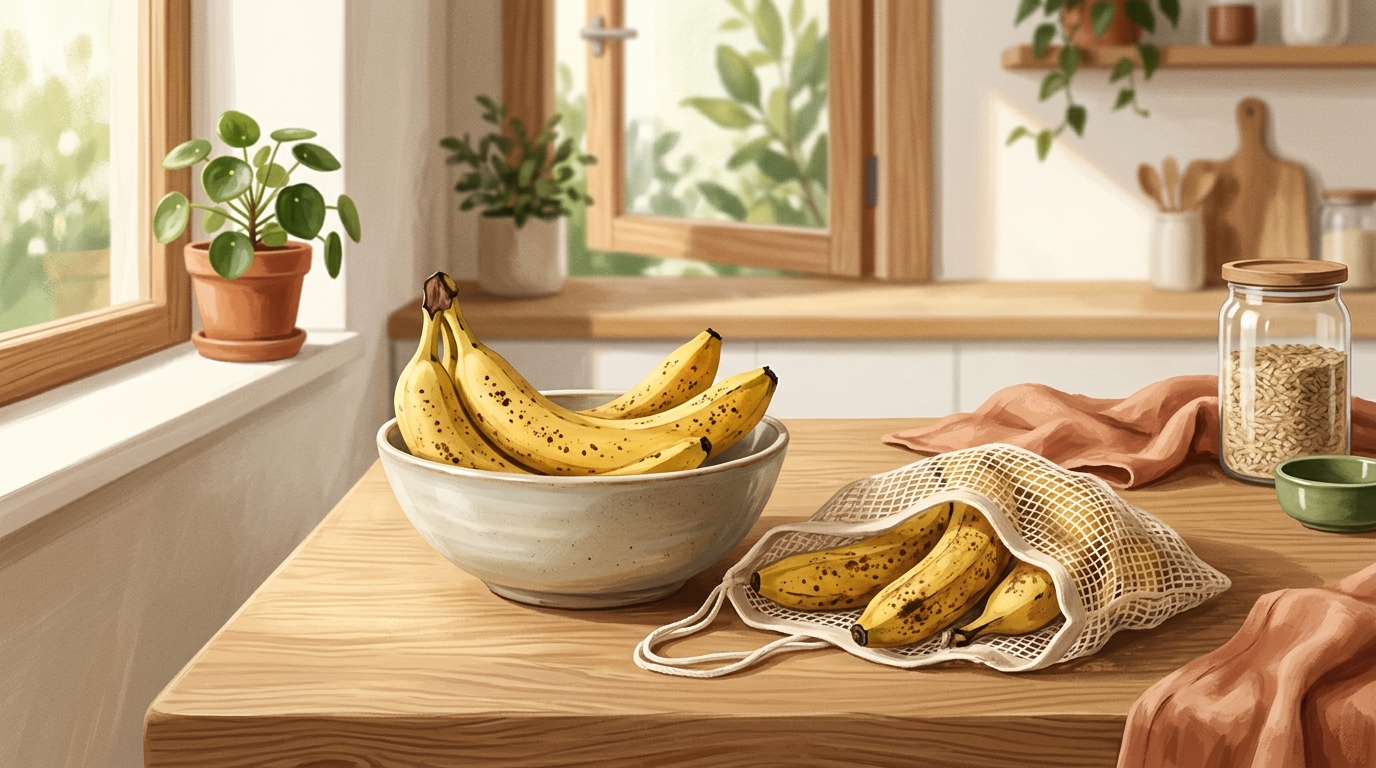
Consumers in Queensland, Australia, who already fold small environmental actions into their daily routines are markedly more willing to say they would buy bananas with blemishes, irregular shapes or other cosmetic flaws, according to a new survey-based study published in Agricultural and Food Economics. The research, led by Mallika Roy and Delwar Akbar of Central Queensland University with colleagues Azad Rahman and Darshana Rajapaksa, surveyed 1,202 consumers across nine urban and regional locations between 7 November and 4 December 2024 and applied an ordered probit regression to identify which behavioural and attitudinal factors track stated preference for imperfect fruit.
The study set out to test whether an integrated behavioural framework, combining the Theory of Planned Behaviour with the Value-Belief-Norm theory, could explain why some shoppers accept cosmetically imperfect produce while others reject it. Bananas are among the most widely consumed fruits globally, yet a significant portion is discarded because of cosmetic imperfections rather than safety or nutritional concerns. In Australia, strict retail standards and consumer preferences for visually appealing produce mean large volumes of edible bananas never reach primary markets, contributing to economic losses and environmental strain. The authors frame consumer acceptance of imperfect produce as a practical behavioural pathway toward United Nations Sustainable Development Goal 12, whose Target 12.3 seeks to halve per capita food waste at retail and consumer levels.
Participants were recruited through a professional survey panel provider using stratified sampling with quotas based on population distribution across metropolitan and regional Queensland, covering Cairns, Townsville, Mackay, Bundaberg, Rockhampton, Toowoomba, Sunshine Coast, Gold Coast and Brisbane. Respondents aged 18 to 65 completed an online questionnaire measuring nine pro-environmental behaviours, including turning off lights and taps, protecting the environment, buying locally produced food, choosing minimal packaging, reducing food waste, discussing sustainability with friends and family, and processing food such as using bananas for smoothies or powder. Each item was rated on a five-point agreement scale. The dependent variable asked whether respondents would be willing to purchase bananas with cosmetic flaws but no nutritional deficiencies, with three ordered response options: yes, no, or indifferent.
The descriptive statistics reveal a striking gap between everyday habits and acceptance of imperfect fruit. Turning off taps scored highest among the behaviours, with a mean of 4.31 on the five-point scale, and turning off lights followed at 4.26. Discussions about sustainability with friends or family occurred far less frequently, averaging 2.90. Preference for imperfect bananas sat at the bottom of the range with a mean of just 1.32, indicating that routine resource-saving practices do not automatically translate into willingness to buy cosmetically flawed produce. The sample itself was predominantly young, gender-balanced and well educated, with more than 300 respondents each in the 18-to-24 and 25-to-29 age brackets, 614 women and 573 men, and 288 holding a bachelor’s degree.
Before running the regression, the researchers examined bivariate associations through cross-tabulations. Among respondents who strongly agreed with turning off the tap, 84.3 percent preferred imperfect bananas, compared with 64 percent of those who strongly disagreed. Strong agreement with protecting the environment was associated with 87.5 percent preference, against 66.7 percent among the least concerned. Support for locally produced food showed a similar gradient, rising from 57.1 percent among the lowest scorers to 86.7 percent among the strongest supporters. Receptiveness to processed banana products such as powder or smoothies produced one of the steepest gradients, with preference climbing from roughly 57 percent among the least receptive to between 88 and 91 percent among the most receptive. A composite pro-environmental behaviour index, built by averaging eight Likert items, confirmed a small-to-moderate but highly significant monotonic association with preference, with Kendall’s tau-b of minus 0.244 before scale alignment, meaning higher pro-environmental behaviour tracked stronger stated preference once coding was harmonised.
The ordered probit model, which preserves the ordinal structure of the yes, indifferent, no response scale, identified two standout predictors. Attitudes toward sustainable food use, captured through willingness to process bananas into smoothies or powder, showed significant positive associations across multiple levels: the lowest engagement level carried a parameter estimate of 0.946, the second 0.504 and the third 0.380, all statistically significant. Environmental protection concern was also strongly associated, with a parameter estimate of 0.453 at the moderate level. Moderate engagement in turning off taps produced a smaller positive estimate of 0.287, and moderate food-waste reduction effort yielded 0.349. Both threshold parameters distinguishing the preference categories were highly significant, indicating respondents differentiate meaningfully between levels of willingness rather than treating the choice as binary.
Social discussion produced a more nuanced and, at first glance, counterintuitive pattern. Because the highest discussion frequency served as the reference category, negative coefficients indicate that less frequent discussers were less likely to prefer imperfect bananas than the most frequent discussers. The level-two coefficient of minus 0.420 was statistically significant, and level four showed a marginally significant negative effect. The authors interpret this as evidence that prevailing social norms within consumers’ networks may act as barriers: if friends, family or colleagues hold negative views about the appearance or desirability of imperfect produce, conversations can reinforce resistance rather than acceptance. Occasional discussion, they suggest, may be insufficient to shift attitudes, whereas strong and consistent social reinforcement could help translate pro-environmental values into behavioural intentions.
Model diagnostics supported the overall fit. The omnibus likelihood ratio chi-square of 137.841 with 20 degrees of freedom was highly significant, confirming that the predictors jointly improve explanatory power. A Wald test confirmed the sustainability-related behavioural variables were jointly significant, and variance inflation factors ranged from 1.21 to 1.59 with a mean of 1.42, indicating multicollinearity was not a concern. Cronbach’s alpha for the nine-item scale reached 0.765, exceeding the conventional 0.70 threshold, and no inter-item correlation exceeded 0.80, supporting discriminant validity. The deviance and Pearson chi-square ratios suggested the model was neither overdispersed nor poorly fitted.
The authors are careful to distinguish stated willingness from observed behaviour. They note that the well-documented attitude-behaviour gap in sustainable consumption research means consumers often express positive environmental attitudes without translating them into purchases, particularly where price, taste, convenience and aesthetic preferences dominate. Because this study measured stated willingness rather than actual market transactions, the findings should be read as evidence of consumer acceptance potential rather than proof of behavioural change. The cross-sectional design also limits causal inference, and the behavioural indicators serve as proxies for theoretical constructs without full confirmatory validation through a measurement model. Structural factors such as retail pricing, availability and supply-chain practices fall outside the model’s scope.
Despite those caveats, the practical implications are concrete. The authors suggest retailers could launch dedicated imperfect-produce product lines with attractive displays and loyalty rewards, provide recipes or demonstration videos showing how blemished bananas work in smoothies and baking, and apply behavioural nudges such as strategic shelf placement and green labelling. Education programs embedding food-waste topics in school and university curricula, drawing on international examples that achieved waste reductions of roughly 13 to 50 percent in campus settings, could cultivate future demand. At the policy level, they point to tax credits for retailers donating unsold edible food to charities, mandatory reporting to track greenhouse-gas savings, and government-endorsed low-waste retail labels as instruments that could scale behavioural change. Targeted campaigns reframing imperfect fruit as an environmentally responsible choice, they argue, would address the social barriers their data exposed while building on the environmental values and waste-reduction habits that already predict acceptance among Australian consumers.
Subject of Research: Consumer acceptance of cosmetically imperfect bananas in Australia
Article Title: Bending the curve: how pro-environmental behaviours shape consumer preference for imperfect bananas in Australia
Article References: Roy, M., Akbar, D., Rahman, A., & Rajapaksa, D. (2026). Bending the curve: how pro-environmental behaviours shape consumer preference for imperfect bananas in Australia. Agricultural and Food Economics, 14(1), Article 62. https://doi.org/10.1186/s40100-026-00504-8
Image Credits: AI Generated
DOI: 10.1186/s40100-026-00504-8
Keywords: imperfect bananas, food waste, consumer behaviour, Queensland survey, ordered probit, Theory of Planned Behaviour, Value-Belief-Norm theory, pro-environmental behaviour, sustainable consumption, circular economy, banana supply chain, SDG 12
News Source: Alan Morgan. (November 4, 2026). Australian survey links everyday eco habits to stated willingness to buy imperfect bananas. Scienmag.