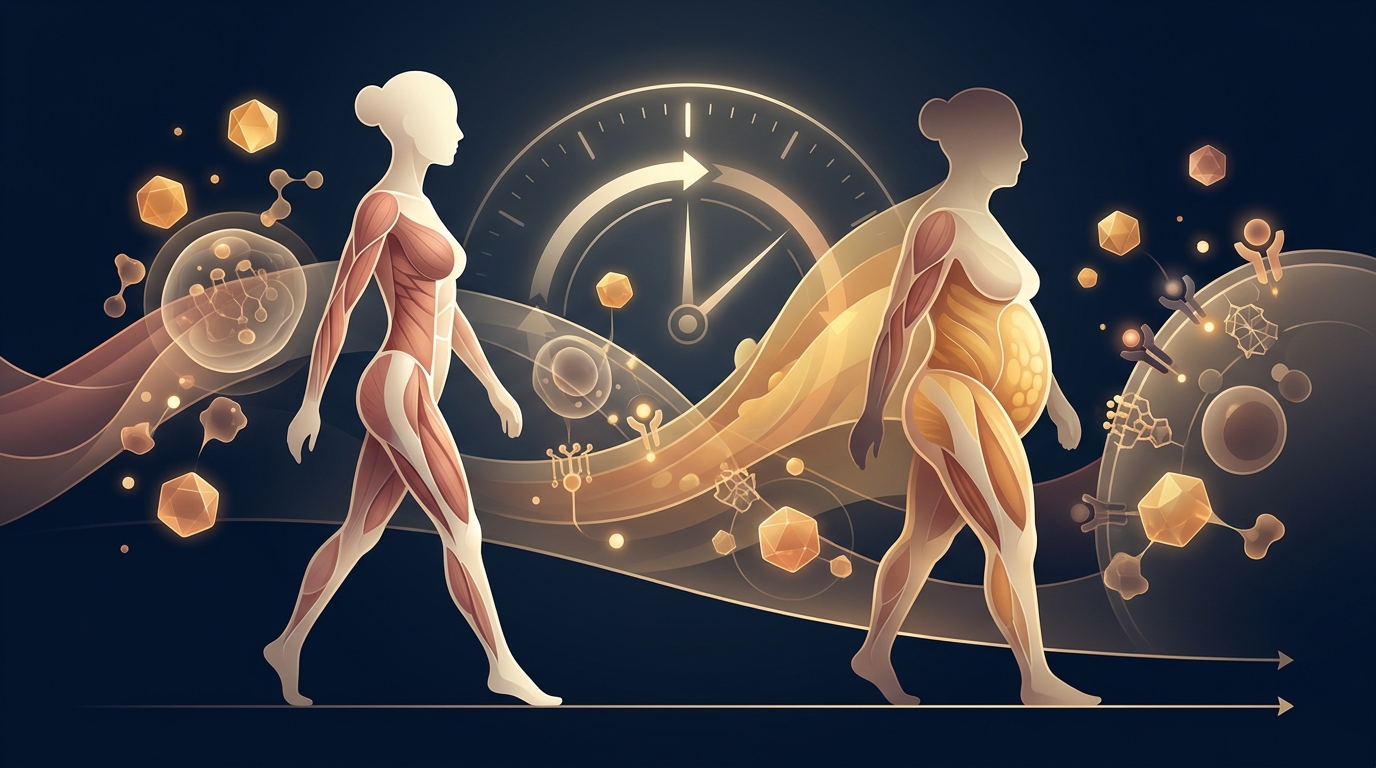
Age-related changes in body composition — shrinking muscle and bone, expanding fat stores — drive frailty, disability, falls and fractures in older adults. A new narrative review in GeroScience asks whether the biological hallmarks of aging, the molecular processes thought to underlie those shifts, actually track with body composition changes over time in living people. The answer, after a sweep of the longitudinal human literature, is that the evidence remains limited and heterogeneous, with one notable exception: insulin-related nutrient sensing.
Emeline Michel of the Gérontopôle in Toulouse and colleagues, together with senior authors Philipe De Souto Barreto and Yves Rolland, reviewed studies that followed adults aged 50 and older with repeated body composition measurements and examined whether hallmark-related biomarkers predicted how those measurements changed. They identified 50 articles. Among the primary hallmarks, only telomere length was identified, and its association with body composition changes was not consistent across studies. No longitudinal human work was found for genomic instability, epigenetic alterations, proteostasis, macroautophagy, cellular senescence, stem cell exhaustion or dysbiosis — meaning seven of the framework’s core pillars have essentially no direct longitudinal evidence in this context.
The antagonistic hallmarks fared better. Deregulated nutrient sensing stood out as the only hallmark with consistent supporting evidence: insulin resistance, hyperinsulinemia, impaired glucose homeostasis and related indices were associated with adverse changes in both muscle and adipose tissue over time.
Mitochondrial dysfunction, another antagonistic hallmark, showed more suggestive than definitive evidence. The reviewed studies relied on indirect biomarkers rather than direct measures of mitochondrial function, and the associations were stronger for adiposity than for muscle or bone. The authors note that the evidence for mitochondrial dysfunction relied on indirect biomarkers and was more suggestive for adiposity than for muscle or bone.
Among the integrative hallmarks, altered intercellular communication and chronic inflammation were the most commonly investigated, with chronic inflammation emerging as the single most studied hallmark across the entire review. Hormonal markers, vitamin D, trace elements, inflammatory indices and other systemic biomarkers showed associations that varied by the specific biomarker measured, by sex, and by which body compartment was assessed. These biomarker-specific, sex-specific, and compartment-specific associations underscore how heterogeneous the evidence remains.
Methodologically, the review notes that body composition was mainly measured using Dual-energy X-ray Absorptiometry.
The authors’ overall verdict is measured. Evidence remains limited and heterogeneous across hallmarks, and the strongest current finding — that insulin-related nutrient sensing is tied to adverse muscle and adipose remodeling — is a starting point rather than a settled conclusion. They call for studies that combine repeated biomarker assessment with precise body composition phenotyping to move the field beyond cross-sectional snapshots and single-timepoint predictors.
Subject of Research: A narrative review examining how biomarkers of the hallmarks of aging relate to longitudinal body composition changes in adults aged 50 and older.
Article Title: Longitudinal associations between the hallmarks of aging and body composition: a narrative review
Article References: Michel, E., Briand, M., Vellas, B., Lucas, A., Guerin, O., De Souto Barreto, P., & Rolland, Y. (2026). Longitudinal associations between the hallmarks of aging and body composition: a narrative review. GeroScience. https://doi.org/10.1007/s11357-026-02629-6
Image Credits: AI Generated
DOI: 10.1007/s11357-026-02629-6
Keywords: hallmarks of aging, body composition, insulin resistance, sarcopenia, adiposity, chronic inflammation, telomere length, mitochondrial dysfunction, Dual-energy X-ray Absorptiometry, narrative review, older adults, GeroScience
News Source: Beatrice Stafford. (November 4, 2026). Insulin resistance stands out as aging hallmark tied to body composition changes. Scienmag.