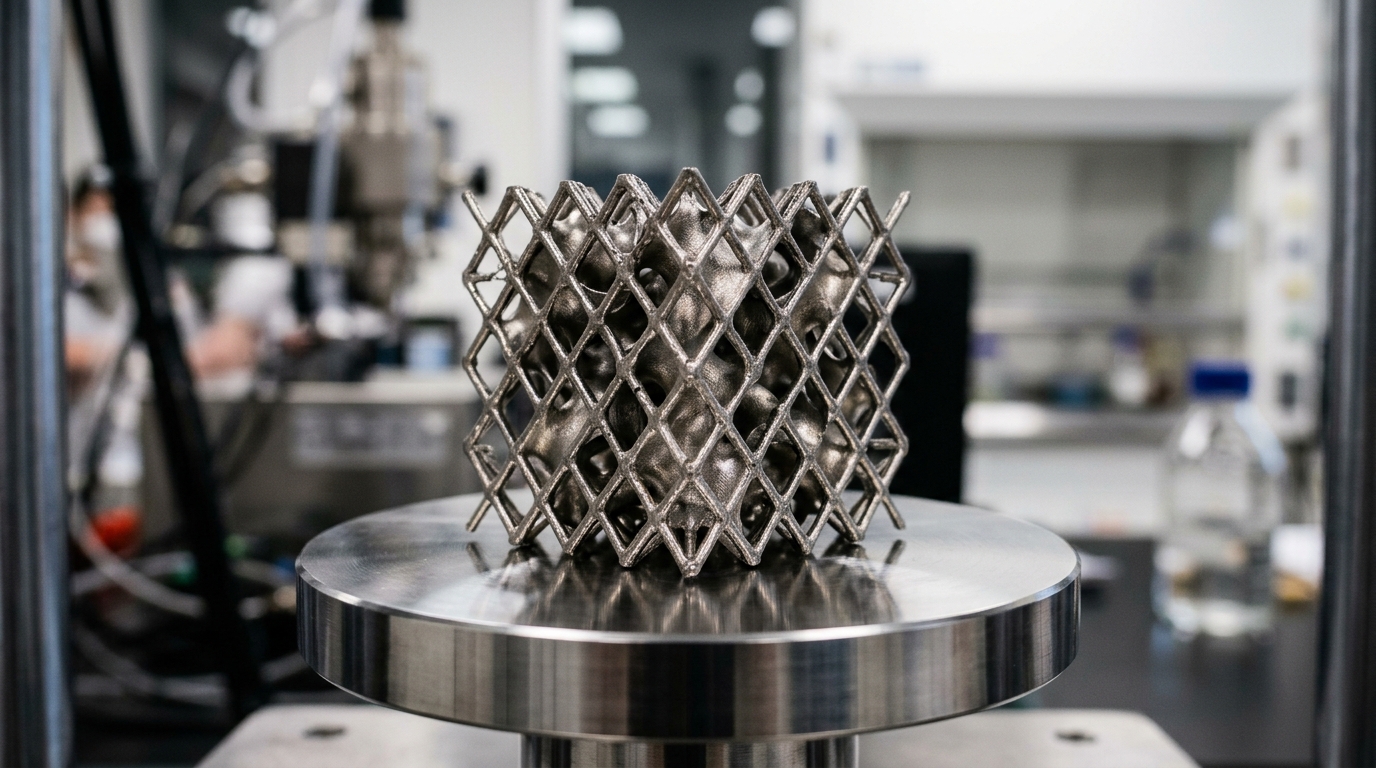
Engineers have combined 3D printing with a hybrid materials strategy to build CoCrNi-based metamaterials that resist compressive damage and cyclic fatigue better than conventional single-topology designs. The work, published in Advanced Composites and Hybrid Materials, embeds precipitation-hardened inner fillings into a ductile matrix, using the design freedom of additive manufacturing to integrate mechanical behaviors that normally conflict with one another.
The key to the new performance is a strain-dependent, sequential yielding mechanism. During initial compression, the softer outer layers deform first and dissipate energy. As loading continues, the inner fillings are progressively engaged, producing a distinctive dual-plateau compressive response. According to the researchers, this staged deformation synergistically enhances both plateau stress and energy absorption, allowing the structure to keep absorbing energy while maintaining resistance to damage.
Under cyclic loading, the metamaterials rely on thermally stable cellular structures containing coherent γ′ precipitates. These nanoscale precipitates alter how damage progresses through the material and suppress cyclic ratcheting, the gradual accumulation of strain that typically degrades structures under repeated loading.
The authors attribute the performance to a synergetic effect operating across multiple length scales: nanoscale precipitation, microscale substructures, and a macroscopic compositional gradient work together to redistribute strain and redirect damage toward regions of the structure that can better tolerate it. This multiscale coordination is what enables the material to combine high compressive energy absorption with fatigue resistance, properties that the abstract describes as traditionally incompatible within a single component.
The design strategy moves beyond monothetic topology, in which a single lattice architecture must serve all mechanical requirements. Instead, the hybrid approach assigns different roles to different regions of the printed structure, letting the ductile matrix handle early-stage energy dissipation while the hardened fillings carry load later in the deformation history.
Subject of Research: Additively manufactured CoCrNi-based hybrid metamaterials with sequential yielding and extended fatigue life under compression
Article Title: Exceptional compressive performance in additively manufactured CoCrNi-based hybrid metamaterials enabled by sequential yielding and gradual strain release
Article References: Wang, J., Hu, D., & Fu, M. W. (2026). Exceptional compressive performance in additively manufactured CoCrNi-based hybrid metamaterials enabled by sequential yielding and gradual strain release. Advanced Composites and Hybrid Materials. https://doi.org/10.1007/s42114-026-02156-0
Image Credits: AI Generated
DOI: 10.1007/s42114-026-02156-0
Keywords: metamaterials, additive manufacturing, CoCrNi, fatigue, compressive performance, energy absorption, precipitation hardening, sequential yielding, γ′ precipitates, aerospace materials, Exceptional, compressive
News Source: Denise Maddox. (November 5, 2026). Hybrid CoCrNi Metamaterials Show Extended Fatigue Life and Dual-Plateau Compression. Scienmag.