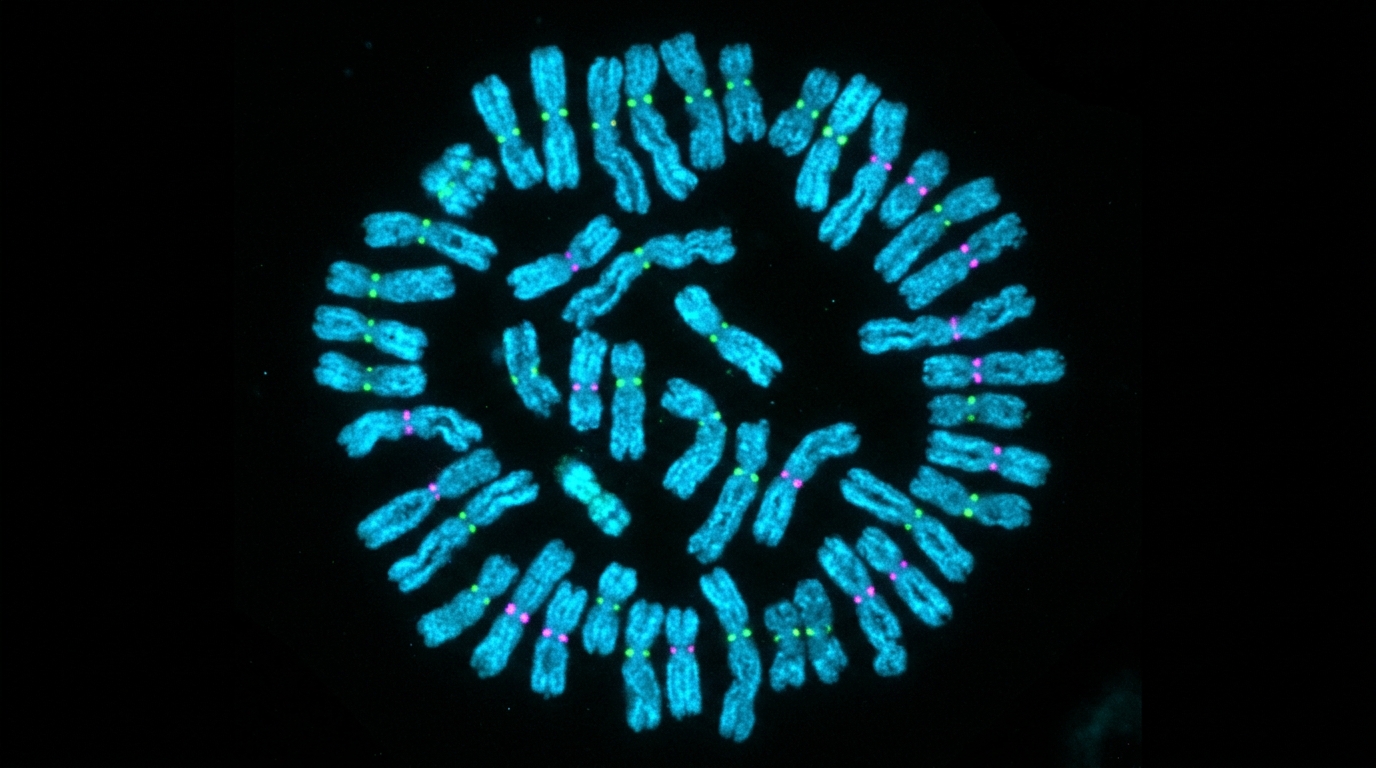
Wheat breeders may have just gained one of the most powerful chromosome-editing tools ever described. In a study published in Nature Plants, researchers report that aiming the CRISPR–Cas9 system at the repetitive DNA of centromeres — the pinched waists of chromosomes that guide their inheritance — can reconfigure up to 11 chromosomes in a single generation of hexaploid bread wheat. From one transformation, the team recovered a library of translocations, isochromosomes and aneuploids, effectively rewriting the wheat karyotype on demand.
The work, reported by Zhou and colleagues and highlighted in a News & Views analysis by Ian R. Henderson, builds on a long history of chromosome engineering in plants. Classical misdivision phenomena in wheat, in which meiotic univalents underwent centromere fission, once created telocentric neochromosomes, and supernumerary B chromosomes helped researchers understand the minimal sequences needed for chromosome inheritance. Over the past decade, genome engineering has added sharper instruments: CRISPR directed to repetitive sequences in wheat, multiple target sites used to generate inversions and translocations in Arabidopsis, and tethering of the centromere protein CENH3 in maize to create a dicentric chromosome that split into two stably inherited neochromosomes.
The new strategy, which the authors call centromere editing-mediated chromosomal variation, or CECV, exploits a quirk of wheat biology. The centromeric sequences of bread wheat are specific classes of retrotransposons belonging to the Cereba and Quinta families. Because these repeats supply thousands of near-identical binding sites for a guide RNA, a single CRISPR design can strike every centromere at once. And because centromeres are typically gene-poor, cutting them is unlikely to knock out protein-coding genes — an attractive feature for a technique whose whole point is to shuffle chromosome arms without wrecking the genes they carry.
Technically, the team designed two single-guide RNAs against the CRW consensus sequence, the Cereba-like centromeric retrotransposon of wheat, with one guide located in the long terminal repeat and the other in an internal non-coding region. The guide RNAs were delivered with Cas9 into immature embryos. On average, each chromosome carried more than a thousand predicted target sites, with the vast majority falling inside the centromere or the surrounding pericentromeric regions. The result is what the News & Views commentary calls remaking wheat with a thousand cuts: a genome challenged simultaneously at every centromere.
The consequences were dramatic. Low-coverage whole-genome sequencing of the regenerated wheat plants detected widespread, chromosome-scale copy number change, totalling an estimated 121 sequence gain or loss events. Approximately 60% of the T0 CECV plants carried chromosome-scale copy number variation, compared with almost none in three control groups. Among chromosome arm-level events, 89% of breakpoints mapped within, or in proximity to, the centromeric regions — exactly where the cuts were directed. Chromosomes with more target sites were altered more often, and the D subgenome, which had the fewest target sites, experienced the fewest changes. Higher-depth sequencing also revealed a second class of megabase-scale deletions and duplications confined to the centromere itself, in plants whose karyotype was otherwise intact.
To see how the variation behaved across generations, the researchers used cytogenetics to karyotype more than 500 T1 progeny plants by fluorescence in situ hybridization. Lines that were already unbalanced diversified further through meiotic segregation, producing nullisomic, ditelosomic, trisomic and tetrasomic individuals among siblings. Approximately 7% of the CECV T1 plants were cytological chimeras, with different cells from the same individual showing different chromosome karyotypes. Translocations dominated the collection, with 60 independent events from 22 T0 lines, involving every chromosome but showing a bias towards the A and B subgenomes. Some translocations were stably inherited, whereas others underwent further structural changes.
Long-read PacBio HiFi assembly of three representative lines provided a molecular view of the rearrangements. The assemblies confirmed direct arm rejoining within the centromere, with local deletions and insertions at the junctions, while collinearity was preserved along the rest of the chromosome. In other words, the chromosome arms themselves remained largely intact; it was the centromeric hinge that had been cut, swapped and repaired.
Chromosome fission and fusion create a hazard: dicentric chromosomes, which carry two centromeres and can be pulled apart during cell division. Such chromosomes can be unstable through the breakage–fusion–bridge cycle, first defined by Barbara McClintock. Alternatively, neocentromeres or centromere remodelling can stabilise inheritance. The authors explored these possibilities and observed remodelling of centromeres on the rearranged chromosomes. A 5AL-5BL derivative chromosome retained the 5A centromere, in which the CENH3 domain expanded by roughly 2 megabases, whereas on the reciprocal 5AS-5BS chromosome, CENH3 occupancy over the 5B-derived sequences was lost. In other lines, centromeric DNA was deleted and CENH3 occupancy was correspondingly reduced, whereas on a 1AL-6BS translocation chromosome the residual 1A domain expanded by approximately 870 kilobases. Genetic loss of sequence and epigenetic redistribution of CENH3 thus act together to resolve the challenge of centromere requirements on rearranged chromosomes — and this centromere plasticity operated rapidly, on a timescale of one or two generations.
Importantly, the rearrangements were not always disruptive to gene activity. RNA sequencing showed that balanced translocation lines arising from CECV were transcriptionally similar to wild type, with only around 1% of genes differentially expressed, no enrichment of changes on the rearranged chromosomes, and few changes near the rearrangement junctions. However, dosage imbalance mattered: in lines carrying extra copies of chromosome 6B, nearly 5,800 genes were differentially expressed, with 17% of them on 6B itself, although the majority were scattered across the structurally unchanged chromosomes. The lesson, the commentary notes, is that chromosome engineering can produce phenotypically normal plants, but the resulting genomes need careful inspection, ideally using the orthogonal techniques of long-read genome assembly and cytogenetics. Because CECV generates a large spectrum of chromosome variation, each derived line requires detailed characterisation.
The implications reach well beyond basic biology. Karyotypes — the number, size and structure of chromosomes — help define species, and they are highly dynamic during evolution, with frequent gains, losses and duplications. Chromosome number, centromere position and the partitioning of genes between chromosome arms shape patterns of chromatin and recombination, as well as chromosome segregation and reproductive compatibility. A library of CRISPR-derived karyotypes differing in arm composition, chromosome length and centromere position could let researchers systematically ask how chromosome architecture governs meiotic pairing, the recombination landscape, transmission fidelity and three-dimensional genome organization. For crop breeding, CECV also promises a means to generate targeted arm translocations between wheat and alien chromosomes on demand, and the authors suggest the degree of karyotype change might be tuned using different promoters or guides restricted to one subgenome. From a single transformation, breeders may now hold a dial for the very architecture of the wheat genome.
Subject of Research: CRISPR editing of centromeric retrotransposons to engineer chromosome variation in hexaploid bread wheat
Article Title: Remaking wheat with a thousand cuts
Article References: Henderson, I. R. (2026). Remaking wheat with a thousand cuts. Nature Plants. https://doi.org/10.1038/s41477-026-02466-7
Image Credits: AI Generated
DOI: 10.1038/s41477-026-02466-7
Keywords: wheat, CRISPR, centromere, chromosome engineering, karyotype, retrotransposon, translocation, CENH3, aneuploidy, crop breeding, genomics, Nature Plants
News Source: Alan Morgan. (November 5, 2026). CRISPR cuts at wheat centromeres rewrite the karyotype in a single generation. Scienmag.