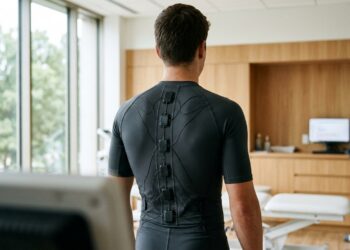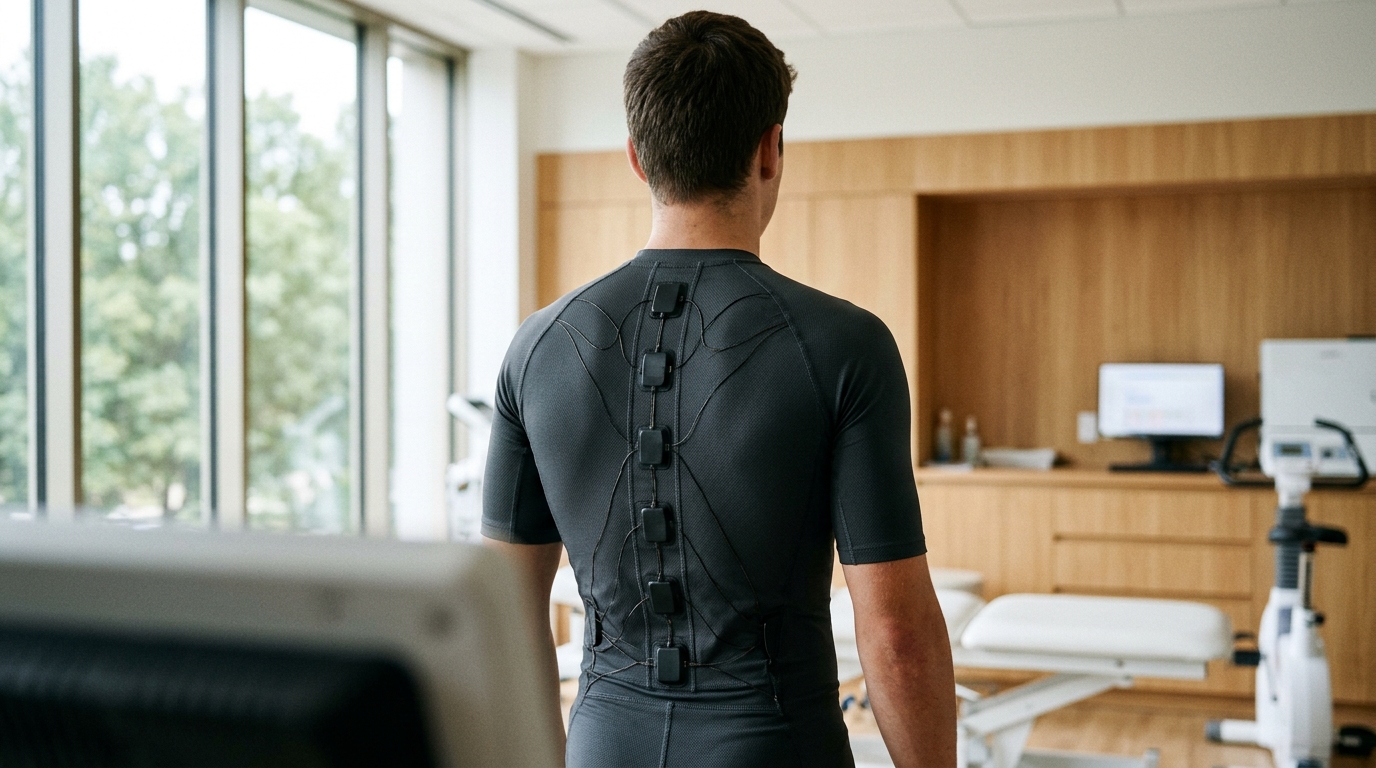
A wearable suit studded with motion vector sensors can identify scoliosis, estimate the degree of spinal curvature and locate where the curve sits, according to a study published in Nature Communications. In a multi-center cohort spanning four hospitals and one school-based screening program, the researchers report accuracies of 92.63 percent for detecting scoliosis, 71.05 percent for quantifying the degree of curvature and 82.76 percent for identifying the location of the curvature.
The device addresses a familiar bottleneck in scoliosis care. Early identification matters because timely clinical intervention can change outcomes, yet conventional static screening relies on subjective assessments, which the authors say leads to limited accuracy and insufficient continuity. The suit offers a radiation-free alternative, and the team suggests it could support longitudinal follow-up and reduce repeat radiographs in scoliosis management.
At the heart of the system is a highly anisotropic mesh engineered with orderly aligned conductive fibers. That alignment is what allows the embedded motion sensors to precisely perceive both the amplitude and the direction of movement. When a person wearing the suit moves, the sensors capture the amplitude and direction of skin-surface deformation, which the researchers use to quantify three-dimensional spinal motions.
The suit integrates these motion sensors at symmetrical positions on the body. By capturing skin-surface deformation amplitude and direction on both sides, the system can quantify three-dimensional spinal motions.
Classification is handled by machine learning. The researchers achieve dynamic scoliosis identification through machine learning-powered evaluation of spinal kinematic symmetry, rather than relying on a single static posture measurement.
The reported performance figures come from testing on a multi-center cohort that included four hospitals and one school-based screening program. Detection of scoliosis was the strongest task at 92.63 percent accuracy. Quantifying the curvature degree proved harder at 71.05 percent, and identifying the curvature location reached 82.76 percent. These are the study’s reported results, and the abstract does not provide additional detail on cohort size, curve severity distribution or comparison against radiographic gold standards.
The technical significance lies in the sensor design. The anisotropic mesh with orderly aligned conductive fibers is what enables the motion sensors to precisely perceive both the amplitude and the direction of movement. The suit integrates motion sensors positioned at symmetrical body locations to quantify three-dimensional spinal motions by capturing skin-surface deformation amplitude and direction.
The authors state that this radiation-free alternative has the potential to support longitudinal follow-up and reduce repeat radiographs in scoliosis management. The study was published as an accepted manuscript shared early for faster access, a citable version subject to further edits before the final Version of Record appears.
Subject of Research: A wearable motion sensor suit that identifies scoliosis by evaluating three-dimensional spinal kinematic symmetry
Article Title: A motion vector sensor-enabled 3D spinal morphology monitoring suit for intelligent scoliosis identification
Article References: Xu, L., Chen, G., Liu, H., Zhao, X., Yao, C., Si, H., Lin, M., Wang, Y., Wang, B., Yin, X., Yuan, J., Qiu, G., Wu, Z., Zhang, T. J., Liao, Q., Zhang, Y., & Wu, N. (2026). A motion vector sensor-enabled 3D spinal morphology monitoring suit for intelligent scoliosis identification. Nature Communications. https://doi.org/10.1038/s41467-026-79186-1
Image Credits: AI Generated
DOI: 10.1038/s41467-026-79186-1
Keywords: scoliosis, wearable sensors, motion vector, spinal morphology, machine learning, radiation-free, screening, spinal curvature, kinematic symmetry, flexible electronics, motion, vector
News Source: Ophelia Keating. (November 5, 2026). Sensor suit tracks spinal motion to flag scoliosis without X-rays. Scienmag.