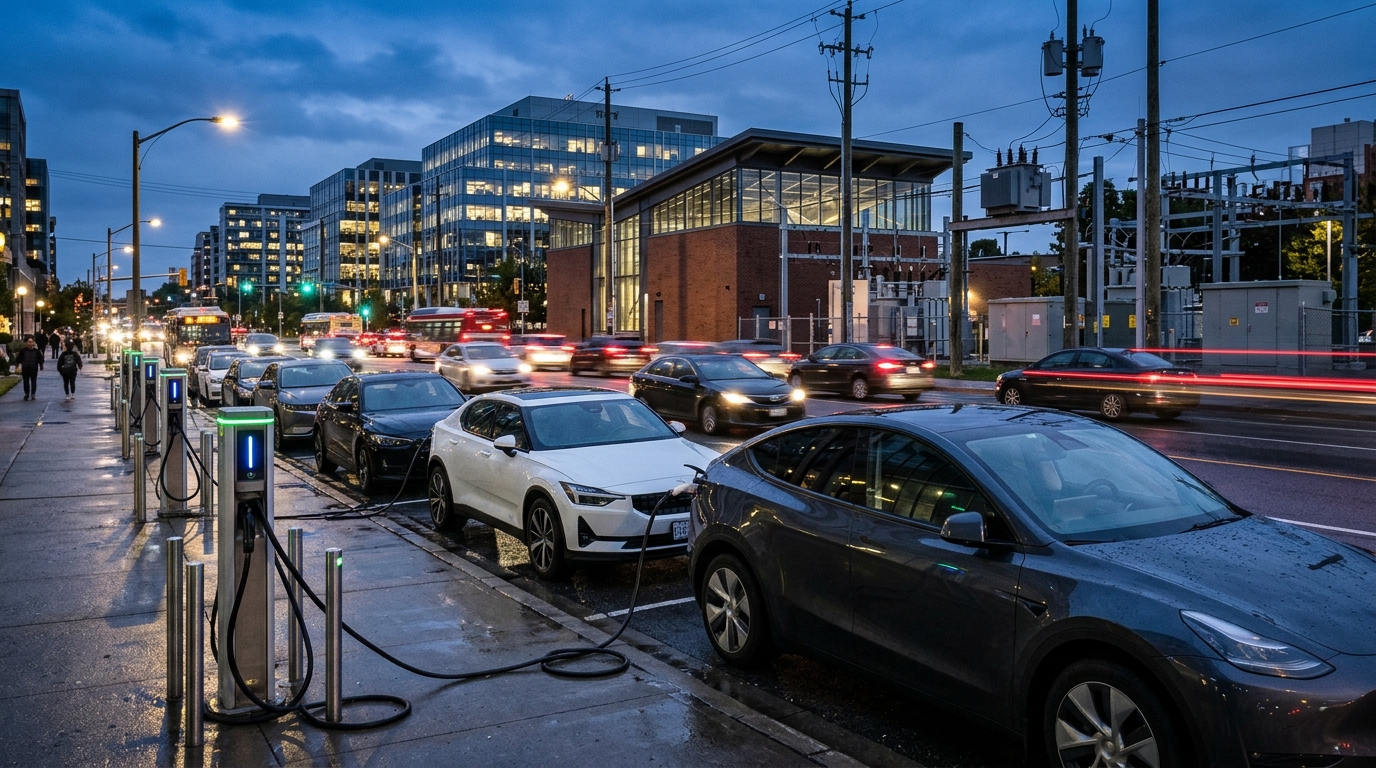
Electric vehicles, charging stations, road networks and the power grid no longer behave as separate systems, and a new study argues they should no longer be managed as separate systems either. Researchers report a deep learning framework that treats the entire human–vehicle–charger–road–grid ecosystem as a single optimization problem, learning coordinated decisions for charging, routing and grid dispatch from continuous interaction with a simulated urban environment. In case studies on a synthetic urban energy–mobility testbed, the approach reduced total system cost by 21.7 percent, improved renewable utilization by 24 percent, and enhanced voltage stability by 15 percent compared with benchmark methods, according to the paper published in Energy Informatics.
The work, led by Yi Pan, Kemin Dai, Mingshen Wang and Xiaodong Yuan, addresses a gap the authors identify in the current literature: most existing studies handle transportation and power systems as loosely coupled or hierarchically coordinated subsystems, relying on static optimization, simplified coupling assumptions, or centralized control architectures. In real urban settings, decisions in the mobility domain can rapidly propagate into grid stress, voltage instability and renewable curtailment, while power system limitations simultaneously reshape feasible routing and charging patterns. Traditional optimization models, often static or decoupled, fail to capture these bidirectional and cross-domain feedback mechanisms, the paper argues, resulting in suboptimal or even infeasible coordination when applied to large-scale, dynamic environments.
The proposed method departs from static optimization and distributionally robust approximations by adopting a dynamic multi-agent deep reinforcement learning paradigm. Each agent represents a distinct domain component—vehicles, chargers, road nodes or grid controllers—and learns adaptive decision policies through cooperative reward sharing and environment embedding, enabling scalable coordination without centralized supervision. The mathematical formulation integrates a multi-term objective that minimizes total energy cost, travel delay and grid imbalance, subject to nonlinear power–traffic coupling constraints. A hybrid convolutional–recurrent neural architecture encodes spatial topology and temporal dependencies, while federated gradient aggregation preserves cross-agent learning stability, the authors write.
At the modeling level, the framework links traffic flow conservation, charging power balance and grid load dynamics through a sequence of nonlinear equality and inequality constraints. Each constraint reflects physical and operational realities such as speed–density relationships, battery energy balance and power capacity limits. The resulting formulation is a large-scale nonlinear programming problem with high-dimensional coupled variables that cannot be effectively solved using conventional convex optimization or static programming methods, according to the study. To manage this complexity, each subsystem’s decision is represented by a parameterized policy function, and a deep Q-learning mechanism iteratively approximates the long-term cost-to-go function associated with each decision sequence, while a graph convolutional encoder captures spatial correlations and a temporal attention mechanism accounts for evolving system states.
The objective function itself is deliberately multi-layered. It aggregates charging, discharging and grid power consumption penalties weighted by energy coefficients; models transportation delay costs through vehicle flow, density and queue dynamics; penalizes deviations in grid voltage and power imbalance through squared deviations; and integrates both fuel-based and grid-related carbon dioxide emission terms. A dynamic coupling term captures temporal correlations between changes in vehicular flow and energy dispatch, and a human-centric satisfaction term introduces behavioral constraints and psychological comfort dynamics that influence charging or driving decisions. A stability-regularization term ensures temporal smoothness of both power dispatch and vehicular flows, the paper states, guaranteeing convergence and physical consistency of solutions during iterative reinforcement learning optimization.
The case study is built on a 15-by-15-kilometer metropolitan zone divided into 120 road segments and 45 charging nodes interfacing with 18 distribution grid substations connected to a 33 kV network. The unified spatiotemporal graph spans approximately 520 buses and 630 edges. Traffic data are synthesized from real datasets derived from the Shenzhen urban mobility open platform, scaled to represent roughly 36,000 vehicles, of which 8,000 are electric. Vehicle arrivals at charging stations follow a time-varying Poisson distribution with a mean of 9.8 vehicles per 10 minutes during peak hours and 3.1 per 10 minutes off-peak, with average charging demand of 32 kWh per session. The grid-side baseline load fluctuates between 210 MW and 285 MW depending on time of day, and voltage constraints are fixed between 0.95 and 1.05 per unit.
The data underlying the simulation reveal the scale of the coordination challenge. During rush-hour clusters around 08:00–10:00 and 17:00–19:00, the mean arrival interval contracts to 5.1 minutes, producing up to 95 arrivals per station per hour—nearly 450 kW of instantaneous charging demand assuming an average session of 32 kWh. During off-peak periods between 02:00 and 04:00, the mean interval widens to approximately 18 minutes, dropping expected station utilization below 30 percent. The energy subsystem must therefore accommodate a 3.5-fold variation in hourly charging intensity throughout the day. A correlation analysis across ten traffic and power features found a strong negative correlation of −0.82 between vehicle density and mean speed, a moderately positive relationship of +0.64 between charging rate and queue length, and a mild inverse coupling of −0.47 between renewable penetration and grid load.
Cross-domain timing matters as much as magnitude. A cross-correlation analysis across 45 network nodes over a ±6-hour lag window found a consistent positive correlation ridge peaking between +1.5 and +2.0 hours, with an average coefficient of +0.63 across 70 percent of nodes—meaning surges in vehicular density generally lead to load increases after a 90-to-120-minute delay, corresponding to the average duration of post-commute charging activity. Nodes in central business and mixed-use zones showed the strongest correlations, up to +0.82, while peripheral nodes displayed weaker and occasionally negative correlations between −0.15 and −0.25, implying that at industrial or fleet-oriented charging stations, load demand schedules may dictate vehicle movement rather than the other way around. The coupling direction between traffic and grid phenomena, the authors conclude, is not uniform and depends strongly on the functional role of each subregion.
Training was carried out on a high-performance computing cluster with four NVIDIA A100 GPUs, two Intel Xeon Gold 6330 processors and 512 GB of RAM, using PyTorch 2.1 and the Deep Graph Library. Each training epoch consisted of 20,000 episodes of 96 time steps corresponding to 15-minute intervals over 24 hours, with a replay memory of 1.2 million transitions and prioritized replay sampling. Convergence was typically achieved after 3.6 × 10⁵ training steps, approximately 22 hours of GPU time for a single run. Across 500 training episodes, the average reward rose from about 0.12 to a stable plateau around 0.98, while the loss decayed from an initial 1.3 to approximately 0.05 by episode 350. Convergence speed surpassed standard PPO baselines by 24 percent and traditional Q-learning by nearly 41 percent, which the authors attribute to the hierarchical attention mechanism embedded in the state encoder.
The results also probe the framework’s limits. In a high-traffic scenario, cost rose to 88 × 10³ USD, a 7.3 percent increase, emissions rose 4.8 percent to 44 tCO₂, and stability declined slightly to 0.93, with the average voltage deviation increasing by only 0.013 per unit. In a renewable-deficit scenario—the harshest stress tested—cost increased to 90 × 10³ USD, a 9.7 percent rise, emissions climbed 11.9 percent to 47 tCO₂, and stability fell to 0.91, still above the sub-0.87 levels the authors report for comparable heuristic dispatch frameworks. An ablation study quantified each component’s contribution: removing the multi-agent architecture caused the largest performance drop, to 0.81 of the full model, followed by reward shaping, spatial embedding and temporal coupling. The authors caution that the approach relies on representative training data and high-fidelity simulations, which may limit immediate deployment in data-scarce environments, that transferring learned policies across cities with different infrastructure characteristics may require retraining, and that the limited interpretability of deep reinforcement learning remains an important challenge for real-world adoption.
Subject of Research: Deep multi-agent reinforcement learning for coordinated optimization of coupled electric vehicle mobility and power grid systems
Article Title: Decision intelligence for coupled mobility–energy infrastructures: learning to coordinate transportation and power systems
Article References: Pan, Y., Dai, K., Wang, M., & Yuan, X. (2026). Decision intelligence for coupled mobility–energy infrastructures: learning to coordinate transportation and power systems. Energy Informatics, 9(1), Article 77. https://doi.org/10.1186/s42162-026-00643-8
Image Credits: AI Generated
DOI: 10.1186/s42162-026-00643-8
Keywords: deep reinforcement learning, electric vehicles, charging infrastructure, power grid optimization, traffic coordination, multi-agent systems, graph neural networks, renewable energy integration, voltage stability, urban energy systems, federated learning, smart cities
News Source: Faith Mcneil. (November 5, 2026). AI learns to steer EV charging, traffic and power grids as one system. Scienmag.