Credit: Christopher Garvie
About 55 million years ago, a rapidly warming climate decimated marine communities around the world. But according to new research, it was a different story for snails, clams and other mollusks living in the shallow waters along what is now the Gulf Coast of the United States. They were able to survive.
The findings, published on Feb. 7 in Scientific Reports, suggest that mollusks in the region may adapt yet again to the climate change of today.
“Mollusks are sort of unique in this aspect as they are better adapted to cope with high temperatures,” said lead author William Foster, an assistant professor at the University College Dublin and former postdoctoral researcher at The University of Texas at Austin Jackson School of Geosciences.
The paper’s co-authors are Jackson school Assistant Professor Rowan Martindale, Cornell College Assistant Professor and former Jackson School postdoctoral researcher Drew Muscente, and Jackson School alumna Anna Weiss, who contributed to the research while earning her Ph.D. Coauthors also include an international team of collaborators and amateur Austin paleontologist Christopher Garvie.
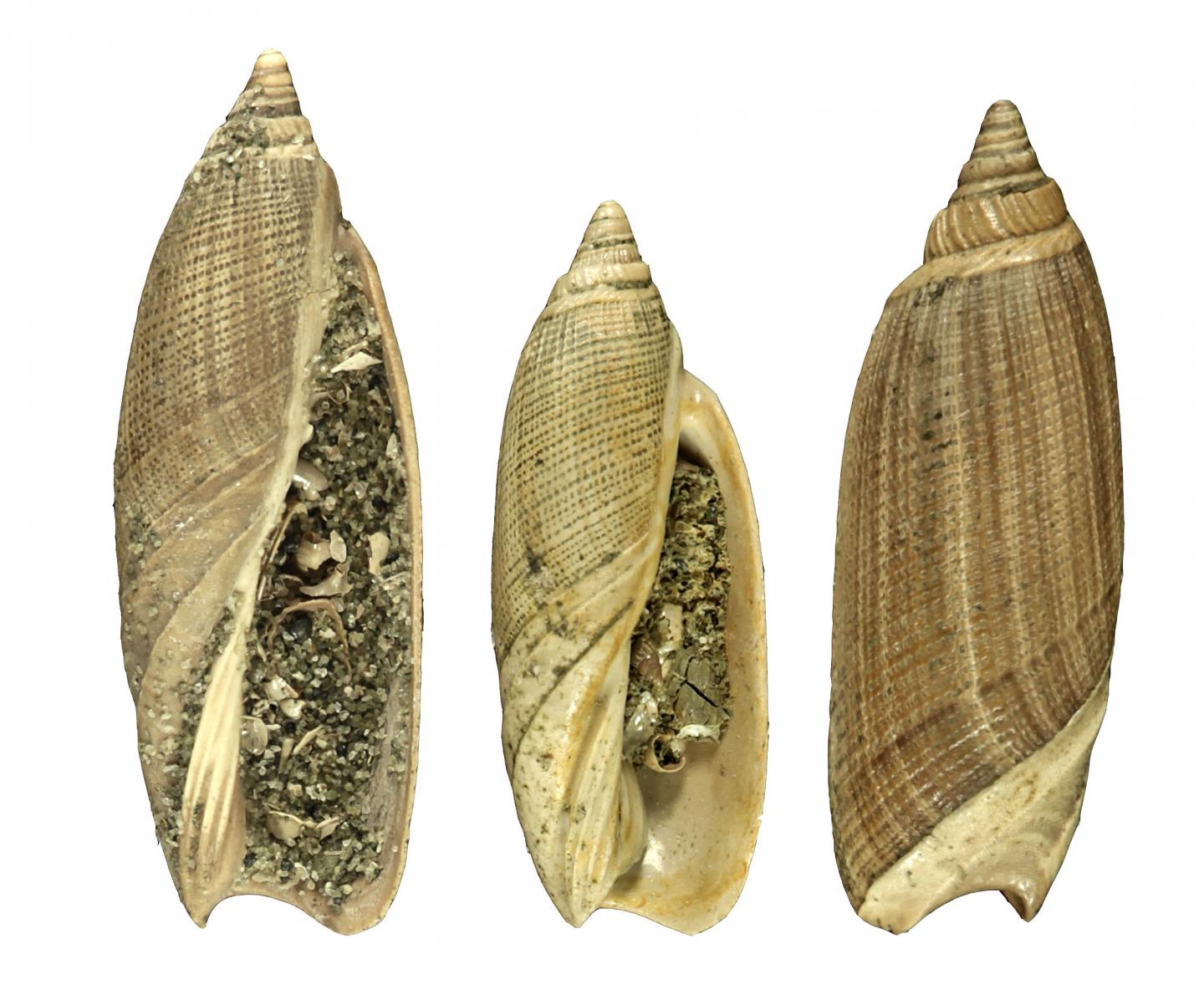
The backbone of the research is Garvie’s personal collection of Gulf Coast mollusk fossils, which he has collected over the past 30 years. He estimates that his collection includes over a quarter million specimens from sites ranging from Texas to Florida on the Gulf Coast and Florida to New Jersey on the Atlantic Coast.
“Being particular about the details, I kept notes of where I got things and I never threw anything away,” Garvie said. “Even if I found 50 of one species, I would keep them all. That turns out to be useful for understanding community evolution and climate change distribution.”
Garvie and Foster met at the Jackson School’s Non-Vertebrate Paleontology Laboratory, the sixth largest paleontological repository in the United States. Garvie’s collection contains specimens from the Cretaceous through the Eocene – a time period starting about 66 million years ago and lasting about 32 million years. It provided a great opportunity to study how periods of climate change during that time impacted mollusk communities.
“This research is a prime example of a scientific study that would not have been possible without a citizen scientist and the excellent collections at the Non-Vertebrate Paleontology Laboratory,” said Martindale.
During the time the research focuses on, the Earth was in a warmer state than it is today, with no large ice sheets covering the poles. Even in this “hot house” state, the period contained multiple temperature spikes that warmed the planet even more. One of these spikes – the Paleocene-Eocene Thermal Maximum (PETM) – occurred about 55 million years ago and is frequently compared to the human-driven climate change happening today. During the PETM, atmospheric carbon dioxide rose rapidly, which in turn caused average global temperatures to rise by 9 to 14 degrees Fahrenheit.
While the PETM led to a decline in coral reef communities and the mass extinction of seafloor dwelling plankton called foraminifera, the Gulf Coast mollusks survived.
“It does highlight that even in events that we think are devastating, there’s still a bit of hope from these resilient communities,” Martindale said.
The scientists found that some mollusk species did go extinct in the 32 million-year period they studied, however they didn’t find any link between those extinctions and temperature spikes, which suggests they were not related to climate change.
While Gulf Coast mollusks made it through the PETM and other temperature spikes unscathed, Foster said that this period of warming may only go so far as an analog for climate change happening today.
The Earth today is in an overall cooler state than it was during the PETM, and temperatures are rising much faster, meaning that mollusks– along with other life– may need to make a larger adjustment to their lifestyles in less time.
“The mollusks that live in the Gulf today are adapted to a colder climate, and the lack of impact in our study differs to projected changes because in the Early Cenozoic, global warming was happening in an already hot world,” Foster said.
Along with climate change, Foster said that Gulf Coast mollusks are facing additional pressure from modern threats of overfishing, pollution, invasive species and loss of habitat, all which have the potential to drive regional extinctions.
###
The research was funded by the National Science Foundation and the Helmholtz Association.
Media Contact
Monica Kortsha
[email protected]
512-471-2241
Original Source
http://www.