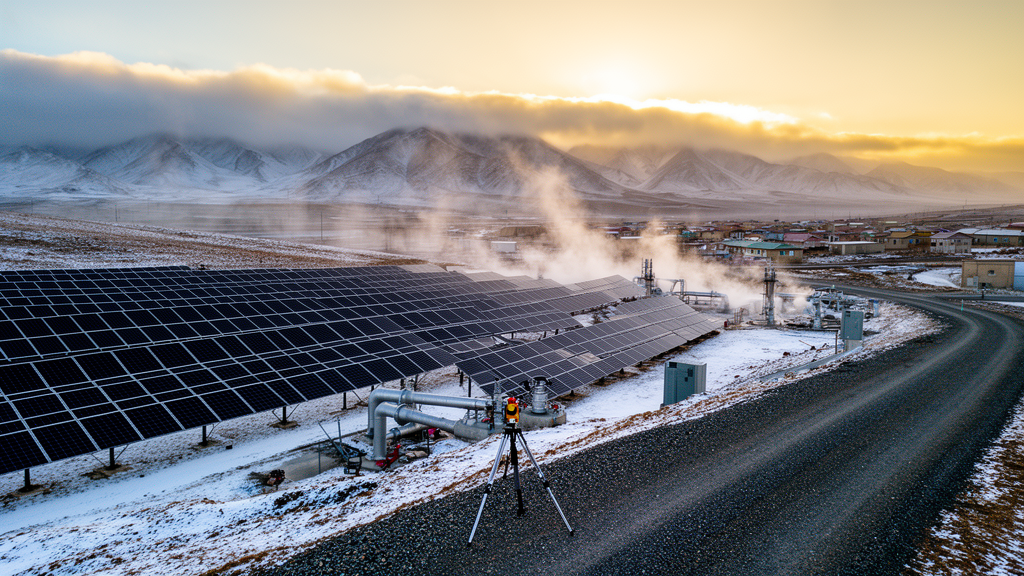
Researchers have assessed where hybrid solar-geothermal power plants could most feasibly be built across three cold-climate provinces in northern Iran, using 17 data layers spanning economic, technical, environmental, and geological criteria within a GIS-based Analytic Hierarchy Process framework to rank land across West Azerbaijan, East Azerbaijan, and Ardabil. Their analysis identifies 1,155.25 square kilometers, or 1.15 percent of the total area of the three provinces, as suitable for combined solar-geothermal development, with an estimated technical energy generation potential of 3,302,987,455 megawatt-hours per year for the three provinces combined.
The study, published in the journal Geothermal Energy, was carried out by Younes Noorollahi, Mohammad Zare, Mohammadali Allahrabbi Shirazi, Hossein Yousefi, and Amir Naseri. Its central innovation, the authors argue, is the simultaneous assessment of solar and geothermal potential in cold regions, incorporating technical and operational considerations that earlier site-selection studies have largely overlooked.
The framework drew on 17 data layers spanning economic, technical, environmental, and geological criteria, producing what the authors describe as a robust and efficient decision-making structure for identifying the best locations for hybrid renewable energy production.
The geographic focus matters. All three provinces sit in cold regions of northwestern Iran, where the combination of solar radiation and geothermal resources presents what the study characterizes as a unique opportunity to capture the complementary benefits of the two renewable sources.
The results were not uniform across the region. East Azerbaijan province showed the highest operational potential for hybrid energy generation, while Ardabil recorded the lowest solar-geothermal energy output of the three. That contrast gives provincial planners a clear hierarchy of where hybrid projects are most likely to succeed operationally.
The authors emphasize that combining the two renewable sources could effectively meet local energy needs, particularly in areas with limited traditional electricity infrastructure.
The study also carries a policy framing. According to the authors, the research provides insights for policymakers and stakeholders in the renewable energy sector and offers a comprehensive framework for optimizing combined solar-geothermal projects that contribute to sustainable energy development in cold regions. The open-access article was published on 21 August 2026 and has already recorded two citations.
Several caveats are worth keeping in view when reading the headline numbers. The 1,155.25 square kilometer figure describes technically suitable area under the criteria and weights the authors chose, not land that has been surveyed, permitted, or reserved for development. The annual generation figure of roughly 3.3 billion megawatt-hours is a technical potential estimate for the three provinces combined, derived from the potential assessment rather than from measured output at operating plants, and actual production would depend on the specific technologies deployed, the geothermal resources confirmed at each site, and the economics of grid connection.
The methodology itself is also assumption-dependent. The authors note that technical and operational aspects of hybrid solar-geothermal systems in cold regions have received less attention in previous studies, which is precisely the gap this framework is designed to address.
Subject of Research: Site suitability mapping for hybrid solar-geothermal power plants in three cold provinces of northern Iran using GIS and the Analytic Hierarchy Process
Article Title: Site suitability assessment for hybrid solar-geothermal energy systems in cold regions using advanced spatial decision-making techniques
Article References: Noorollahi, Y., Zare, M., Shirazi, M. A., Yousefi, H., & Naseri, A. (2026). Site suitability assessment for hybrid solar-geothermal energy systems in cold regions using advanced spatial decision-making techniques. Geothermal Energy. https://doi.org/10.1186/s40517-026-00401-9
Image Credits: AI Generated
DOI: 10.1186/s40517-026-00401-9
Keywords: geothermal energy, solar energy, hybrid power plants, GIS, Analytic Hierarchy Process, site suitability, Iran, East Azerbaijan, Ardabil, renewable energy, cold regions, spatial analysis
News Source: Violet Maxwell. (October 29, 2026). GIS Study Maps Best Sites for Hybrid Solar-Geothermal Plants in Cold Northern Iran. Scienmag.