• HOME
  • NEWS
  • EXPLORE
    • CAREER
      • Companies
      • Jobs
    • EVENTS
    • iGEM
      • News
      • Team
    • PHOTOS
    • VIDEO
    • WIKI
  • BLOG
  • COMMUNITY
    • FACEBOOK
    • INSTAGRAM
    • TWITTER
Tuesday, August 18, 2026
BIOENGINEER.ORG
No Result
View All Result
  • Login
  • HOME
  • NEWS
  • EXPLORE
    • CAREER
      • Companies
      • Jobs
        • Lecturer
        • PhD Studentship
        • Postdoc
        • Research Assistant
    • EVENTS
    • iGEM
      • News
      • Team
    • PHOTOS
    • VIDEO
    • WIKI
  • BLOG
  • COMMUNITY
    • FACEBOOK
    • INSTAGRAM
    • TWITTER
  • HOME
  • NEWS
  • EXPLORE
    • CAREER
      • Companies
      • Jobs
        • Lecturer
        • PhD Studentship
        • Postdoc
        • Research Assistant
    • EVENTS
    • iGEM
      • News
      • Team
    • PHOTOS
    • VIDEO
    • WIKI
  • BLOG
  • COMMUNITY
    • FACEBOOK
    • INSTAGRAM
    • TWITTER
No Result
View All Result
Bioengineer.org
No Result
View All Result
Home NEWS Science News Biology

Fossil expands ancient fish family tree

Bioengineer by Bioengineer
December 19, 2019
in Biology
Reading Time: 2 mins read
0
IMAGE
Share on FacebookShare on TwitterShare on LinkedinShare on RedditShare on Telegram

Second African lungfish found far south
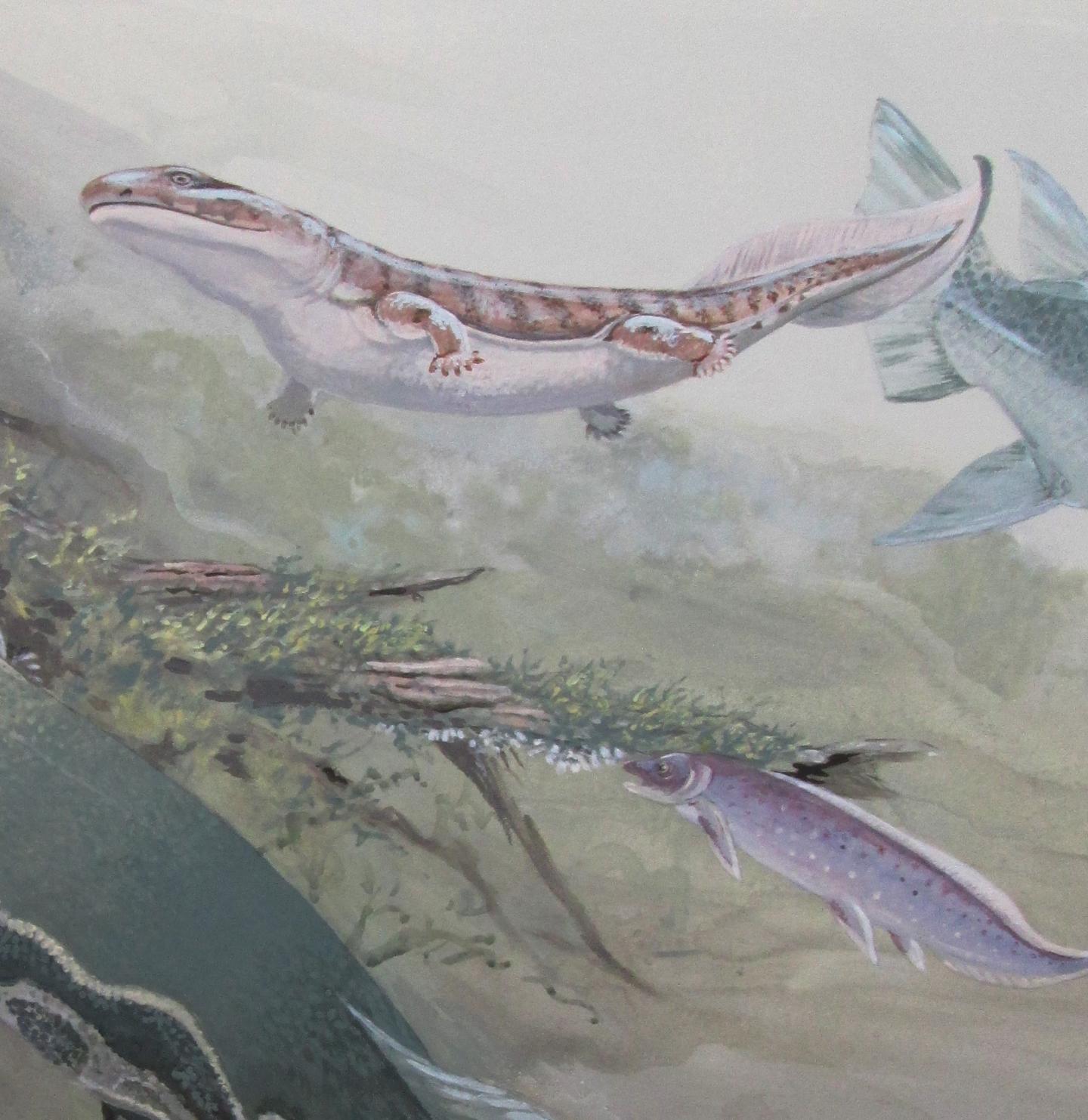
IMAGE

Credit: Artist’s impression by Maggie Newman


A second ancient lungfish has been discovered in Africa, adding another piece to the jigsaw of evolving aquatic life forms more than 400 million years ago.

The new fossil lungfish genus (Isityumzi mlomomde) was found about 10,000km from a previous species described in Morocco, and is of interest because it existed in a high latitude (70 degrees south) or polar environment at the time.

Flinders University researcher Dr Alice Clement says the “scrappy” fossil remains including tooth plates and scales were found in the Famennian Witpoort Formation off the western cape of South Africa.

“This lungfish material is significant for a number of reasons,” Dr Clement says.

“Firstly it represents the only Late Devonian lungfish known from Western Gondwana (when South America and Africa were one continent). During this period, about 372-359 million years ago, South Africa was situated next to the South Pole,” she says.

“Secondly, the new taxa from the Waterloo Farm Formation seems to have lived in a thriving ecosystem, indicating this region was not as cold as the polar regions of today.”

Dr Clement says the animal would still have been subject to long periods of winter darkness, very different to the freshwater habitats that lungfish live in today when there are only six known species of lungfish living only in Africa, South America and Australia.

Isityumzi mlomomde means “a long-mouthed device for crushing” in isiXhosa, one of the official languages of South Africa.

Around 100 kinds of primitive lungfish (Dipnoi) evolved from the early Devonian period more than 410 million years ago. More than 25 originated in Australian (Gondwanan) and others are known to have lived in temperate tropical and subtropical waters of China and Morocco in the Northern Hemisphere.

Lungfish are a group of fish most closely related to all tetrapods – all terrestrial vertebrates including amphibians, reptiles, birds and mammals.

“In this way, a lungfish is more closely related to humans than it is to a goldfish!” says Dr Clement, who has been involved in naming three other new ancient lungfish.

###

The paper, ‘A high latitude Devonian lungfish, from the Famennian of South Africe’ (2019) by RW Gess and AM Clement has been published in PeerJ DOI: 10.7717/peerj.8073

Dr Clement worked with palaeontologist Dr Rob Gess at Rhodes University in Grahamstown, South Africa with a Flinders University Vice-Chancellor’s Award for Early Career Researcher.

Media Contact
Dr Alice Clement
[email protected]
61-422-152-358

Related Journal Article

http://dx.doi.org/10.7717/peerj.8073

Tags: Climate ChangeEarth ScienceEvolutionMarine/Freshwater BiologyPaleontologyPlate Tectonics
Share13Tweet8Share2ShareShareShare2

Related Posts

Scientists map plant-fungus symbiosis at single-cell resolution

Scientists map plant-fungus symbiosis at single-cell resolution

August 18, 2026
One in 20 Australian women now receive intravenous iron infusions

One in 20 Australian women now receive intravenous iron infusions

August 18, 2026

Scientists identify crucial steps that initiate DNA replication

August 18, 2026

Diverse Legume Defence Signals and Clustered Receptors Co-Evolved from Conserved Subtilase Scaffolds

August 18, 2026
Please login to join discussion

POPULAR NEWS

  • Scientists map plant-fungus symbiosis at single-cell resolution

    29 shares
    Share 12 Tweet 7
  • Machine Learning Predicts Microslit Panel Surface Impedance in Grazing Flow

    29 shares
    Share 12 Tweet 7
  • UC San Diego Wins $12.3 Million Grant to Study HIV-Methamphetamine Connection

    29 shares
    Share 12 Tweet 7
  • Engineered Gel Cells Carry Artificial DNA Receptors to Detect and Treat Aflatoxin

    29 shares
    Share 12 Tweet 7

About

We bring you the latest biotechnology news from best research centers and universities around the world. Check our website.

Follow us

Recent News

Scientists map plant-fungus symbiosis at single-cell resolution

Machine Learning Predicts Microslit Panel Surface Impedance in Grazing Flow

UC San Diego Wins $12.3 Million Grant to Study HIV-Methamphetamine Connection

Subscribe to Blog via Email

Enter your email address to subscribe to this blog and receive notifications of new posts by email.

Join 85 other subscribers
  • Contact Us

Bioengineer.org © Copyright 2023 All Rights Reserved.

Welcome Back!

Login to your account below

Forgotten Password?

Retrieve your password

Please enter your username or email address to reset your password.

Log In
No Result
View All Result
  • Homepages
    • Home Page 1
    • Home Page 2
  • News
  • National
  • Business
  • Health
  • Lifestyle
  • Science

Bioengineer.org © Copyright 2023 All Rights Reserved.