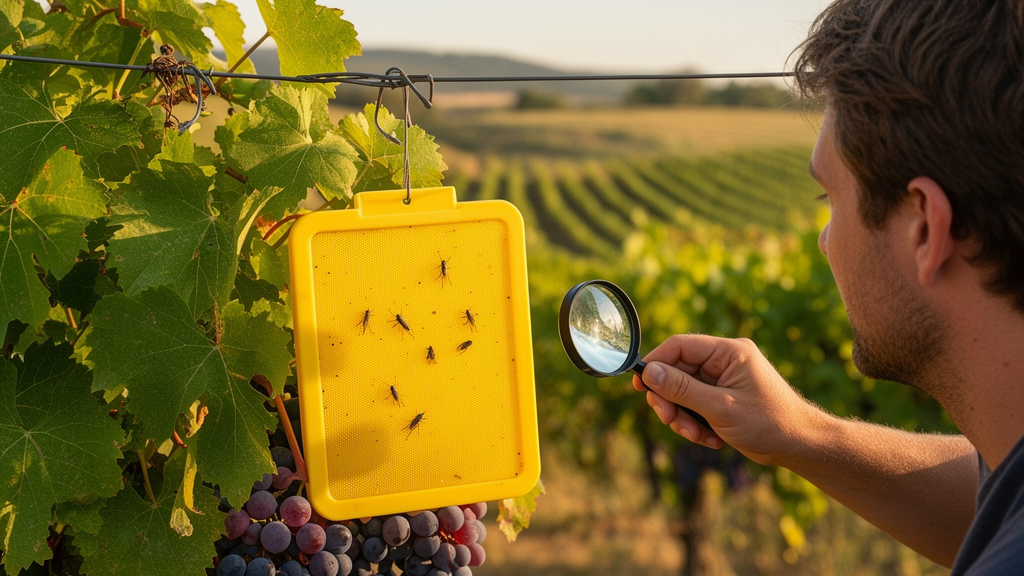
Agricultural engineers and entomologists benchmarking computer vision frameworks have demonstrated that single-stage deep learning detectors can accurately identify insect vectors responsible for transmitting Flavescence dorée phytoplasmas on field-deployed yellow sticky traps. Flavescence dorée represents one of the most economically devastating phytoplasma diseases affecting European viticulture, destabilizing wine production across major growing regions. The disease is caused by phytoplasmas within the 16SrV-C and 16SrV-D subgroups, which are classified as regulated quarantine organisms by the European Food Safety Authority. Because curative antibiotic treatments are prohibited across European agriculture, vineyard management relies almost entirely on uprooting symptomatic vines and enforcing mandatory insecticide applications. These chemical treatments target the primary insect vector, the univoltine leafhopper Scaphoideus titanus, an ampelophagous species native to North America that was first documented in Europe in 1958. In addition to this primary vector, secondary vectors such as the mosaic leafhopper Orientus ishidae have become significant surveillance priorities because they feed on wild reservoir plants along vineyard borders and facilitate landscape-scale pathogen movement.
Vector surveillance serves as a compulsory cornerstone of Integrated Pest Management programs under Commission Implementing Regulation (EU) 2022/1630, requiring extensive deployment of yellow sticky traps across vineyards. In Italy, national decrees mandate the systematic monitoring of adult leafhopper populations within demarcated quarantine zones. This conventional practice creates severe logistical bottlenecks during the critical summer flight period from mid-June to late October, when female leafhoppers deposit sixty to sixty-five eggs. Manual trap evaluation does not scale efficiently to large commercial vineyard areas and is complicated by extreme morphological similarities among co-occurring Cicadellidae species. To resolve these operational constraints, the research team designed an empirical benchmark evaluating modern single-stage object detection architectures to determine whether automated vision pipelines can reliably distinguish Scaphoideus titanus and Orientus ishidae under realistic trap conditions.
The experimental investigation centered on constructing a dedicated visual dataset derived from commercial vineyards located in Piedmont, northern Italy. Field traps were installed during the summer of 2025 across intensive viticultural agroecosystems in Dogliani and Serralunga d’Alba within Cuneo Province, as well as Chieri and Grugliasco within Turin Province. Traps monitored diverse grape cultivars including Dolcetto, Chardonnay, Barbera, Pinot noir, Sauvignon, Moscato, and Nebbiolo. Sampling protocols incorporated two distinct commercial trap designs: large Glutor traps measuring 40 by 25 centimeters and smaller Goldentrap units measuring 16 by 25.5 centimeters. Traps were distributed along vineyard perimeters and interior rows, with border traps receiving particular focus due to adjacent hazelnut groves that harbor elevated densities of Orientus ishidae. Following a standard field exposure period of two weeks, 140 field traps containing confirmed vector specimens were recovered alongside a sweep-net laboratory reference trap assembled with adult leafhoppers arranged in dorsal, ventral, and lateral orientations.
Image acquisition protocols were engineered to capture practical optical variability while maintaining geometric consistency. The researchers constructed a rigid wooden bench structure holding a 16-megapixel GXVISION USB camera module equipped with a Sony IMX298 sensor and a manually focused 6-millimeter fixed M12 lens positioned exactly 7 centimeters above the trap surface. This standardized distance maximized the pixel footprint of small insects within a 7.0 by 5.0 centimeter field of view at resolutions of 640 by 480 and 1280 by 960 pixels. Rather than standardizing illumination, the team intentionally captured images under unconstrained ambient daylight, overhead room lighting, and supplementary lamps to expose algorithms to natural variations in brightness and color saturation. The resulting dataset comprised 1,569 cropped images containing 1,563 labeled individuals of Scaphoideus titanus and 1,572 labeled individuals of Orientus ishidae, spanning varying insect densities, environmental debris, printed text lines, and hanging perforations without artificial digital enhancement.
The benchmarked detection framework focused on one-stage convolutional neural network architectures from the YOLO family, specifically contrasting the established YOLOv8m baseline against newer YOLO11m and YOLO26m variants. Architecturally, YOLOv8 incorporates an anchor-free detection head with a modified CSPDarknet backbone utilizing C2f modules. YOLO11 refines feature extraction through C3k2 and C2PSA attention modules, whereas YOLO26 eliminates head complexity by removing Distribution Focal Loss and non-maximum suppression post-processing in favor of direct bounding box prediction optimized by ProgLoss, STAL loss, and MuSGD. Detectors were trained on an Intel Core i7 system accelerated by an NVIDIA GeForce RTX 3060 Ti GPU running CUDA 11.8. To decouple architectural merits from training anomalies, the researchers applied an identical five-seed training protocol across all configurations, employing an empirically tuned data augmentation regime where saturation adjustments were restricted to preserve subtle leafhopper wing coloration patterns.
Quantitative evaluations across the annotated test partition revealed that all fine-tuned detector configurations delivered robust diagnostic performance, achieving mean Average Precision at 0.50 Intersection over Union above 0.930. The YOLO26m model trained with Stochastic Gradient Descent achieved the highest overall detection accuracy, recording a mean AP at IoU 0.50 of 0.953 (95% CI: 0.932 to 0.974) and a mean AP across IoU thresholds from 0.50 to 0.95 of 0.668 (95% CI: 0.618 to 0.718). In comparison, the widely adopted YOLOv8m architecture demonstrated superior cross-run reproducibility with the narrowest confidence interval for mAP50-95 (mean: 0.652, 95% CI: 0.635 to 0.670) and the highest mean precision of 0.920. Conversely, YOLO26m trained with the AdamW optimizer exhibited wider variance in recall and mAP50-95, demonstrating that optimization dynamics exert a decisive influence on how advanced convolutional backbones adapt to small, domain-specific agricultural datasets.
Species-level performance breakdowns highlighted consistent diagnostic accuracy across target classes, with models generally obtaining slightly higher detection metrics for Scaphoideus titanus than for Orientus ishidae. For Scaphoideus titanus, YOLO26m with SGD reached an AP50 of 0.951 and an AP50-95 of 0.683, while YOLOv8m achieved an AP50 of 0.943 and the highest per-class precision at 0.940. For Orientus ishidae, YOLO26m with SGD attained an AP50 of 0.955 and precision of 0.927. Systematic error inspections indicated that mutual misclassification between the two target vectors was exceptionally rare, with only two reciprocal confusion events identified across the test set. Instead, false positive detections for Orientus ishidae arose primarily when darker non-target arthropods or dark organic particulate debris mimicked the characteristic mottled wing pattern of the mosaic leafhopper. False negatives were predominantly confined to heavily degraded, desiccated insect carcasses lacking diagnostic wings or specimens obscured beneath overlapping debris.
Detailed qualitative comparisons exposed distinct failure modes that differentiate architectural generations. The older YOLOv8m and YOLO11m models occasionally generated duplicate bounding boxes when evaluating clusters of insects in high-density regions, presenting a critical operational limitation for automated counting systems supporting threshold-based pesticide decisions. YOLO11m further displayed dual-class ambiguity, occasionally assigning simultaneous conflicting labels to individual specimens. When scaling down the YOLO26 architecture to lightweight small and nano variants, detection accuracy remained competitive: YOLO26s recorded an mAP50 of 0.948, while YOLO26n registered 0.944, although both compact models exhibited occasional false negative errors on Scaphoideus titanus under bright specular reflections cast by protective plastic wrapping.
To evaluate the feasibility of deploying automated vision systems directly on edge hardware within smart traps or portable field counters, the researchers exported the best-performing YOLO26 models in NCNN format and benchmarked them on Raspberry Pi 4 and Raspberry Pi 5 single-board computers. On the Raspberry Pi 4, inference latency averaged 382.46 milliseconds per frame for YOLO26n (2.61 FPS), 1019.71 milliseconds for YOLO26s (0.98 FPS), and 4060.29 milliseconds for YOLO26m (0.25 FPS). Upgrading to the Raspberry Pi 5 yielded substantial processing gains, reducing inference latency by 4.4-fold for YOLO26n to 87.64 milliseconds (11.41 FPS), 5.1-fold for YOLO26s to 198.05 milliseconds (5.05 FPS), and 6.3-fold for YOLO26m to 648.13 milliseconds (1.54 FPS). Resident RAM utilization scaled predictably with parameter counts, demanding between 770.0 and 943.9 megabytes on Raspberry Pi 5 and between 837.5 and 1143.1 megabytes on Raspberry Pi 4, confirming that lightweight models can run within standard embedded constraints.
The authors contextualized their findings by analyzing methodological validation boundaries, emphasizing that random image-level partitioning introduces an optimistic bias compared to trap-independent grouping. Re-partitioning experiments showed that when all images from specific traps were strictly isolated into the test set, YOLO26m performance settled at an mAP50 of 0.923 and mAP50-95 of 0.657, reflecting the influence of background correlation across crops extracted from the same physical trap. While fixed-distance laboratory photography provided high-resolution feature capture, the authors note that operational field implementation will require automated multi-view scanning mechanisms to achieve full trap coverage without manual intervention. By providing an open-access annotated dataset of verified field specimens, this benchmark establishes an empirical foundation for transitioning Flavescence dorée vector surveillance from laborious manual trap examination to robust, automated edge-computing inspection systems.
Subject of Research: Automated object detection benchmarking for Flavescence dorée insect vectors on vineyard sticky traps
Article Title: Benchmarking one-stage object detectors for field-based detection of Flavescence dorée vectors
Article References: Dho, M., De Luigi, A., Gonella, E., Manduca, G., Romano, D., & Alma, A. (2026). Benchmarking one-stage object detectors for field-based detection of Flavescence dorée vectors. Smart Agricultural Technology, 15, Article 102698. https://doi.org/10.1016/j.atech.2026.102698
Image Credits: AI Generated
DOI: 10.1016/j.atech.2026.102698
Keywords: Flavescence doree, Scaphoideus titanus, Orientus ishidae, yellow sticky traps, YOLO object detection, YOLOv8, YOLO11, YOLO26, precision agriculture, pest surveillance, deep learning, viticulture, computer vision, edge computing, Raspberry Pi, integrated pest management, insect monitoring
News Source: Alan Morgan. (November 12, 2026). Benchmarking Single-Stage Object Detectors for Vineyard Flavescence Dorée Vector Surveillance. Scienmag.