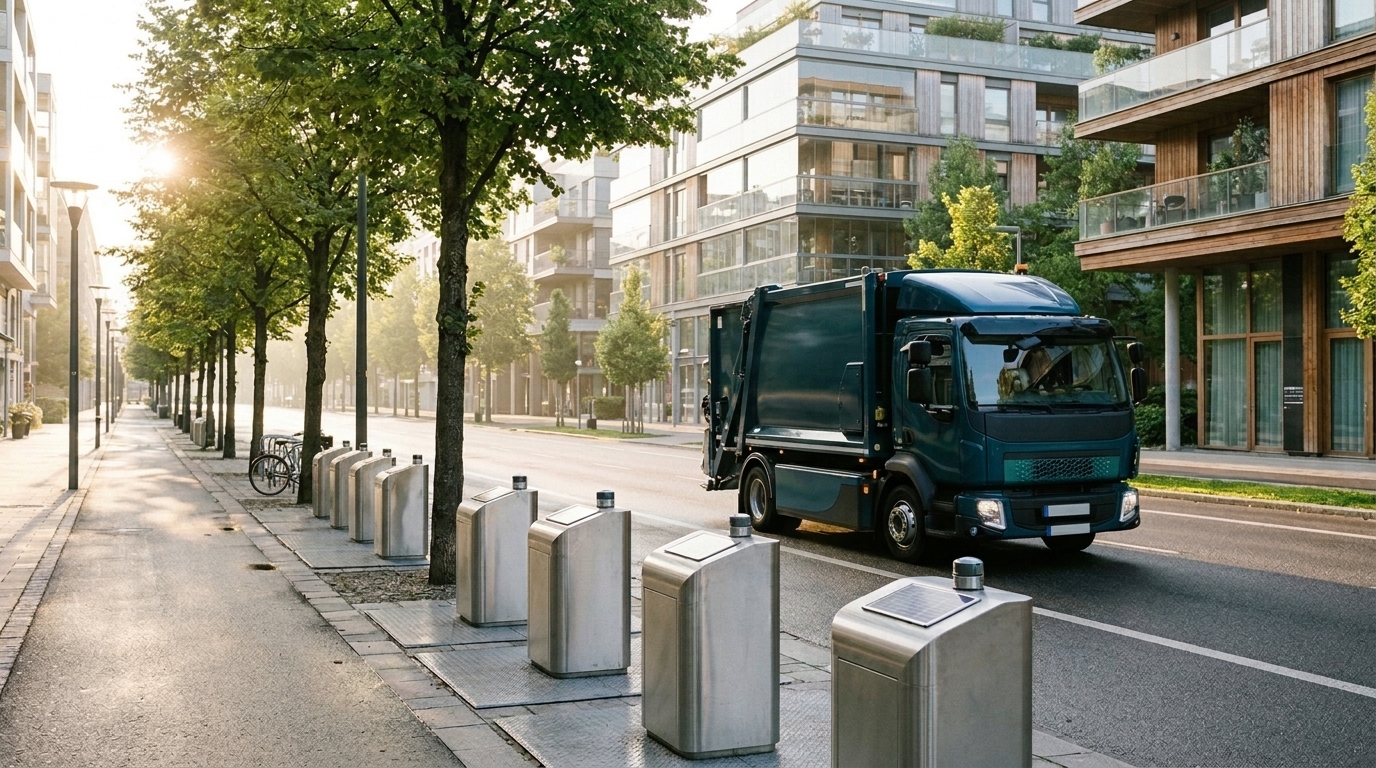
Municipal waste collection in fast-growing cities still runs largely on fixed schedules that ignore what is actually happening inside each bin. Overflowing containers go unserviced while trucks burn fuel visiting half-empty ones, and city administrators lack any accountability signal linking service delivery to need. A research team at Vellore Institute of Technology in Chennai has now designed a three-tier edge, fog and cloud architecture, called SWMS, that aims to close that gap by sensing bin conditions in real time, routing collection vehicles dynamically and layering policy enforcement on top. Crucially, the authors report that every result in their study is computational: no physical prototype was deployed, and all bin data are synthetic.
The system’s smart bins are equipped to measure fill level, methane concentration, temperature and weight. Rather than streaming that telemetry straight to a distant cloud server, the design assigns district-level fog nodes to evaluate alert thresholds and compute collection routes locally. A cloud tier handles the slower administrative work, running a graduated compliance enforcement mechanism and an Eco-Score gamification layer intended to make segregation duties verifiable and reward good behaviour. The authors argue that the problems facing waste management are as much about governance as engineering: statutory segregation duties are unenforceable without an evidentiary base, enforcement instruments are ungraduated, and the distributional burden of service falls invisibly on some neighbourhoods.
Latency is the technical heart of the argument. A seeded Monte Carlo model placed the fog-mediated alert path at 30.9 milliseconds, against 233.1 milliseconds for a cloud-only counterfactual in which every message must traverse the wide-area network. Two discrete-event simulations confirmed that gap. The seven-and-a-half-fold difference matters because methane buildup and fire risk inside bins are time-critical hazards; a cloud round trip measured in hundreds of milliseconds may be too slow to trigger a timely response, whereas a fog node sitting within the district can act almost immediately.
Routing performance was benchmarked against a proven optimal solution. The team’s greedy algorithm followed by 2-opt local improvement closed to within 5.1 percent of the optimum, matching the best tuned metaheuristic while requiring three orders of magnitude less computation. That trade-off is significant for municipal fleets, where route plans must be regenerated frequently as bin states change, and compute budgets at the fog tier are limited.
The headline efficiency figure comes from a service-parity comparison, in which dynamic routing served the same bins as the fixed schedule. Daily collection distance fell by 37.9 percent in the model, and the result was reproduced at 38.7 percent when the routes were tested on an actual OpenStreetMap street network rather than an abstract graph. Scalability analysis showed that computation grows as O(n^1.72) up to 20,000 bins, sub-linear growth that the authors present as evidence the architecture could handle city-scale deployments. Fault injection experiments raised the overflow-alert F1 score from 0.70 to 0.80 even when 50 percent of sensors were faulty, suggesting some resilience to degraded hardware.
The sensor error model deserves particular attention because it was calibrated to real gas-sensor data, even though the bin data themselves are synthetic. This calibration grounds the fault-tolerance results in measured sensor behaviour rather than purely assumed noise. The compliance and gamification layers, by contrast, were implemented but never validated by any user study, a limitation the authors state plainly.
That limitation shapes the study’s most consequential recommendation. Because a non-zero sensor error rate entails a non-zero rate of wrongful penalties, the authors conclude that the compliance layer should first be deployed as a non-penal, evidentiary and advisory instrument rather than a penal one. In other words, sensor readings could document segregation behaviour and inform municipal decisions without automatically triggering fines, at least until the evidentiary chain is proven trustworthy in practice.
The paper situates the design in the public-governance and regulatory-governance literatures and enumerates the obstacles any real deployment would face: statutory authority, due process, administrative discretion, attribution of waste in communal bins, distributive incidence, legitimacy, data protection and municipal capacity. Attribution is especially thorny in apartment blocks where many households share one bin; a sensor can measure the container but not the offender. The authors frame these as governance questions that engineering alone cannot resolve.
For city managers watching the smart-city space, the study offers a quantified case that fog computing can serve time-critical waste alerts far faster than cloud-only designs, and that dynamic routing can meaningfully shrink collection distances in simulation. But the numbers are model outputs, not field measurements, and the governance apparatus built on top of them remains untested with real users. The gap between a 37.9 percent simulated distance saving and a fleet actually redeployed on city streets is exactly where future deployment studies will have to earn their keep.
Subject of Research: A computational three-tier edge, fog and cloud architecture for policy-aware smart waste management with dynamic routing and graduated compliance enforcement.
Article Title: An IoT based three-tier fog computing architecture for policy-aware Smart Waste Management using fog and edge
Article References: Prakash, A. K., Sambath, M., Subramanian, A., & Sethupathy, D. (2026). An IoT based three-tier fog computing architecture for policy-aware Smart Waste Management using fog and edge. Frontiers in Sustainable Cities, 8, Article 1960337. https://doi.org/10.3389/frsc.2026.1960337
Image Credits: AI Generated
DOI: 10.3389/frsc.2026.1960337
Keywords: fog computing, smart waste management, Internet of Things, dynamic vehicle routing, edge computing, smart cities, digital governance, gamification, municipal solid waste, latency, route optimization, sensor faults
News Source: Denise Maddox. (November 5, 2026). Fog computing could cut waste collection routes by nearly 38 percent in simulation. Scienmag.