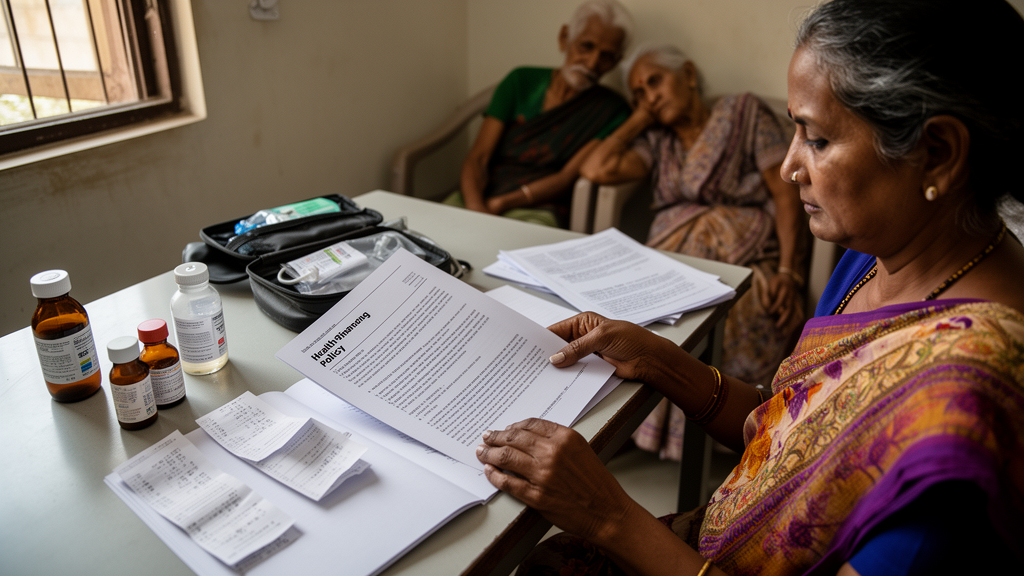
A 2025 revision of the United Nations’ main measure of financial protection in health has substantially changed how households are classified as facing hardship, and a documentary policy brief using India as a case study argues that the change exposes an important measurement problem: national spending ratios, household hardship indicators and measures of care forgone are often treated as interchangeable even though each captures something different. The revised Sustainable Development Goal indicator 3.8.2 now judges out-of-pocket health payments against a household’s discretionary budget, defined as consumption or income remaining after a societal poverty line. Any positive payment by a household at or below that line counts as hardship.
The change was approved by the UN Statistical Commission in March 2025 and applied retrospectively when the 2025 Global Monitoring Report rebuilt the time series. Under the revised definition, the share of the world’s population facing financial hardship in 2019 was 12.7 percentage points higher than the superseded measure had implied. The revision restored, in modified form, a capacity-to-pay approach proposed in 2003: it retained the 40% threshold and the logic of measuring payment against resources left after basic needs, but replaced a food-based subsistence deduction with a societal poverty line and changed the treatment of the poorest households. The policy brief describes this sequence not as definitive convergence on a single true measure, but as a shift in the balance among competing values, including comparability and equity.
The mathematical effect is substantial. Let c represent daily per-capita consumption or income, o out-of-pocket health payment and z the societal poverty line. The revised discretionary budget is d=c−z, and household members are counted when o>0 and o>0.4d. A household at or below the poverty line therefore has a zero or negative discretionary budget, so any positive payment qualifies. In the hypothetical examples used in the brief, a household consuming USD 2.50 per person per day and paying USD 0.10 for health was not counted under the old 10% rule but is counted as impoverishing under the new measure. By contrast, a household consuming USD 12 and paying USD 2, or 16.7% of total consumption, was counted under the old rule but not the revised one because the payment was below 40% of its USD 8.85 discretionary budget. The threshold rises with resources, reaching nearly 40% of total consumption for the best-off households.
India illustrates why the revised household measure cannot be confused with the country’s headline national-accounts ratio. The National Health Accounts estimate of out-of-pocket expenditure as a share of total health expenditure fell from 64.2% in 2013–14 to 39.4% in 2021–22, then rose to 43.4% in 2022–23. These are aggregate ratios describing how the national health bill was financed, not estimates of the number of households whose payments crossed a hardship threshold. In the accounts, government expenditure is part of the denominator, so the ratio can move because public spending changes even when household payments do not. The figures are also presented in nominal national totals, with the out-of-pocket component modelled partly from survey rounds rather than observed annually.
The arithmetic behind India’s 2021–22 low point is important. Published aggregates show household out-of-pocket spending rising from INR 3.28 lakh crore in 2020–21 to INR 3.56 lakh crore in 2021–22 and INR 3.83 lakh crore in 2022–23. The ratio fell in 2021–22 because total health expenditure grew faster than household spending: total health expenditure rose 22.3% and government health expenditure 37.2%. In 2022–23, government health expenditure fell 11.2% and total health expenditure fell 2.6% while out-of-pocket spending continued to grow. India’s health ministry attributes the earlier trough to one-off pandemic response and vaccination outlays. The published series is consistent with that explanation, but the brief does not establish how much of the movement it explains, because it does not calculate a counterfactual, deflate the figures, convert them to real per-person amounts or identify which households paid.
Population-level coverage figures also do not directly measure financial protection. The National Sample Survey 80th round, fielded through 2025, reported insurance coverage of 47.4% of rural people and 44.3% of urban people, compared with 14.1% and 19.1% in 2017–18. The same survey reported a median payment of INR 24,000 across private hospitalisations, excluding childbirth, covering insured and uninsured people; the private-hospital category included hospitals empanelled under government financing schemes. It therefore cannot be interpreted as the payment made by an insured household or as a combined public-and-private figure. The survey also found average hospitalisation payments of INR 6,631 in public facilities and INR 50,508 in private facilities, excluding childbirth; for childbirth, the corresponding amounts were INR 2,299 and INR 37,630, while institutional delivery accounted for 96.2% of births. These findings show that provider type and payment distributions matter, while coverage statistics alone do not reveal whether patients are protected.
The revised indicator also leaves one form of financial hardship largely invisible. Indicator 3.8.2 is built from payments made, so a household that needs care but does not seek it records no expenditure and is not classified as facing hardship. The brief proposes a companion measure among people reporting an ailment: the share who did not obtain care and gave a financial reason, such as treatment costs, transport expenses or lost earnings. Other reasons, including distance, waiting times, quality concerns or a judgement that illness did not require treatment, should be reported separately rather than pooled into a single rate. Such a measure would remain conditional on illness being reported and would miss need that was never perceived or never disclosed, but most national household surveys already collect information on treatment sought and reasons for not seeking it.
India’s survey data show why this missing measure matters while also illustrating its limits. The 2025 round recorded an ailment for 13.1% of people within a 15-day window, compared with 7.5% in 2017–18. The brief cautions that this near-doubling cannot be read as proof of a comparable increase in underlying disease burden: the rounds differed in timing, questionnaire and context, while post-pandemic symptom recognition and contact with the health system may have changed. The comparison is therefore a change in reported illness, not a measured trend in need. Within 2025, urban residents reported more illness than rural residents, 14.9% compared with 12.2%, even though rural residents used public facilities more often when they obtained care. Self-reported morbidity can understate need where expectations are low and overstate it where medical contact is frequent, making it an imperfect denominator for forgone care.
Based on the documentary review, the brief recommends six changes to health-financing measurement, four of which can be implemented with data already collected. Custodian agencies should publish old and revised series together during the transition, and empirical claims should identify the threshold, denominator, indicator version and survey instrument. Statistical offices should report the impoverishing and non-impoverishing components of the revised measure separately. Health ministries and national-accounting agencies should publish real, per-capita out-of-pocket and government health spending alongside the aggregate ratio and flag years containing one-off public outlays. National statistical offices should cross-tabulate insurance status, provider type and payment per episode. A harmonised companion measure of financially attributed forgone care is also recommended, although it requires agreed definitions and reporting periods. The central lesson is that no single headline can establish financial protection: household measures show whether payments caused hardship, national accounts show how the health bill was financed, and forgone-care measures reveal who never paid because they did not obtain treatment.
Subject of Research: Measurement of financial protection, health expenditure and forgone care after the 2025 revision of SDG indicator 3.8.2, illustrated with Indian evidence.
Article Title: Counting what goes uncounted: strengthening measurement of financial protection in health after the 2025 revision of SDG indicator 3.8.2, with evidence from India
Article References: Sriram, S. (2026). Counting what goes uncounted: strengthening measurement of financial protection in health after the 2025 revision of SDG indicator 3.8.2, with evidence from India. Frontiers in Health Services, 6, Article 1955057. https://doi.org/10.3389/frhs.2026.1955057
Image Credits: AI Generated
DOI: 10.3389/frhs.2026.1955057
Keywords: SDG indicator 3.8.2, financial protection, health financing, catastrophic health expenditure, out-of-pocket spending, forgone care, health insurance, India, universal health coverage, health metrics, Counting, goes
News Source: Ophelia Keating. (October 22, 2026). Documentary policy brief finds revised health-financing measures expose hidden hardship in India. Scienmag.