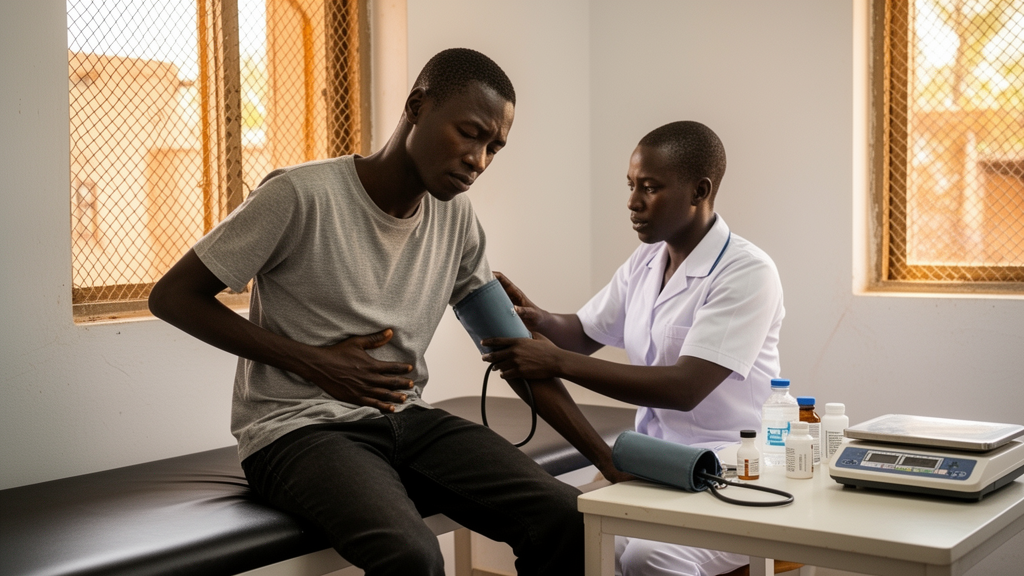
Clinical symptoms were consistently associated with lower quality-of-life scores among 722 people living with HIV receiving care at nine treatment sites in Bamako, Mali, according to a cross-sectional study conducted from January to September 2023. The analysis examined six outcomes: overall quality of life, health perception and four domains—physical health, psychological health, social relationships and environment. Lower income, lack of formal education, marital status, underweight, older age, interruption of antiretroviral therapy and care site were also associated with selected outcomes after correction for multiple testing. Because the study measured participants at one point in time, it cannot establish that these factors caused differences in well-being.
The investigators collected sociodemographic, clinical, therapeutic and laboratory data and assessed quality of life with the World Health Organization Quality of Life HIV Brief instrument, known as WHOQOL-HIV-BREF. Participants had a mean age of 41.0 years, with a standard deviation of 11.9 years, and 78% were women. The mean overall quality-of-life score was 2.6, with a standard deviation of 1.2, while the mean health-perception score was 3.2, with a standard deviation of 1.1. Mean domain scores were 15.7 for physical health, 12.3 for psychological health, 12.9 for social relationships and 11.7 for environment. These results characterize the enrolled population at the participating sites and should not be treated as estimates for all people living with HIV in Bamako.
Six separate multivariable linear regression models were fitted for the six quality-of-life outcomes. The investigators used HC3 heteroskedasticity-robust standard errors and applied the Benjamini-Hochberg procedure globally across coefficient tests to control the false discovery rate. The largest reported difference involving clinical symptoms appeared in the physical-health domain, where the symptom coefficient was −2.61, with a 95% robust confidence interval of −3.13 to −2.10. This model estimate indicates lower adjusted physical-health scores among participants reporting clinical symptoms, although it does not demonstrate that symptoms produced the difference. The consistent association across all six outcomes was a central descriptive result of the study rather than proof of a causal pathway.
Other findings were specific to particular measures. Lower income and lack of formal education were associated with selected quality-of-life outcomes, as were marital status, underweight, older age, interruption of antiretroviral therapy and the site where care was received. These associations survived the study’s false-discovery-rate correction, but that statistical procedure does not remove the possibility of residual confounding or establish why the relationships occurred. The cross-sectional design also cannot determine whether the factors preceded changes in quality of life, accumulated over time or could be altered by changes in treatment and personal circumstances. The scope was further limited to people already receiving care at nine sites, meaning the findings do not directly describe people who were not enrolled in care or those in other parts of Mali.
The results place quality of life alongside clinical outcomes in the assessment of HIV care, with symptoms showing the clearest cross-domain relationship in the dataset. The authors concluded that routine services could benefit from integrating mental-health care, symptom management, nutritional and social support, and interventions that promote sustained antiretroviral therapy use. That conclusion is an implication for service design, not evidence that the proposed combination has already been tested in a trial or shown to improve quality of life in this population. The study instead identifies where associations were observed and where further longitudinal or intervention studies would be needed to address causation.
Subject of Research: Clinical, socioeconomic and treatment factors associated with quality of life among people living with HIV in Bamako, Mali
Article Title: Factors associated with quality of life among people living with HIV/AIDS in Bamako, Mali: a cross-sectional study
Article References: Telly, N., Sogodogo, A., Sangho, O., Diarra, S. S., Coulibaly, C. A., Kéita, S., Dolo, H., Diallo, I., Traoré, A. A., Yanogué, A., Traoré, S., Traoré, M. T., Konaté, M., Kayentao, K., & Doumbia, S. (2026). Factors associated with quality of life among people living with HIV/AIDS in Bamako, Mali: a cross-sectional study. BMC Public Health. https://doi.org/10.1186/s12889-026-30014-7
Image Credits: AI Generated
DOI: 10.1186/s12889-026-30014-7
Keywords: HIV care, quality of life, clinical symptoms, Bamako, Mali, antiretroviral therapy, cross-sectional study, health perception, mental health, nutrition, Factors, associated
News Source: Ophelia Keating. (October 22, 2026). Clinical symptoms linked to lower quality of life among Bamako HIV care patients. Scienmag.