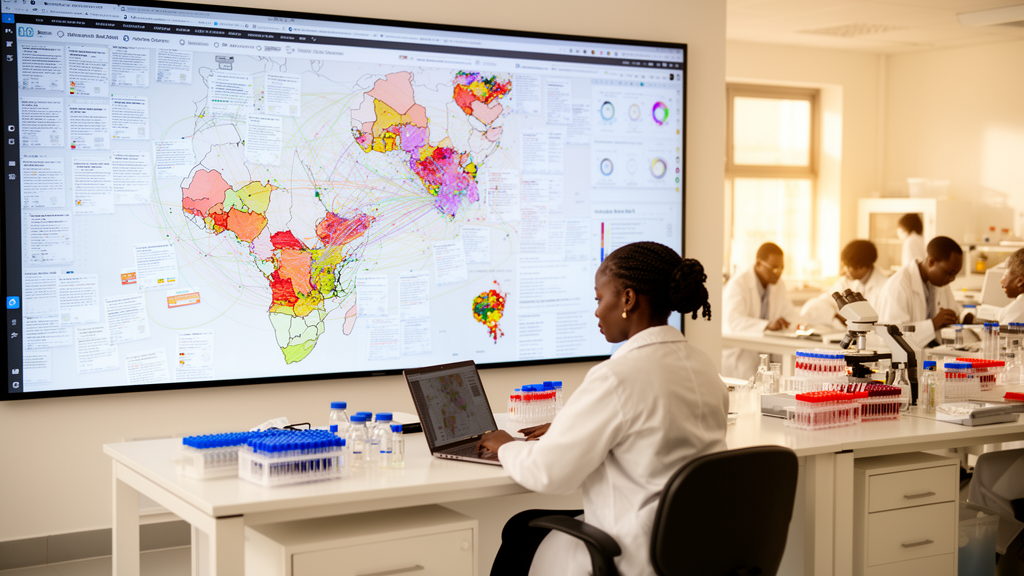
A systematic review found 43 eligible studies that applied artificial intelligence to infectious-disease prediction, management, surveillance or outbreak prediction in Africa between 2015 and 2025. The studies addressed diseases including HIV, malaria, COVID-19 and tuberculosis. South Africa had the largest number of included studies, followed by Nigeria, Uganda, Ethiopia and Tanzania, showing uneven geographic coverage of the research base.
The review, published in BMC Infectious Diseases , aimed to characterize how artificial intelligence has been used in infectious-disease work across Africa and to examine the opportunities and constraints surrounding that use. It included original, peer-reviewed studies in which machine learning or deep learning was used for management, prediction, surveillance or outbreak prediction. Investigators followed PRISMA 2020 guidelines and registered the review on PROSPERO as CRD420251243329.
They searched PubMed, the African Journals Online platform, Scopus, Google Scholar and ScienceDirect. The searches retrieved 5,050 records: 2,551 from PubMed, 2,000 from ScienceDirect, 102 from African Journals Online, 233 from Scopus and 164 from Google Scholar. Of the 5,006 records screened, 43 met the predefined eligibility criteria.
The researchers systematically extracted information on study characteristics, key findings and the performance metrics reported for the artificial-intelligence models. The geographic breakdown showed 10 included studies from South Africa, eight from Nigeria, six from Uganda, five from Ethiopia and four from Tanzania. These counts place the largest share of the eligible evidence in the five most represented countries.
The review therefore documents activity in several parts of Africa, but it does not establish that AI-based infectious-disease research was evenly distributed across the continent or that the included countries represented every national research setting. Random forest was among the most commonly used machine-learning models, alongside support vector machine, artificial neural network and logistic regression. Among the deep-learning approaches, long short-term memory was the most common.
These measures were tied to the models and outcomes reported in each study. The review does not report from the supplied evidence that any one model produced uniformly superior results across infectious-disease prediction, management, surveillance and outbreak forecasting. The authors nevertheless concluded that artificial intelligence is increasingly used for infectious diseases in Africa while remaining underutilized.
They identified constraints involving policy frameworks, health-data quality, digital infrastructure, funding for health systems and research, and governance. In calling for investment and commitments to address these barriers, the review framed artificial intelligence as a developing capability whose wider use depends on structural conditions in data, infrastructure, financing and oversight. Overall, the review identifies 43 studies and 5,050 database records as the basis for its assessment of AI applications in African infectious-disease research.
Subject of Research: Systematic review of artificial-intelligence applications for infectious-disease prediction, management and surveillance in Africa
Article Title: Utilization of artificial intelligence for infectious disease in Africa: a systematic review
Article References: Anulaobi, C. C., Ogaba, A. K., Udoh, I. O., David, P. W., Ozugha, E. P., Nwadike, P. I., Maduka, Y. O., Miller, O. C., Nnana, M. E., & Ajayi, A. O. (2026). Utilization of artificial intelligence for infectious disease in Africa: a systematic review. BMC Infectious Diseases. https://doi.org/10.1186/s12879-026-14276-5
Image Credits: AI Generated
DOI: 10.1186/s12879-026-14276-5
Keywords: artificial intelligence, infectious diseases, Africa, systematic review, machine learning, deep learning, public health surveillance, HIV, malaria, COVID-19, tuberculosis, Utilization
News Source: Blake Davidson. (October 22, 2026). African infectious-disease AI review finds 43 studies, uneven coverage and barriers. Scienmag.