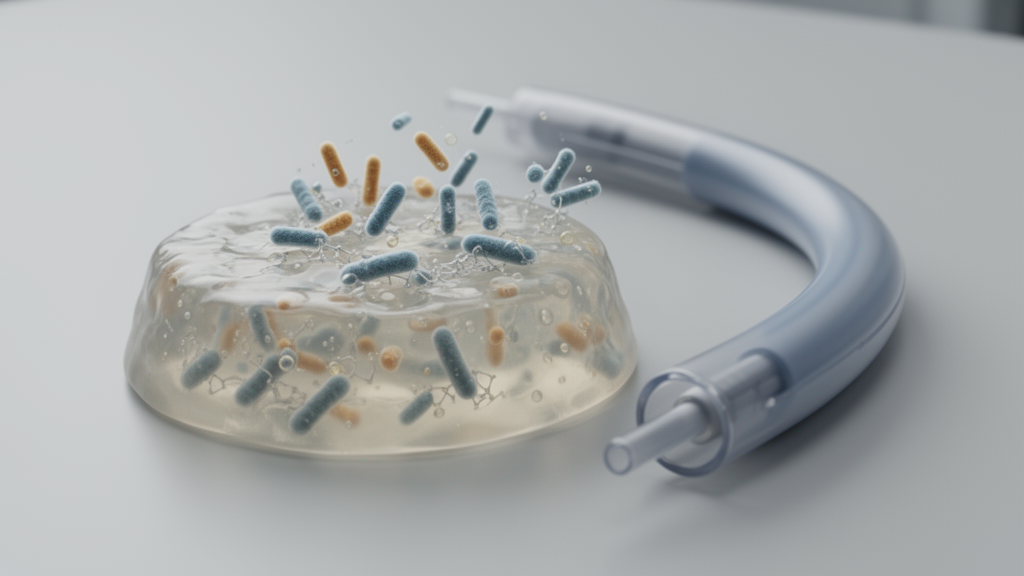
A University of Waterloo team has developed a proof-of-concept hydrogel designed to release bacteriophages in response to a biofilm-associated enzyme, with the long-term aim of controlling catheter-associated urinary tract infections. The system, named HydroGuard, embeds lytic phages in a photocrosslinked gelatin methacryloyl matrix that is intended to degrade when the enzyme GelE is present. In preliminary laboratory tests using an Escherichia coli surrogate, the phage cocktail produced the greatest apparent reduction in visible bacterial growth, while small holes in the gel suggested that enzymatic degradation may have occurred. These observations lacked quantitative bacterial counts and statistical analysis, so the findings establish feasibility rather than therapeutic efficacy against Enterococcus faecalis, the intended target.
HydroGuard was presented as a “HYPOTHESIS AND THEORY” article in Frontiers in Systems Biology, published on 22 October 2026 by Shilpa Rao, Rhyan McLean and Aadila Zakir Hussain. The concept addresses a problem associated with catheter-associated urinary tract infections: microorganisms can adhere to catheter surfaces and form biofilms, microbial communities encased in an extracellular matrix that makes them difficult to eradicate and less susceptible to antibiotics. E. faecalis is a particular concern because it produces GelE, a zinc metalloprotease that promotes biofilm formation and degrades host proteins such as fibrinogen. The proposed delivery system turns that enzyme into a local trigger: GelE-mediated breakdown of the hydrogel would make mobile phages available where biofilm-associated bacteria are present.
The team fabricated the biomaterial by modifying gelatin with methacrylic anhydride to produce GelMA, then combining it with an Irgacure photoinitiator and curing the mixture under ultraviolet light. Preliminary laboratory observations led the researchers to use a GelMA concentration of 15% weight per volume and an initiator concentration of 0.5%. Freeze-dried GelMA was dissolved in phosphate-buffered saline, mixed with the photoinitiator and cured for approximately 25 minutes under a 254-nanometre lamp. Hydrogels were formed in plastic containers measuring 6 by 6 centimetres with a height of 1 centimetre. Phage-containing hydrogels were prepared in 20-millilitre batches, and 100 microlitres of phage mixture was injected just beneath the gel surface with a sterile syringe. This protocol placed the biological cargo near the surface, where it could interact with a developing biofilm, but comprehensive characterization of swelling, pore morphology, rheological properties and microstructural imaging was outside the scope of the concept-validation work.
Four lytic E. coli phages—T2, T4, T7 and lambda vir—were selected for the cocktail, with each strain propagated and checked for infectivity. Clear lysis zones appeared on bacterial lawns, confirming that the phages remained active under the experimental conditions. Genome extraction and restriction digestion generated patterns that matched predictions for T2, T4 and T7, while lambda vir produced weaker but interpretable fragments. These validation steps established that viable phages could be propagated and incorporated into the experimental material. They did not, however, demonstrate activity against native E. faecalis: the selected phages used E. coli as their host rather than the intended clinical target. The researchers stated that testing additional phage combinations would be necessary.
To study the triggering enzyme without directly handling pathogenic E. faecalis, the researchers introduced the gelE gene into a pUC19 plasmid and expressed it in E. coli BL21, using E. coli DH5α during assembly. This Biosafety Level 1 arrangement was intended to emulate GelE activity while providing a proxy for native E. faecalis. The researchers explicitly noted that the surrogate does not reproduce the target bacterium’s physiology, regulation of gelE expression, biofilm composition or interactions with bacteriophages. E. coli biofilms were grown for three days on glass microscope slides at 37 °C under continuous shaking, with the medium replenished daily to create a dynamic environment with shear stress. The slide-based system was likewise described as a prototype rather than a faithful model of a urinary catheter, so its findings were used to assess the concept alongside the computational modelling.
When mature biofilms were placed biofilm-side down against the hydrogels, the systems were held at 4 °C for 24 hours to reduce loss of phage activity. Samples of exposed biofilm material were then serially diluted at 10^-2, 10^-4, 10^-6 and 10^-8 and plated on ampicillin-containing agar, while a hydrogel without phages served as a negative control. T7 alone produced limited visible inhibition, with growth remaining similar to the control, while lambda vir alone appeared more inhibitory but still allowed colonies to develop. The cocktail gave the greatest apparent reduction in visible growth. Biofilm was also observed mainly in the corners of the slides, furthest from the injection site, and the small holes seen in the gel were consistent with possible GelE-driven degradation. Because no quantitative enumeration, biofilm-biomass measurement or statistical comparison accompanied these observations, the result remains qualitative evidence for the proposed mechanism rather than a measurement of antimicrobial efficacy.
Alongside the bench work, the researchers assembled a multiscale computational framework to examine processes that could not yet be measured fully in the laboratory. Its biofilm component represented three phases of E. faecalis colonization on a catheter: attachment, lateral spread and detachment. A Langmuir adsorption model described conditioning-film formation, advection-diffusion represented bacterial transport, and Smoluchowski kinetics captured irreversible attachment. A Fisher–Kolmogorov–Petrovsky–Piskunov reaction-diffusion model then tracked surface biomass density in cells per square centimetre and film thickness in micrometres, while an ordinary differential equation model included erosion and periodic sloughing. The simulation used literature-derived and preliminary experimental parameters where available, while uncertain inputs were examined through sensitivity analyses. This component supplied the environmental context for subsequent simulations of hydrogel degradation and phage availability.
A separate partial differential equation model represented GelE-dependent GelMA degradation and phage diffusion through the hydrated matrix. As the matrix broke down, its geometry and effective diffusivity changed, allowing immobilized phages to become mobile and escape toward an idealized sink at the hydrogel surface. Under the simulated conditions, cumulative phage release reached approximately 10% after ten hours, and increasing enzyme concentrations produced faster release. The predicted curves were biphasic: an initial burst from mobile phages already present in the gel, followed by a slower sustained phase associated with enzymatic matrix degradation. Hydrogel crosslinking density emerged as an important design parameter, with sensitivity analysis revealing a trade-off between structural stability and antimicrobial responsiveness. These release profiles are computational projections and have not yet been experimentally validated.
The hydrogel model was coupled to a modified predator-prey model of phage-bacteria population dynamics, incorporating adsorption, latent period, burst size, phage decay and bacterial growth. Published E. coli parameters were available, whereas several E. faecalis-specific values were not; Monte Carlo analysis therefore sampled biologically plausible ranges through 1,000 simulations. A further set of 500 simulations varied initial bacterial and phage concentrations to calculate bacterial log reduction, the time required to cross a defined infection-related threshold and an overall treatment-success score. Under the simulated release conditions, bacterial concentrations remained above that threshold for less than ten hours. These results identify parameter regions for future experiments, but they do not constitute evidence that HydroGuard would suppress infections in patients. The work as a whole combines preliminary surrogate experiments with models intended to guide optimization of material composition, degradation kinetics and phage-release profiles.
Finally, the team used ProteinMPNN to generate collagen-like peptide variants that could strengthen GelMA while retaining accessible GelE cleavage sites. AlphaFold3 predicted high-confidence folding for repeated GPH units, with pLDDT values above 90, and PyRosetta was used for energy minimization and structural validation. Increasing the sampling temperature to 0.5 and applying a soft bias of 3.0 toward lysine raised the average lysine count from 0.019 to 2.89 residues per sequence, increasing the pool of candidates for methacrylation. After structural and energetic screening, 157 sequences were assessed using degree of methacrylation, collagen-like structure and degradation-potential measures, with rigid, degradable and balanced candidates selected for further study. The integrated work supports an early-stage enzyme-responsive biomaterial rather than an established infection-control method. Direct release testing, quantitative antimicrobial measurement, validation against native E. faecalis and fuller physical characterization remain necessary before the platform’s therapeutic performance can be assessed.
Subject of Research: Prototype enzyme-responsive GelMA hydrogel and computational modelling for bacteriophage delivery in catheter-associated urinary tract infection research
Article Title: HydroGuard: a controlled release hydrogel-phage delivery system to combat catheter-associated urinary tract infections
Article References: Rao, S., McLean, R., & Zakir Hussain, A. (2026). HydroGuard: a controlled release hydrogel-phage delivery system to combat catheter-associated urinary tract infections. Frontiers in Systems Biology, 6, Article 1923468. https://doi.org/10.3389/fsysb.2026.1923468
Image Credits: AI Generated
DOI: 10.3389/fsysb.2026.1923468
Keywords: HydroGuard, catheter-associated urinary tract infections, bacteriophage delivery, GelMA hydrogel, gelatinase GelE, Enterococcus faecalis, biofilms, computational modelling, antimicrobial biomaterials, controlled, release, hydrogel-phage
News Source: Kristina Jarvis. (October 22, 2026). Prototype enzyme-responsive hydrogel embeds phages for catheter-infection research. Scienmag.