Controlled release technology will facilitate medical use of physiologically active gases
Credit: NIMS
NIMS has developed a solid material capable of slowly releasing hydrogen sulfide (H2S) and nitric oxide (NO) when exposed to air. These gases can induce physiologically favorable effects at low concentrations (e.g., reducing inflammation and expanding blood vessels). However, their medical use has been limited due to difficulties in storing them and regulating their concentration. This material can release these gases safely and conveniently and will facilitate their medical use.
Although H2S and NO are toxic at high concentrations, they can generate beneficial physiological effects when used at low concentrations, such as anti-oxidation, reducing inflammation, expanding blood vessels and regulating insulin secretion. Human bodies produce these gases in small amounts to regulate various physiological functions. Medical use of these gases has been drawing a great deal of interest in recent years. For example, a low concentration of NO can be administered by inhalation to patients with severe respiratory failure (e.g., newborns with persistent pulmonary hypertension and acute respiratory distress syndrome) to expand their pulmonary vessels, thereby improving their symptoms. In addition, hot springs containing H2S have long been known to have positive effects on the skin and cardiovascular system, making H2S a potentially promising agent in the types of medicine dedicated to extending healthy life spans. However, the use of these gases has been accompanied by safety concerns and requires a large system equipped with high-pressure gas tanks. To address these issues, efforts have been made to develop solid materials capable of safely and easily storing medically useful gases and releasing them at regulated concentration in the hope of facilitating their medical use.
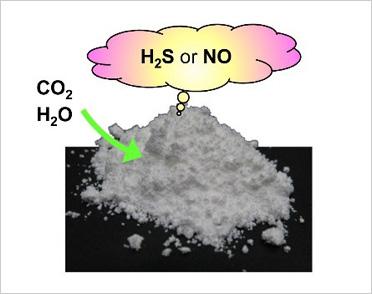
The NIMS research team recently developed a solid material using an inorganic compound called a layered double hydroxide which can slowly release H2S or NO at a desirable concentration when exposed to air. This material is primarily composed of layers of two-dimensional hydroxide nanosheets that contain magnesium (Mg) and aluminum (Al). This research team previously discovered that carbonate ions in the interlayer space of nanosheet layers are actively exchanged with atmospheric carbon dioxide. In this project, the team intercalated gas-source ions to the interlayer spaces and allowed them to interact with atmospheric carbon dioxide and water vapor, yielding H2S or NO gas. The team then adjusted the Mg/Al ratio in the nanosheets, thereby modifying the size of the gap between them. Different gap sizes enabled H2S or NO gas to be released stably at an intended concentration. The team also succeeded in fabricating a portable NO inhaler prototype capable of operating without a power source. This safe material composed of relatively inexpensive and nontoxic ingredients, including Mg and Al, can be kept in good condition by storing it in a gas impermeable bag. This material can be used easily by exposing it to air in a manner similar to using disposable hand warmers.
Through future study, the team is hoping to develop new drugs and medical devices incorporating this material. The use of such products may enable the provision of new health services and emergency medical services, such as making NO inhalation technologies available at home, at various destinations and in developing countries. Moreover, the material structure the team have developed may be applied to the synthesis of new materials capable of releasing other types of functional gases.
###
This research project was carried out by Shinsuke Ishihara (Senior Researcher, International Center for Materials Nanoarchitectonics (MANA), NIMS) and Nobuo Iyi (NIMS Special Researcher, MANA, NIMS). This research was published in Nature Communications, an open access scientific journal, at 10:00 am on January 23, 2020, GMT (7:00 pm on January 23, Japan Time).
Contacts
(Regarding this research)
Shinsuke Ishihara
Senior Researcher,
Frontier Molecules Group,
Nano-Materials Field,
International Center for Materials Nanoarchitectonics (MANA),
National Institute for Materials Science (NIMS)
Tel: +81-29-860-4602
E-Mail: ISHIHARA.Shinsuke=nims.go.jp
(Please change “=” to “@”)
Nobuo Iyi
NIMS Special Researcher,
Soft Chemistry Group,
Nano-Materials Field,
International Center for Materials Nanoarchitectonics (MANA),
National Institute for Materials Science (NIMS)
Tel: +81-29-860-4357
E-Mail: IYI.Nobuo=nims.go.jp
(Please change “=” to “@”)
(General information)
Public Relations Office
National Institute for Materials Science
Tel: +81-29-859-2026, Fax: +81-29-859-2017
Email: pressrelease=ml.nims.go.jp
(Please change “=” to “@”)
Media Contact
Yasufumi Nakamichi
[email protected]
81-298-592-105
Original Source
https:/
Related Journal Article
http://dx.