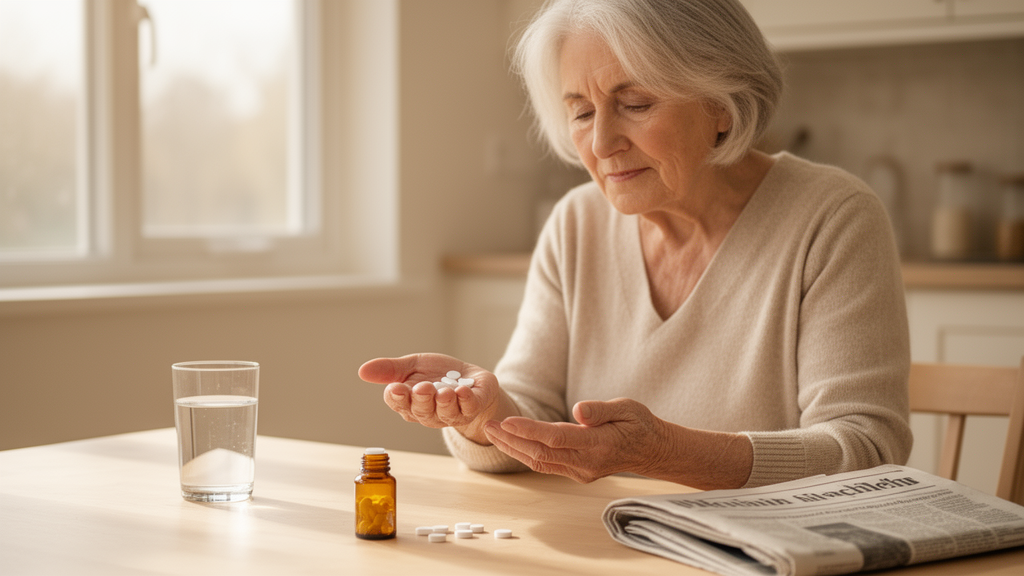
Low-dose aspirin, one of the most widely taken drugs in the world, does not preserve functional capacity in older adults, and in women it may actually accelerate a small decline in the very abilities that define healthy aging. That is the conclusion of a new secondary analysis of the large ASPREE randomized controlled trial, published in GeroScience, in which researchers constructed a composite measure of intrinsic capacity from more than 18,000 trial participants and tracked how it changed over nearly five years of daily aspirin or placebo.
ASPREE originally enrolled 19,114 community-dwelling people aged 65 to 98 who were relatively healthy, free of major physical disability, dementia, and known cardiovascular disease, and randomized them to take either 100 milligrams of aspirin or a placebo tablet every day. The trial’s primary finding, reported previously, was that aspirin did not prolong survival free of dementia and physical disability. Because death, dementia, and disability are late-stage outcomes, the research team asked whether a more sensitive, function-centred measure might reveal effects that the original endpoint missed.
That measure was built on the concept of intrinsic capacity, a framework introduced by the World Health Organization in its 2015 healthy aging report. Rather than counting diseases, intrinsic capacity captures the composite of an individual’s physical and mental abilities across domains that older people value: mobility, cognition, vitality, and psychological well-being. Because the ASPREE trial had not originally planned to measure intrinsic capacity, the investigators repurposed existing trial data to build a modified four-domain index. Cognition came from a battery of tests covering global cognition, episodic memory, language and executive function, and psychomotor speed. Locomotion was measured as gait speed over a timed three-meter walk, vitality as handgrip strength recorded with a dynamometer, and psychological well-being from a short depression scale whose scores were reversed so that higher values always meant better function.
The composite score was calculated annually for 18,581 participants, or 97.2 percent of the trial, with 10,451 females and 8,130 males contributing a total of 31,837 measurements in females and 24,999 in males. Each domain was standardized against the baseline mean and standard deviation, and the index was expressed as an average z-score, with higher scores indicating better functional abilities. Because gait speed and grip strength were not assessed in years one and three of the trial by protocol, values for those years were imputed for individual participants, with sensitivity analyses using only the unimputed data confirming that this choice did not alter the results.
Before testing aspirin, the team validated the index. Baseline chronological age correlated negatively with intrinsic capacity in both sexes, with a correlation coefficient of minus 0.30 in females and males alike. The index also correlated strongly with a 67-item deficit accumulation index that captures multisystem biological aging, at minus 0.56 in females and minus 0.54 in males, an association that remained significant after adjustment for age, education, and race or ethnicity. Among a subsample of 560 Australian participants who provided baseline blood samples, lower intrinsic capacity was associated with accelerated aging on several epigenetic DNA methylation clocks, including PC-PhenoAge, PC-GrimAge, and DunedinPACE, particularly in females, although a recently derived DNA methylation clock designed specifically for intrinsic capacity showed no association. The authors note that the correlation with the deficit index is partly driven by overlapping functional items such as gait speed and grip strength present in both scales.
The clinical validation was equally striking. Over a median of 4.7 years of follow-up, the risk of losing disability-free survival, the composite of death, dementia, and persistent physical disability that served as the trial’s primary endpoint, rose steeply with declining intrinsic capacity. Females in the lowest quintile of baseline intrinsic capacity had a 4.6-fold increased risk compared with those in the highest quintile, with a hazard ratio of 4.62 and a 95 percent confidence interval of 3.16 to 6.75, while males in the lowest quintile had a 4.3-fold increased risk, with a hazard ratio of 4.32 and a confidence interval of 3.42 to 5.48. The association persisted after adjustment for a range of covariates, including frailty.
Against this validated backdrop, the aspirin results were sobering. In sex-stratified linear mixed models, women randomized to aspirin showed a small but statistically significant faster decline in intrinsic capacity compared with women on placebo, with a beta coefficient of minus 0.006 per year and a 95 percent confidence interval of minus 0.010 to minus 0.001, yielding a p value of 0.01. The authors estimate this additional decline as equivalent to roughly one to two months of capacity loss. In men, aspirin had no significant effect on the trajectory of intrinsic capacity, with a beta of minus 0.0004 and a p value of 0.86. Across the full sample, the three-way interaction of sex, treatment, and time did not reach conventional statistical significance, at p equal to 0.06, a nuance the authors report transparently. The findings were consistent in sensitivity analyses that accounted for the competing risk of death, excluded the sparsely attended year seven visit, used unimputed data, or substituted a rescaled 100-point score for the z-score.
Why women might fare worse on aspirin is not settled. The authors point to recognized sex differences in platelet reactivity and in the response to aspirin, with some earlier research suggesting males derive greater benefit from the drug. They also highlight a possible role for hemoglobin. In ASPREE, randomization to aspirin increased incident anemia by 20 percent and was associated with a sharper decline in hemoglobin concentrations, and even mild anemia in older age has been linked in prior studies to reduced functional capacity, weaker grip strength, low mood, and worse cognition. Where sex differences have been examined, the negative impact of anemia has frequently been greater in females. In the Cardiovascular Health Study, for example, lower hemoglobin was associated with lower gait speed and cognitive scores in females only, and a Chinese longitudinal study of more than 4,500 people likewise found anemia linked to worse cognitive performance specifically in women. The authors stress that this mechanism remains a hypothesis rather than a demonstrated cause.
Several limitations deserve emphasis. This was a post-hoc analysis, not a prespecified trial endpoint, and the participants were generally healthy, predominantly white Australians, which restricts generalizability to other populations. The main analysis used a four-domain measure rather than the full five-domain World Health Organization definition, because sensory data on eyesight and hearing were available only at two time points in a subset of 8,368 participants; in that subsample, which had higher baseline capacity than the rest of the cohort, aspirin showed no effect on the five-domain score in either sex. The observed deficit-index correlation is also partly inflated by shared functional components. Subgroup analyses found little evidence of effect modification, with the only significant interaction in females being age group, where women aged 75 to 84 at randomization showed greater aspirin-associated decline.
Nevertheless, the study stands as one of the first large-scale randomized trials to examine a measure of intrinsic capacity, and its message is clear. Low-dose aspirin is not effective at preserving functional capacity in primary prevention among older adults, and in older women it was associated with a small additional decline. The authors conclude that targeting the chronic low-grade inflammation hypothesized to drive capacity decline likely requires more nuanced approaches than broad anti-inflammatory treatment, and that future geroscience trials must incorporate sex-stratified analyses to identify which older adults, if any, stand to benefit.
Subject of Research: The effect of low-dose aspirin on intrinsic capacity and healthy aging in older males and females
Article Title: Validation of an intrinsic capacity index and the effects of aspirin in older males and females: secondary analysis of a randomized controlled trial
Article References: Ryan, J., Phyo, A. Z. Z., Wieczorek, M., Espinoza, S., Woods, R. L., Owen, A., Sheets, K., Orchard, S. G., Wolfe, R., Ekram, A. R. M. S., Horvath, S., Murray, A., & Bischoff-Ferrari, H. A. (2026). Validation of an intrinsic capacity index and the effects of aspirin in older males and females: secondary analysis of a randomized controlled trial. GeroScience. https://doi.org/10.1007/s11357-026-02624-x
Image Credits: AI Generated
DOI: 10.1007/s11357-026-02624-x
Keywords: aspirin, intrinsic capacity, healthy aging, ASPREE trial, randomized controlled trial, epigenetic clocks, disability-free survival, inflammaging, sex differences, geroscience, older adults, primary prevention
News Source: Beatrice Stafford. (October 29, 2026). Daily aspirin fails to preserve healthy aging and may slightly worsen it in older women. Scienmag.