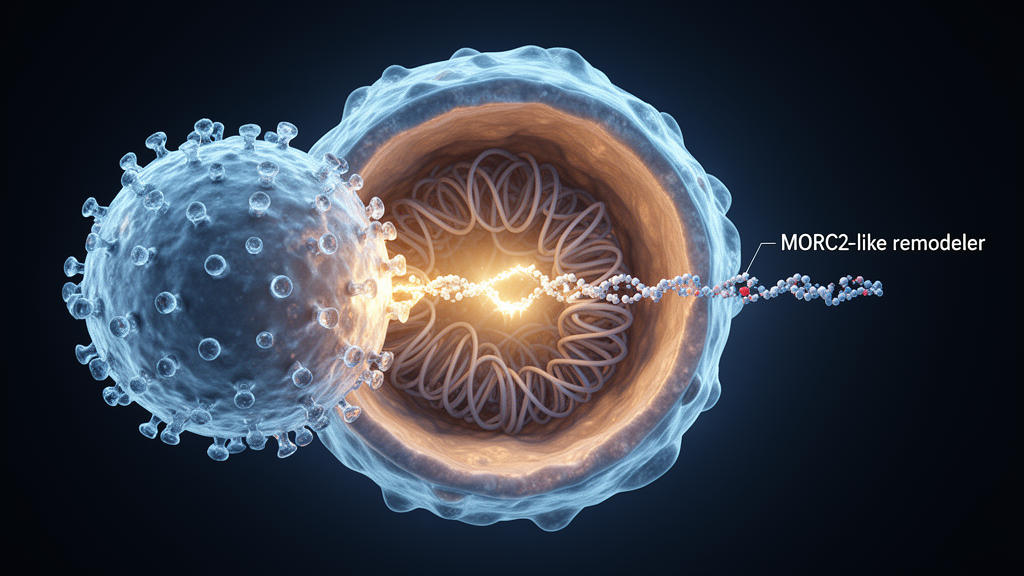
Human cytomegalovirus, one of the most widespread herpesviruses in the human population, has long been known to manipulate the cells it infects with remarkable sophistication. A new study published in PLOS Pathogens reveals an unexpected dimension of this manipulation: the virus recruits a host protein called MORC2, a chromatin remodeling enzyme, to help it mount a DNA damage response on its own genome. The finding, reported by Jiseok Jeong, Dongjoon Jeong, Sungwon Lee, Junhyun Park, Hyewon Kim and Kwangseog Ahn, offers a mechanistic explanation for how a large DNA virus manages the replication stress that threatens the integrity of its genetic material during the productive phase of infection.
Human cytomegalovirus, abbreviated HCMV, carries a double-stranded DNA genome of approximately 230 kilobase pairs, making it one of the larger viral genomes that replicates inside human cells. During lytic infection, when the virus actively produces new progeny, this genome is copied repeatedly and at high speed, a process that inevitably generates DNA lesions and replication-associated stress. Because HCMV does not encode a canonical set of DNA repair enzymes of its own, it must depend on the DNA damage response machinery of the host cell to keep its genome in a replicable state. How the virus directs host repair proteins specifically to its own DNA, rather than allowing them to disperse across the cellular genome, has remained a poorly understood question in virology.
The new work identifies MORC Family CW-type zinc finger 2, or MORC2, as a central player in answering that question. MORC2 is a host chromatin remodeler, an ATP-consuming enzyme that alters the packaging of DNA around histone proteins and thereby changes how accessible specific stretches of chromatin are to the proteins that act on them. The researchers found that HCMV infection induces the expression of MORC2 in infected cells, and that this induction is not incidental. When MORC2 was depleted, viral DNA replication became less efficient and the production of progeny virus dropped, indicating that the protein provides a tangible benefit to the viral life cycle.
A key observation of the study concerns the localization of MORC2 during infection. In uninfected cells, MORC2 is distributed in a pattern associated with its normal chromatin-related functions. Upon HCMV infection, however, the protein redistributes to viral replication compartments, specialized nuclear structures where viral genomes accumulate, are copied and are packaged into new virions. This relocalization places MORC2 physically at the sites where viral DNA is most vulnerable to damage and where the DNA damage response must be deployed if replication is to continue without catastrophic genome failure.
The mechanistic detail that emerges from the study is that MORC2 acts on the architecture of viral chromatin itself. Using its ATPase activity, the energy-consuming motor domain characteristic of this family of remodelers, MORC2 enhances the accessibility of viral chromatin. In practical terms, the viral genome, which is coated with nucleosomes and otherwise relatively compacted, becomes more open in the presence of active MORC2. This opening has a downstream consequence that lies at the heart of the paper: it facilitates the accumulation of gamma-H2AX, the phosphorylated form of histone variant H2AX that serves as the canonical beacon of DNA double-strand breaks and the organizing signal for the cellular damage response.
Gamma-H2AX is more than a passive marker. Its accumulation over damaged DNA creates a platform onto which repair factors are recruited, forming foci that coordinate sensing, signaling and repair of lesions. The researchers showed that MORC2-dependent chromatin opening at viral replication compartments facilitates the recruitment of these DNA repair factors to the viral genomes. In other words, the virus appears to use a host remodeling enzyme to prepare its own chromatin so that the damage response can be efficiently installed exactly where it is needed. Without MORC2, the signaling cascade on viral DNA is weakened, and the consequences for viral replication and progeny production follow directly.
Perhaps the most intriguing part of the study concerns how MORC2 is delivered to the viral replication compartments in the first place. The authors found that HCMV UL112-113, a viral locus whose products are known to participate in the early assembly of replication compartments, mediates a process of phase separation that facilitates MORC2 recruitment. Phase separation is a physical phenomenon in which proteins and nucleic acids condense into membrane-less compartments, a mechanism increasingly recognized as a general principle of cellular organization. In the context of HCMV infection, UL112-113-driven condensates appear to concentrate MORC2 within the viral replication compartments, ensuring that the remodeler acts preferentially on viral rather than host chromatin.
This recruitment mechanism ties together several threads of modern virology and cell biology. Large DNA viruses such as HCMV must build dedicated nuclear factories for genome synthesis, and phase-separated condensates have emerged as a structural principle of these factories. The new findings suggest that such condensates do more than concentrate viral replication proteins; they also serve as docking environments for host factors that the virus needs, in this case a chromatin remodeler that tunes the physical state of viral DNA. By coupling condensate formation to the recruitment of MORC2, the virus achieves a degree of selectivity that would otherwise be difficult to explain, given the enormous excess of host chromatin in the infected nucleus.
The broader significance of the work lies in the framework it provides for understanding how DNA viruses cope with replication stress. Rather than encoding its own repair machinery, HCMV appears to have evolved to co-opt host chromatin dynamics, converting a general host stress response into a virus-supportive program. The authors describe this as a mechanistic framework for how DNA viruses alleviate replication stress by hijacking host chromatin remodelers. Because MORC2 is required for efficient viral DNA replication and progeny production, the protein also emerges as a potential point of vulnerability for antiviral intervention, although the study itself is framed as basic mechanistic biology rather than therapeutic development.
For the field of herpesvirus biology, the study adds MORC2 to a growing list of host chromatin-associated factors whose services are enlisted by HCMV, and it connects the viral DNA damage response to the physical organization of replication compartments through phase separation. It also raises questions that future work will need to address, including which specific repair pathways are loaded onto viral genomes downstream of MORC2-mediated chromatin opening, and whether other DNA viruses deploy comparable strategies to remodel their chromatin during infection. What is already clear from the present findings is that the boundary between viral and host genome management is far more permeable than a simple list of viral genes might suggest, and that a 230-kilobase viral genome depends, in part, on the remodeling activities of the very cell it infects.
Subject of Research: How human cytomegalovirus recruits the host chromatin remodeler MORC2 to activate the DNA damage response on viral genomes during lytic infection.
Article Title: Human cytomegalovirus exploits host chromatin remodeler MORC2 to promote the DNA damage response on viral genomes
Article References: Jeong, J., Jeong, D., Lee, S., Park, J., Kim, H., & Ahn, K. (2026). Human cytomegalovirus exploits host chromatin remodeler MORC2 to promote the DNA damage response on viral genomes. PLOS Pathogens, 22(10), e1014693. https://doi.org/10.1371/journal.ppat.1014693
Image Credits: AI Generated
DOI: 10.1371/journal.ppat.1014693
Keywords: human cytomegalovirus, MORC2, chromatin remodeling, DNA damage response, viral replication compartments, gamma-H2AX, phase separation, UL112-113, herpesvirus, replication stress, PLOS Pathogens, viral chromatin
News Source: Kristina Jarvis. (October 14, 2026). Cytomegalovirus Hijacks Host Chromatin Remodeler MORC2 to Fuel Viral Genome Repair. Scienmag.