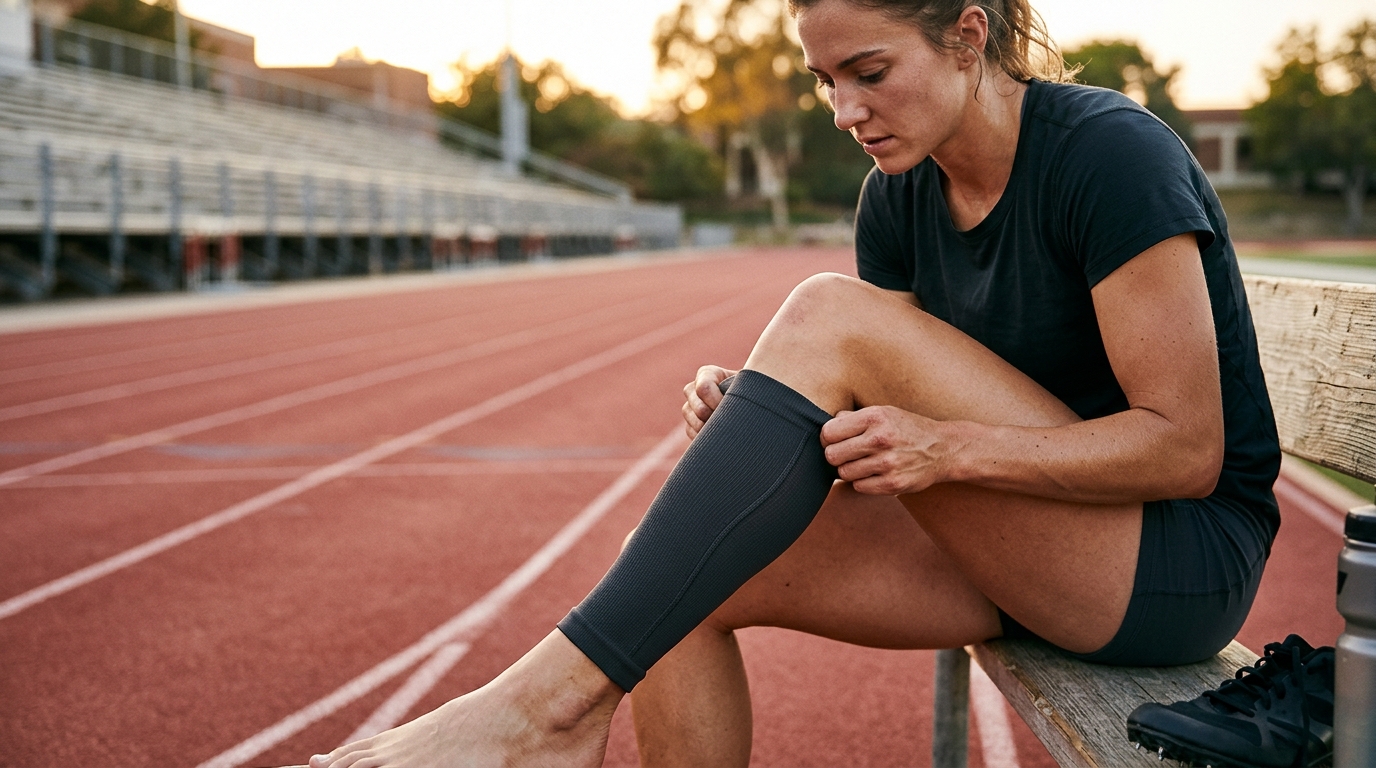
A compression sleeve designed specifically for female collegiate athletes, with silicone striping inspired by kinesiology tape, failed to deliver measurable short-term gains in strength, jump performance, or power in a pilot study, even though the athletes who wore it consistently praised its comfort and usability. The findings, published in the journal Fashion and Textiles, come from a team at the University of Delaware that combined textile engineering, garment construction, and athlete feedback in a single user-centered development process aimed at addressing hamstring muscle soreness in female NCAA athletes.
The study began with a survey of 34 female NCAA athletes, either actively competing at the University of Delaware or graduated within the previous one to two years, to identify what they actually wanted from a recovery garment. Most respondents, 79 percent, were actively competing, and 86 percent reported at least three years of competitive participation. A striking 85 percent reported experiencing delayed onset muscle soreness, or DOMS, in the hamstrings after training or competition, with symptoms typically lasting three to four days and rated as moderate in intensity at a mean of 5.3 on a 10-point scale. During episodes of hamstring soreness, the athletes most frequently cited feeling more prone to injury, at 40 percent, difficulty maintaining consistency in practice, at 38 percent, and reduced recovery between repetitions, at 35 percent, as their key concerns. Quadriceps soreness was nearly as common, reported by 79 percent of respondents, with a mean pain rating of 5.7 out of 10.
When asked to rate desired compression sleeve characteristics, the athletes placed the greatest importance on durability, with a mean rating of 8.38, followed by lightweight construction at 6.76, high stretch at 6.62, and breathability at 6.48. Current approaches to managing soreness relied primarily on passive methods applied outside of practice, including rest at 77 percent, foam rolling at 74 percent, and stretching at 69 percent, pointing to what the researchers identified as an unmet need for wearable recovery solutions that could be integrated directly into athletic routines rather than used only afterward.
Those survey priorities were translated into measurable textile performance parameters. Five candidate performance fabrics commonly used in compression apparel were evaluated under standard laboratory conditions of 21 plus or minus 2 degrees Celsius and 65 plus or minus 2 percent relative humidity. Thickness was measured according to ASTM D1777, fabric mass per unit area followed ASTM D3776, and air permeability was assessed under ASTM D737 using an automatic tester maintaining 200 Pa of pressure over a 20 square centimeter test area, with ten measurements recorded per fabric. Tensile behavior was measured on a benchtop testing system following ISO 13934, with five specimens per fabric cut in the wale direction and tested at a crosshead speed of 100 millimeters per minute. A one-way ANOVA found that fabric type had a significant effect on all measured performance variables.
Among the five materials tested, the spacer scuba knit stood out with the greatest thickness at 1.3 millimeters and high elongation at 433 percent, indicating a favorable balance between structural support and extensibility. Superflex heavy compression spandex also performed well, showing low air permeability of 135.87 millimeters per second and the highest elongation value at 463.08 percent. After comparing the leading candidates, the researchers selected spacer scuba knit for prototype development, citing not only its mechanical performance but also a more favorable hand-feel considered important for comfort during repeated wear and athletic movement. The choice reflected a deliberate trade-off, since greater fabric thickness can improve the durability of knit materials even as knitted constructions are often associated with lower durability than woven ones.
The resulting prototype incorporated an elastomeric silicone striping applied to the inner surface of the sleeve along the hamstring contact area, an attempt to embed the directional support principles of kinesiology taping directly into a reusable garment rather than relying on single-use adhesive tape. Six prototypes were assembled in small, medium, and large sizes for the right and left legs, with a 4-inch wide sew-on Velcro strip for adaptable fastening and edges finished with 1-inch wide fold-over elastic trim. Kinesiology tape, introduced by Dr. Kenso Kase in the 1970s, is applied along the path of specific muscles and can stretch considerably while remaining adhered to the skin, moving with the body during activity. Prior studies have suggested that taping may reduce DOMS-related pain and improve strength recovery following strenuous exercise, though findings vary across protocols and populations, and tape applications are typically temporary, dependent on correct placement and tension, and generate considerable material waste over repeated use.
To evaluate the design, eight athletes who had completed the initial survey volunteered for four repeated sprint testing sessions separated by 24-hour intervals, with all procedures approved by the University of Delaware Institutional Review Board. Each session began with a standardized warm-up adapted from typical track-and-field routines, including a five-minute self-paced jog, dynamic mobility drills, and running drills such as high knees, butt kicks, A-skips, and B-skips performed in place for approximately 20 seconds each. Participants then donned the compression sleeve on a leg assigned through computerized randomization, while the opposite limb served as the control condition in a within-subject design. The sprint protocol was designed to simulate high-intensity interval training conditions common in collegiate athletics: fifteen 30-meter maximal sprints departing every 65 seconds, followed immediately by a 90-degree squat hold for ten seconds to further engage the lower-extremity musculature.
Functional performance was assessed through three measures of lower-extremity performance: an isometric hamstring strength test and an isometric quadriceps strength test using a wireless handheld dynamometer, and the Sparta single-leg jump test recorded with force plate software, which calculated jump height in inches and maximal power output normalized to body mass in watts per kilogram. Compression pressure applied by the garment was monitored with a pneumatic pressure sensor placed beneath the sleeve at the midpoint of the posterior thigh, yielding an average of 10.12 mmHg with a standard deviation of 1.25 mmHg, near the upper end of the range suggested in prior literature for comparable applications. The eight participants ranged in age from 21 to 23 years, seven had NCAA track and field experience, and one had competed in collegiate rowing. Their mean height was approximately 169 centimeters and mean body mass 64 kilograms. No adverse effects related to sleeve wear, including skin irritation or discomfort, were reported.
The quantitative results were unambiguous in one direction. A series of between-subjects ANOVAs indicated no statistically significant differences between the compression-sleeve and control conditions for any measured outcome: hamstring peak force, F(1,14) = 0.486, p = .497; quadriceps peak force, F(1,14) = 0.082, p = .779; jump height, F(1,14) = 0.075, p = .788; and maximum power, F(1,14) = 0.162, p = .693. All p-values exceeded .05 and the effect sizes were small. Bonferroni-adjusted pairwise comparisons supported these findings, with mean differences between the compression-sleeve and control legs not statistically significant for any variable, and all 95 percent confidence intervals included zero. A paired-samples t-test comparing perceived soreness between the sleeved and control legs similarly found a mean difference of 0.06 with a 95 percent confidence interval of -1.21 to 1.34, not statistically significant, t(7) = 0.116, p = 0.911, indicating that the prototype did not produce a measurable reduction in perceived soreness relative to the control condition.
Yet the qualitative picture was more nuanced. Participants rated the ease of independently donning the sleeve at a mean of 1.13 on a 10-point scale where 1 meant extremely easy, indicating the sleeve was generally simple to apply. Fabric comfort while running averaged 7.0 on a scale from 1, very uncomfortable, to 10, very comfortable, and all participants reported that the sleeve did not inhibit their running. Ratings for compression tightness averaged 5.25, suggesting the sleeve was perceived as appropriately snug, though some participants noted slippage during use. Several athletes described the sleeve as comfortable, adjustable, and easy to wear, and some perceived less soreness in the leg wearing the prototype. One participant who wore the sleeve on her left leg reported by the fourth session that her right hamstring, the one without the sleeve, was definitely still more sore than the left. The researchers noted that these reports were not reflected in the statistical findings but suggest that some athletes perceived a recovery-related benefit associated with sleeve wear, consistent with prior work showing that athletes often report positive subjective experiences with compression garments even when objective physiological outcomes are limited or inconsistent.
The authors attribute the absence of measurable effects to several factors. The silicone treatment did not fully reproduce the surface adhesion or mechanical behavior of traditional kinesiology tape, likely contributing to bunching, slippage, and uneven surface behavior during use. The mean pressure of approximately 10 mmHg was near the lower end of the recommended range for thigh compression and may have been insufficient to affect muscle oscillation, venous return, or force output in a detectable way. The sprint protocol may not have produced a sufficiently strong or consistent soreness response in this trained population, and acute performance testing may not capture longer-term or cumulative recovery benefits that could emerge with repeated use. The small sample size limited statistical power and reduced generalizability, and participants’ familiarity with sprint training may have reduced the protocol’s effectiveness as a DOMS stimulus. Some observed improvements between early sessions may have reflected growing familiarity with the testing procedures rather than true recovery effects. The method used to create the tape-inspired internal treatment was experimental and not fully standardized, applied with a cotton swab to produce a textured rather than smooth surface that may have affected both comfort and performance.
Despite the null results, the study establishes the feasibility of integrating textile testing, garment development, and athlete feedback within a single user-centered design process for a population that remains understudied. Prior research suggests that kinesiology taping may reduce muscle soreness, supporting the broader design premise that a better-optimized compression sleeve could potentially deliver related benefits if its mechanical action is more effectively engineered. Because kinesiology tape is typically single-use, a reusable garment-based alternative may offer a more sustainable approach to recovery support. The study also adds to the still-limited body of research examining recovery interventions specifically for female athletes, contributing to more sex-specific approaches to apparel design, training support, and rehabilitation. Future prototypes should explore graduated compression profiles, region-specific pressure zoning, and sizing systems based more directly on thigh morphology rather than generalized apparel sizing, along with stronger DOMS induction protocols, longer follow-up periods, and larger participant samples. The findings may also help coaches, trainers, and athletes form more realistic expectations about the role of compression garments in DOMS management and encourage more evidence-based use of recovery products.
Subject of Research: Development and evaluation of a user-centered hamstring compression sleeve for recovery in female NCAA athletes
Article Title: Addressing hamstring muscle soreness in female NCAA athletes: design and evaluation of a user-centered compression sleeve for recovery
Article References: Megivern, S., & Gorea, A. (2026). Addressing hamstring muscle soreness in female NCAA athletes: design and evaluation of a user-centered compression sleeve for recovery. Fashion and Textiles, 13(1), Article 21. https://doi.org/10.1186/s40691-026-00471-0
Image Credits: AI Generated
DOI: 10.1186/s40691-026-00471-0
Keywords: compression sleeve, female NCAA athletes, delayed onset muscle soreness, kinesiology taping, textile testing, user-centered design, hamstring recovery, spacer scuba knit, sports apparel, pilot study, elastomeric striping, repeated sprint protocol
News Source: Denise Maddox. (November 5, 2026). Compression sleeve for female NCAA athletes eased soreness perceptions but not performance. Scienmag.