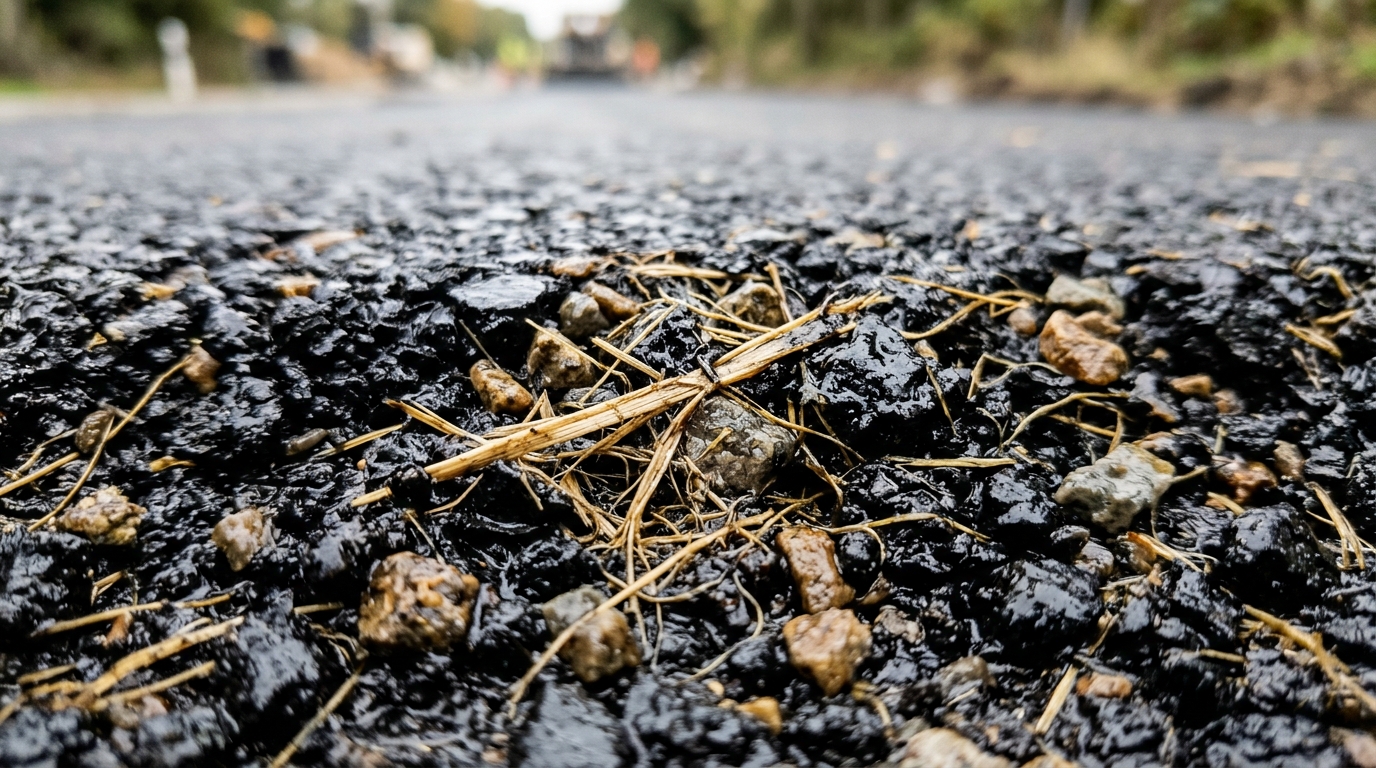
Engineers in China have turned an agricultural waste problem into a pavement material, showing that fibers extracted from corn stalks can keep a porous asphalt mixture within technical specifications even when nearly half of the mix comes from milled-up old roads. The study, published in Frontiers in Materials, combined two pressing issues: the open burning of corn stalks, which causes environmental pollution, and the difficulty of recycling high proportions of reclaimed asphalt pavement, or RAP, whose aged binder tends to make recycled mixes brittle and moisture-sensitive. The researchers report that with a chemically treated corn stalk fiber added at 1.2% by mass of the binder, a recycled PAC-13 porous asphalt mixture containing about 40% RAP met every key performance requirement they tested, while mixtures at 50% and 60% RAP fell short on several counts.
The team prepared corn stalk fibers two ways. The physical-mechanical route soaked air-dried stalks until saturated, cut them into roughly 10-millimeter sections, and sheared them in a high-speed crusher. Single-factor experiments identified a 3-hour soak and a 2-minute crushing time as the best combination, yielding a fiber extraction rate of 73.94% and an oil absorption ratio of 7.23. The chemical route immersed stalk sections in sodium hydroxide solution at 60 °C, washing, crushing, drying and sieving the result afterward. Varying the alkali concentration showed that 3% NaOH balanced yield and quality: the extraction rate rose from 68.45% at 1% to 80.21% at 3%, and the oil absorption ratio climbed from 6.76 to 8.25, while higher concentrations brought diminishing returns and, at 5%, actually damaged the fiber structure. Holding concentration at 3% and extending treatment time showed that 50 minutes maximized oil absorption at 8.56, though the extraction rate slipped to 74.33% as some fine fibers dissolved or were lost in washing.
Spectroscopic and thermal analysis explained why the alkali-treated fibers performed better. Fourier-transform infrared spectra of the physical-method fibers showed strong absorption bands for hemicellulose carbonyl groups and lignin aromatic rings; in the NaOH-treated fibers these peaks nearly vanished, confirming that the alkaline bath had selectively dissolved hemicellulose and lignin while leaving the cellulose backbone intact. Thermogravimetric analysis, run from 35 °C to 600 °C under nitrogen, told a similar story. The physical fibers began decomposing at 230 °C and even showed a hemicellulose decomposition peak near 275 °C. The alkali-treated fibers started decomposing at 292 °C, 62 °C higher, with no hemicellulose peak and a residual mass of 28.8% at 600 °C. Both fiber types met the requirements of the Chinese standard JT/T 533-2004 for lignin fibers used in asphalt pavement, with lengths under 6 millimeters, ash contents near 18%, and near-neutral pH. The authors attribute the superior thermal stability and oil absorption of the alkali fibers to their higher cellulose purity, which should also promote stronger interfacial bonding with asphalt.
With the fiber preparation settled, the researchers blended the alkali-treated fibers into 70# grade A road petroleum asphalt at dosages from 0.4% to 2.0% by mass, shearing the mix at high speed and letting it develop at 180 °C for an hour. Basic tests showed a consistent pattern: as fiber content rose, penetration at 25 °C fell and the softening point climbed. Going from 0% to 2.0% fiber dropped penetration 29.4%, from 68.7 to 48.5 in 0.1-millimeter units, and raised the softening point 16.3%, from 46.5 °C to 54.1 °C. Ductility at 10 °C declined from 28.3 cm to 16.3 cm, still above the 15 cm specification minimum. The penetration index, a measure of temperature susceptibility, increased continuously with fiber content.
Rheological testing sharpened the picture. Using a dynamic shear rheometer with 25-millimeter parallel plates, the team swept temperatures from 40 °C to 88 °C at 10 rad/s. At 64 °C, the base asphalt had a complex shear modulus of roughly 0.74 kPa; fiber modification lifted this to 1.10 kPa at 0.4%, 1.40 kPa at 0.8%, 1.64 kPa at 1.2%, 1.90 kPa at 1.6%, and 2.40 kPa at 2.0%, increases of up to 224.3%. The phase angle moved the other way, falling from 86.93° for the base binder to 82.48° at 1.2% and 79.35° at 2.0%, meaning the modified binders behaved more elastically and less viscously. The authors link this to a three-dimensional fiber network that restricts molecular flow and resists shear deformation, the mechanism behind rutting resistance in hot weather.
Low-temperature behavior was more delicate. Bending beam rheometer tests at −6 °C, −12 °C and −18 °C showed that modest fiber doses actually lowered creep stiffness: at −18 °C the base asphalt measured 297.78 MPa, and the 0.4% binder cut that by 2.3%. The creep rate, or m-value, which reflects stress relaxation, also edged upward, from 0.360 for the base asphalt to 0.370 at 1.2% fiber, a 2.78% gain the authors describe as slight but consistent, within typical BBR repeatability rather than a statistically significant change. Beyond 1.2%, things reversed. At 1.6% fiber the −18 °C stiffness rose to 298.45 MPa and the m-value fell to 0.345; at 2.0% the stiffness hit 301.05 MPa with an m-value of 0.350, both worse than the unmodified asphalt. The explanation offered is fiber aggregation at high doses, which degrades dispersion and introduces interface defects that embrittle the binder.
Weighing all the binder evidence, the team settled on 1.2% as the optimal fiber content. At that dose the modified asphalt showed a 21.1% penetration decrease, a 10.3% softening point increase to 51.3 °C, a ductility of 22.4 cm that stayed within specification, a complex shear modulus 121.62% above the base binder at 64 °C, and improved stress relaxation at −18 °C. Doses above 1.6% pushed ductility below 19.6 cm, close to the specification floor, while degrading low-temperature performance, so 1.2% represented the best balance of high- and low-temperature behavior.
The real test came in the mixture. The researchers used the 1.2% fiber-modified binder to prepare recycled PAC-13 porous asphalt concrete, a mix with a nominal maximum aggregate size of 13.2 millimeters and a target air void content of 20%, at RAP contents of 20%, 30%, 40%, 50% and 60%. The RAP came from cold milling of a pavement surface course and was sieved so that only the 8-16 millimeter fraction was used. As RAP content climbed, optimum binder content fell from 5.0% to 4.2%, air voids rose from 18.5% to 25.2%, and Marshall stability dropped from 7.2 kN to 5.0 kN, a 30.6% decline. The authors attribute these shifts to the increased viscosity of the aged RAP binder, reduced compactibility, and incomplete blending between virgin and aged asphalt.
Pavement performance followed the same downward trajectory, and the data revealed a threshold near 40% RAP. Dynamic stability in wheel tracking at 60 °C under 0.7 MPa fell from 6,300 cycles/mm at 20% RAP to 4,200 cycles/mm at 60%, a 33.3% reduction, but at 40% RAP it still registered 5,350 cycles/mm, above the 5,000 cycles/mm minimum that Chinese standard JTG/T 3350-03-2020 sets for drainage asphalt mixtures; at 50% RAP it slipped to 4,850, below the limit. Moisture resistance showed the same pattern: the freeze-thaw splitting strength ratio dropped from 89.1% at 20% RAP to 71.3% at 60%, yet at 40% RAP it was 82.5%, clearing the 80% requirement, while at 50% it fell to 76.5%. Low-temperature failure strain declined from about 3,050 microstrain at 20% RAP to 2,700 at 40% and 2,150 at 60%, with the steepest losses beyond the 40% mark. Drain-down loss and Cantabro loss both rose monotonically, reaching 0.50% and 17.04% respectively at 60% RAP, the latter exceeding specification limits, while at 40% RAP they stood at 0.28% and 9.8%.
Taken together, the results support 40% RAP as the practical ceiling for this fiber-modified recycled porous asphalt under the materials and conditions studied. At that dosage the mixture posted an air void content of 21.8%, within the 20% ± 2% target, a Marshall stability of 6.3 kN above the 5.0 kN code minimum, and the passing dynamic stability, freeze-thaw ratio and failure strain values noted above. The work also carries an environmental dividend: China effectively utilizes less than 40% of its crop straw output, with much of the rest burned or discarded, and the authors frame corn stalk fiber as a way to valorize that waste while reducing reliance on lignin fibers made from virgin forest resources. They caution that the findings are specific to their materials and experimental conditions, and that the microscopic mechanisms of fiber-asphalt interaction across preparation processes remain an open question for future study.
Subject of Research: Using chemically treated corn stalk fibers to modify asphalt binder for recycled porous asphalt mixtures containing high proportions of reclaimed asphalt pavement
Article Title: Corn straw fiber-modified asphalt for high-RAP recycled PAC-13 mixtures: preparation, rheology, and pavement performance
Article References: Sun, F., Wang, Y., Liu, L., Zhang, F., Wang, C., & Wu, W. (2026). Corn straw fiber-modified asphalt for high-RAP recycled PAC-13 mixtures: preparation, rheology, and pavement performance. Frontiers in Materials, 13, Article 1967566. https://doi.org/10.3389/fmats.2026.1967566
Image Credits: AI Generated
DOI: 10.3389/fmats.2026.1967566
Keywords: corn stalk fiber, modified asphalt, reclaimed asphalt pavement, PAC-13, porous asphalt concrete, rheology, dynamic shear rheometer, bending beam rheometer, Marshall stability, freeze-thaw splitting, dynamic stability, asphalt recycling
News Source: Denise Maddox. (November 5, 2026). Corn stalk fibers let recycled asphalt mixes reach 40% RAP without failing specs. Scienmag.