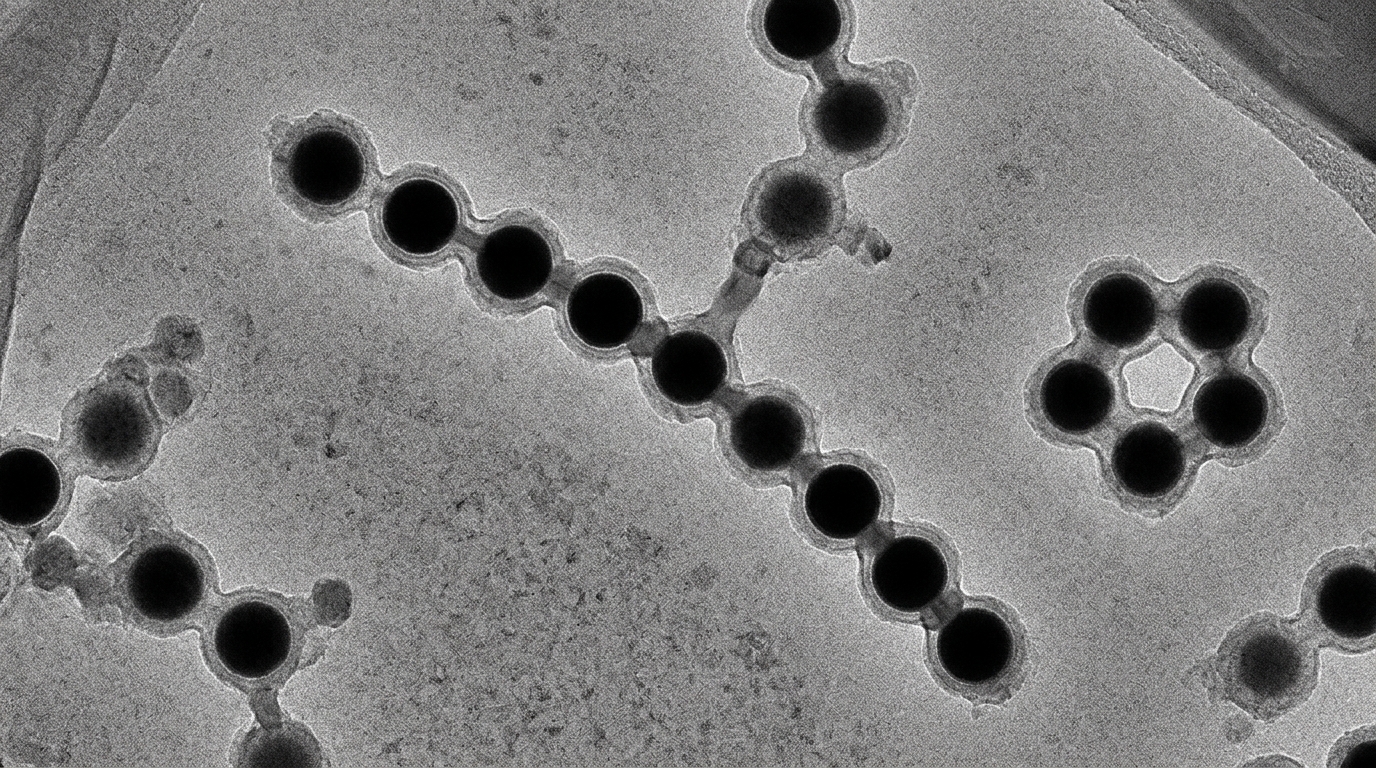
Nanoparticles can now be coaxed into crystal structures that break their own symmetry, thanks to a design trick that requires no anisotropic particles at all. Researchers report in Nature Materials that isotropic nanoparticles coated with flexible, electrostatically active polymer ligands can acquire an effective valency during assembly itself, allowing them to form lattices with lower coordination numbers, lower packing densities and unexpected symmetries than hard-sphere packing would predict.
The finding challenges a long-standing assumption in programmable matter. Attractive ligand interactions typically drive nanoparticle superlattices toward densely packed arrangements that maximize nearest-neighbour bonding, so engineers who wanted directional bonding usually assumed they had to build it into the particles themselves, through shape anisotropy or patterned surface chemistry. The new work shows that valency need not be encoded in particle geometry at all: it can emerge spontaneously when the ligand corona is deformable enough.
Their building blocks, termed NCTs, are isotropic particles whose surfaces carry electrostatically active ligands. When two such particles approach, their polymer coronas do not simply interpenetrate or compress uniformly. Instead, if the ligands are sufficiently flexible, they reconfigure to align along the interparticle interface, concentrating bonding in specific directions and generating an effective valency that the individual particle does not intrinsically possess.
Crucially, the degree of ligand deformability acts as a tunable dial. Increasing deformability lowers the lattice coordination numbers that the assemblies adopt, the researchers found. In other words, softer, more reconfigurable coronas push the particles away from maximal bonding and toward sparser, lower-symmetry lattices. This is the opposite of what densest-packing arguments would suggest for spherical building blocks, and it means the final crystal structure is set not only by particle size and charge but by the mechanical character of the polymer brush.
Because the effect arises from ligand mechanics rather than particle shape, it opens a route to lattice symmetries that would otherwise be inaccessible with isotropic building blocks. The study identifies design considerations for assembling such particles into structures with lower coordination, packing density and symmetry than hard-sphere packing predicts, effectively programming the superlattice through the choice of graft architecture and ligand flexibility.
The implications extend across the field of self-assembling nanomaterials.
The work also reframes how valency itself is understood in colloidal and nanoparticle assembly. Rather than being a fixed property of a building block, valency here is a dynamic, emergent outcome of the assembly process, produced by ligand reconfiguration at the moment particles meet.
Still, the central message is striking: symmetry breaking in nanoparticle crystals does not demand symmetry breaking in the particles. Sometimes, flexibility is enough.
Subject of Research: Spontaneous valency from flexible ligands in nanoparticle superlattice assembly
Article Title: Breaking symmetry in nanoparticle superlattices via spontaneous valency
Article References: Sbalbi, N., Kronenberger, S., Shinzawa, H., Ye, M., Jayaraman, A., & Macfarlane, R. J. (2026). Breaking symmetry in nanoparticle superlattices via spontaneous valency. Nature Materials. https://doi.org/10.1038/s41563-026-02787-0
Image Credits: AI Generated
DOI: 10.1038/s41563-026-02787-0
Keywords: nanoparticle superlattices, spontaneous valency, ligand flexibility, self-assembly, coordination number, symmetry breaking, polymer coronas, electrostatic assembly, programmable matter, hard-sphere packing, Breaking, symmetry
News Source: Denise Maddox. (November 5, 2026). Flexible ligands give symmetric nanoparticles spontaneous valency. Scienmag.