Walking inside a rigid robotic exoskeleton is an experience few people describe as natural. Most rehabilitation exoskeletons guide the legs along pre-recorded gait trajectories, typically restricted to the sagittal plane, and those generic patterns may limit how comfortable and lifelike the movement feels. A new pilot study from researchers at Delft University of Technology and collaborating institutions asked whether tailoring those trajectories to the individual walker could change how users perceive the machine’s rigid guidance. The answer, at least for the young unimpaired volunteers tested, was unexpectedly no.
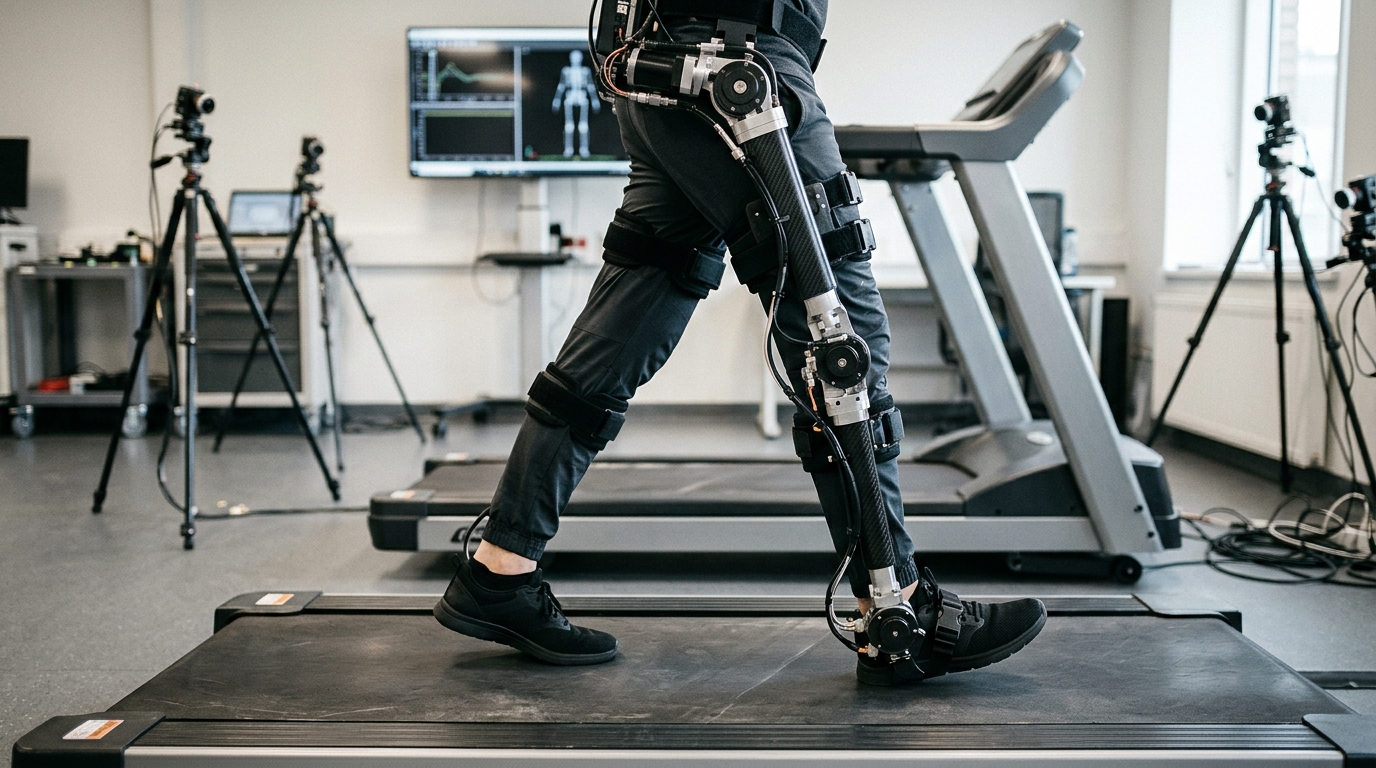
The study, published in Frontiers in Robotics and AI, presented a data-driven gait personalization framework for an exoskeleton capable of multi-planar motion. Unlike conventional systems that constrain movement to flexion and extension, this device also supported hip abduction and adduction as well as pelvic translation and rotation, allowing a broader repertoire of walking kinematics. Personalized trajectories for each participant were generated using regression models trained on anthropometric, demographic, and walking speed data drawn from a normative database, so that the enforced pattern reflected the walker’s own body dimensions and pace rather than a population average.
To test whether this personalization mattered subjectively, the team ran a within-subject experiment involving ten young unimpaired participants. Each participant experienced the personalized trajectory alongside two standard patterns derived from the same normative database: one created by averaging all trajectories in the database, and one selected at random. The researchers evaluated the conditions in terms of comfort, naturalness, and overall experience, comparing ratings across pattern types.
The central result was a null finding. The researchers did not find significant differences across the pattern conditions, meaning that participants rated the personalized, averaged, and randomly selected trajectories similarly on the subjective measures. This held despite all trajectories being executed with high accuracy, thanks to a stiff position-derivative controller that faithfully tracked the intended kinematics. In other words, the exoskeleton delivered each pattern precisely as designed, yet the precision did not translate into a perceptible advantage for the personalized pattern.
There was, however, a striking effect over time. Pattern conditions encountered in later trials were rated as significantly more comfortable and more natural than those in the first trial. This suggests that participants might have adapted to walking within the exoskeleton regardless of which gait pattern was enforced. Familiarity with the machine, rather than the specific trajectory it imposed, appeared to drive improvements in how the experience felt.
The authors argue that this adaptation effect carries practical weight for the field. If users grow more comfortable with an exoskeleton simply through repeated exposure, then experiments evaluating gait patterns must account for user adaptation during testing, or early discomfort ratings may reflect novelty rather than the intrinsic quality of a pattern. Their findings also highlight the importance of integrating subjective feedback when designing personalized gait controllers, since objective trajectory tracking accuracy alone did not predict how participants judged the experience.
Robot-aided gait rehabilitation is valued for enabling high-intensity and repeatable therapy, and the motivation for personalization is straightforward: a trajectory matched to an individual’s anthropometry and walking speed should, in principle, feel more natural than a generic one. This study tested that principle in its simplest population, young unimpaired walkers, and as a pilot user experience evaluation it leaves open the question of whether clinical populations, such as stroke survivors or people with gait impairments, would respond differently to personalized guidance. For them, deviations from their own habitual movement patterns may be far more consequential than for healthy volunteers who can adapt quickly to any enforced pattern.
The work also demonstrates a technical capability worth noting. The exoskeleton’s stiff position-derivative controller executed all gait patterns with high accuracy, including the multi-planar components that most systems omit. That engineering achievement makes the null result more informative: it was not a failure of implementation, where the personalized pattern was poorly tracked and therefore unfairly judged, but a genuine absence of detectable subjective differences among accurately executed patterns in this participant group.
For now, the study’s authors frame their conclusions carefully. The results suggest participants might have adapted to walking within the exoskeleton regardless of the enforced gait pattern, and the findings underscore that subjective experience deserves a central place in the design loop for personalized gait controllers. Whether personalization ultimately benefits the patients rehabilitation robots are built to serve remains a question for future studies with the populations who need this technology most.
Subject of Research: A pilot study testing whether personalized exoskeleton gait patterns improve user comfort and perceived naturalness compared with standard trajectories.
Article Title: The impact of gait pattern personalization on the perception of rigid robotic guidance: a pilot user experience evaluation
Article References: Luciani, B., Poggensee, K. L., Vallery, H., van den Berg, A., Woernle, S. D., Mogharabi, M., Gasperina, S. D., & Marchal-Crespo, L. (2026). The impact of gait pattern personalization on the perception of rigid robotic guidance: a pilot user experience evaluation. Frontiers in Robotics and AI, 13, Article 1937649. https://doi.org/10.3389/frobt.2026.1937649
Image Credits: AI Generated
DOI: 10.3389/frobt.2026.1937649
Keywords: exoskeleton, gait rehabilitation, gait pattern personalization, robotics, human-centered robotics, kinematics, user experience, biomedical robotics, pilot study, motion adaptation, impact, gait
News Source: Denise Maddox. (November 6, 2026). Personalized exoskeleton gait patterns fail to beat standard ones in comfort trial. Scienmag.