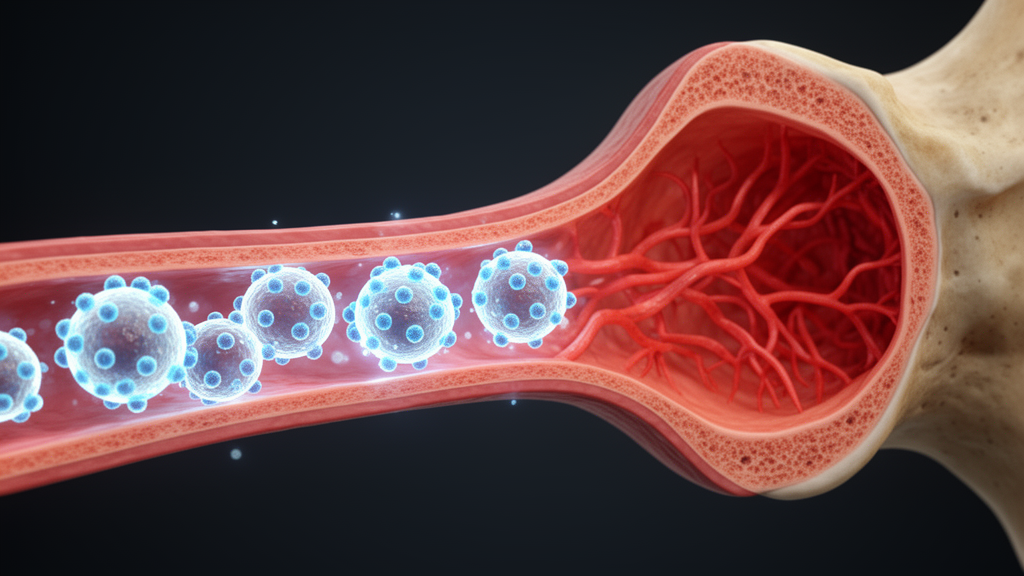
Acute myeloid leukemia is increasingly described not as a disease of leukemic cells alone but as a malignancy shaped by its surroundings. A new review published in Cancer Nanotechnology argues that three interacting biological systems—extracellular vesicles, platelet activation, and neutrophil extracellular trap (NET)-associated inflammation—form an emerging framework linking bone marrow niche remodeling, measurable residual disease, and therapy resistance in AML. The authors also examine how bioinspired nanotherapeutics, including carriers that hitchhike on platelets and neutrophils, might one day deliver drugs directly into the leukemic marrow niche.
According to the review, the strongest disease-specific evidence concerns AML-derived extracellular vesicles. These membrane-bound particles transfer bioactive proteins, RNAs, lipids, and metabolic cargo between cells, and the authors report that they can reprogram stromal, endothelial, immune, and hematopoietic cells. Through this signaling, leukemic vesicles are described as supporting leukemic stem-cell survival, angiogenic and metabolic adaptation, and resistance to therapy. The review’s highlights add that AML-specific studies support roles for leukemic vesicles in stromal reprogramming, metabolic adaptation, mitochondrial support, and chemotherapy resistance.
Platelet-derived vesicles add a second, less mature layer to the proposed axis. The authors suggest that these particles may contribute a thromboimmune and chemoresistance-associated dimension through platelet–blast interactions and vesicular signaling. However, the review is explicit that this evidence is weaker than the extracellular vesicle literature: platelet-derived vesicle mechanisms in AML are described as partly supported by associative, preclinical, or extrapolated findings rather than by mature disease-specific validation.
The third component, neutrophil extracellular traps—web-like structures released by neutrophils—may contribute to inflammatory, endothelial, coagulation, and immune remodeling in the marrow, the review states. Like the platelet arm of the axis, NET-associated pathways in AML are characterized as biologically plausible but less mature than the vesicle evidence, and the authors caution that the network as a whole is unevenly validated.
Building on this biological framework, the review critically examines AML-relevant nanoplatforms. These include marrow-homing lipid nanoparticles, biomimetic membrane-coated carriers, stimulus-responsive systems, and platelet- or neutrophil-hitchhiking strategies. Particular emphasis is placed on carrier chemistry, physicochemical design, targeting selectivity, payload selection and release, biodistribution, and translational limitations. The authors report that bioinspired platelet- and neutrophil-hitchhiking nanotherapeutics may improve marrow-directed delivery in experimental models, but they stress that safety and efficacy in AML require disease-specific validation.
The review is unambiguous that these bioinspired strategies remain investigational. Before any clinical translation, the authors write, they require AML-specific validation of leukemia-versus-normal-hematopoiesis selectivity, thrombogenicity, carrier-cell function, safety, manufacturing reproducibility, and antileukemic efficacy. Targeting vesicle biogenesis, platelet activation, NETosis, mitochondrial transfer, and niche-dependent metabolic vulnerabilities is described as a preclinical, microenvironment-directed therapeutic concept rather than an established approach.
Beyond therapy, the review proposes that biomarkers associated with extracellular vesicles, platelets, NETs, mitochondria, and metabolism may complement measurable residual disease monitoring. Such biomarkers could ultimately support mechanism-based patient selection, response monitoring, and precision marrow-directed therapy, the authors suggest. The highlights note that clinical implementation of these biomarkers would require prospective validation, and that targeting the triad may complement mutation-directed and immune therapies by disrupting multiple non-genetic resistance mechanisms relevant to residual AML.
The article is an open-access review, published on 12 September 2026, and is being shared early as a peer-reviewed, accepted manuscript that remains subject to further edits before the final version of record. Its framing is deliberately evidence-calibrated: the authors rank the extracellular vesicle literature as the most mature component of the axis, position platelet-derived vesicle and NET mechanisms as promising but less developed, and treat all nanotherapeutic applications as hypotheses awaiting AML-specific testing rather than near-term clinical options.
For researchers and clinicians following microenvironment-directed approaches in AML, the review’s central contribution is its integration of vesicle, platelet, and NET biology with nanocarrier design and residual disease monitoring into a single framework. Whether that framework translates into validated therapies will depend on the disease-specific validation the authors themselves identify as the outstanding requirement.
Subject of Research: A review of extracellular vesicle, platelet, and NET signaling in the acute myeloid leukemia bone marrow niche and bioinspired nanotherapeutic strategies
Article Title: Bioinspired cell-hitchhiking nanotherapeutics in acute myeloid leukemia: targeting the EV–platelet–NET axis and the leukemic bone marrow niche
Article References: Heydari, F., Golmohammadi Zohouri, M., Ghani Hassan, H., Fahmi, S., Mansuri, N., Mozafari, F., Hamblin, M. R., & Naghinezhad, J. (2026). Bioinspired cell-hitchhiking nanotherapeutics in acute myeloid leukemia: targeting the EV–platelet–NET axis and the leukemic bone marrow niche. Cancer Nanotechnology. https://doi.org/10.1186/s12645-026-00428-4
Image Credits: AI Generated
DOI: 10.1186/s12645-026-00428-4
Keywords: acute myeloid leukemia, extracellular vesicles, platelets, neutrophil extracellular traps, bone marrow niche, nanotherapeutics, therapy resistance, measurable residual disease, biomimetic drug delivery, leukemic stem cells, review, Bioinspired
News Source: Nathaniel Bowman. (October 29, 2026). Cell-hitchhiking nanotherapeutics aim at the marrow niche in AML, but remain investigational. Scienmag.