Pregnancy rewrites nearly every rule of cardiovascular physiology, and a new review argues that the way blood pressure moves through those nine months may matter as much as any single reading. Writing in Frontiers in Cardiovascular Medicine, researchers from the University Hospitals of Geneva and University Hospital Basel synthesize evidence on how blood pressure normally behaves across gestation and the postpartum period, and how deviations from that expected pattern can flag hypertensive disorders of pregnancy before conventional diagnostic thresholds are ever crossed. Their central message is that absolute blood pressure values alone tell only part of the story: longitudinal trajectories and circadian patterns, particularly the behavior of blood pressure at night, may reveal cardiovascular maladaptation while readings still sit comfortably within the normal range.
The physiological story begins almost immediately after conception. Vasodilatory mediators including nitric oxide, prostaglandins, and progesterone drive systemic vasodilation during the first trimester, lowering systemic vascular resistance. The heart compensates with a sustained rise in cardiac output of roughly 20 to 40 percent over the course of pregnancy, driven early on by increased stroke volume and later, in the third trimester, by a progressive increase in heart rate. Blood volume expands, ventricular wall mass grows, and myocardial contractility improves, establishing a high-output, low-resistance circulatory state that ensures adequate uteroplacental perfusion. The result is the characteristic blood pressure trajectory of uncomplicated pregnancy: a decline during early gestation, reaching a nadir at approximately 20 to 24 weeks, followed by a gradual rise back toward prepregnancy levels by term.
The renal and hormonal dimensions of this adaptation are equally dramatic. Glomerular filtration rate rises by approximately 50 percent and renal plasma flow by up to 80 percent, lowering serum creatinine, urea, and uric acid. The renin-angiotensin-aldosterone system is markedly upregulated: placental estrogen stimulates hepatic angiotensinogen synthesis, and aldosterone concentrations climb from about eight weeks of gestation to levels three- to sixfold higher than in nonpregnant women by the third trimester, promoting sodium and water retention and a net extracellular fluid expansion of approximately 1.5 liters. Yet maternal blood pressure stays relatively low, because vascular sensitivity to angiotensin II is reduced and progesterone acts as a physiological mineralocorticoid antagonist, blunting sodium retention at the receptor level.
What does a normal trajectory actually look like at the population level? The review highlights a landmark international observational cohort conducted between 2009 and 2016 across eight countries, which enrolled 4,607 healthy women at low risk of pregnancy complications. At approximately 12 weeks of gestation, median blood pressure was around 111.5/69.1 mmHg. Diastolic pressure dipped slightly to a nadir of about 111/68.5 mmHg near 20 weeks, then both systolic and diastolic values climbed steadily, reaching a median maximum of approximately 119.6/76.3 mmHg at 40 weeks, an overall increase of about 8 mmHg systolic and 7 mmHg diastolic from early pregnancy to term. Notably, all of these values remained well below the conventional diagnostic threshold of 140/90 mmHg.
The pathological counterpart is subtler than many clinicians might expect. Evidence reviewed by the authors indicates that women who subsequently develop gestational hypertension or preeclampsia often remain normotensive during early pregnancy, but their blood pressure fails to exhibit the expected mid-gestational decline. In one analysis of circadian patterns, women who later developed hypertensive disorders had a mean first-trimester blood pressure of 115.3/67.2 mmHg, within the normal range but consistently higher than in uncomplicated pregnancies, and they showed no physiological dip. As pregnancy progressed, the divergence widened: values ran approximately 13/7 mmHg higher during the second trimester and up to 16/9 mmHg higher during the third, despite remaining below diagnostic thresholds. Preeclampsia, moreover, is characterized by a steeper rise in the second half of pregnancy than gestational hypertension alone.
Circadian patterns add a further layer of predictive information. An early increase in circadian blood pressure amplitude, driven largely by the nocturnal decline, is followed from the second to the third trimester by a reduction in variability as the nighttime dip becomes blunted. A blunted or absent nocturnal blood pressure decline is commonly observed in preeclampsia and has been linked to altered circadian activity of the renin-angiotensin-aldosterone system and increased sympathetic activity. Nocturnal hypertension has emerged as a strong predictor of preeclampsia during the second half of pregnancy: in a large cohort, both systolic and diastolic nocturnal hypertension remained independently associated with preeclampsia risk after adjustment for daytime blood pressure and maternal characteristics, and at mid-pregnancy screening between 20 and 27 weeks, nocturnal hypertension was associated with a markedly increased risk of preeclampsia or eclampsia, with an odds ratio of 5.32. When both daytime and nocturnal hypertension were entered into predictive models, only the nocturnal component remained statistically significant.
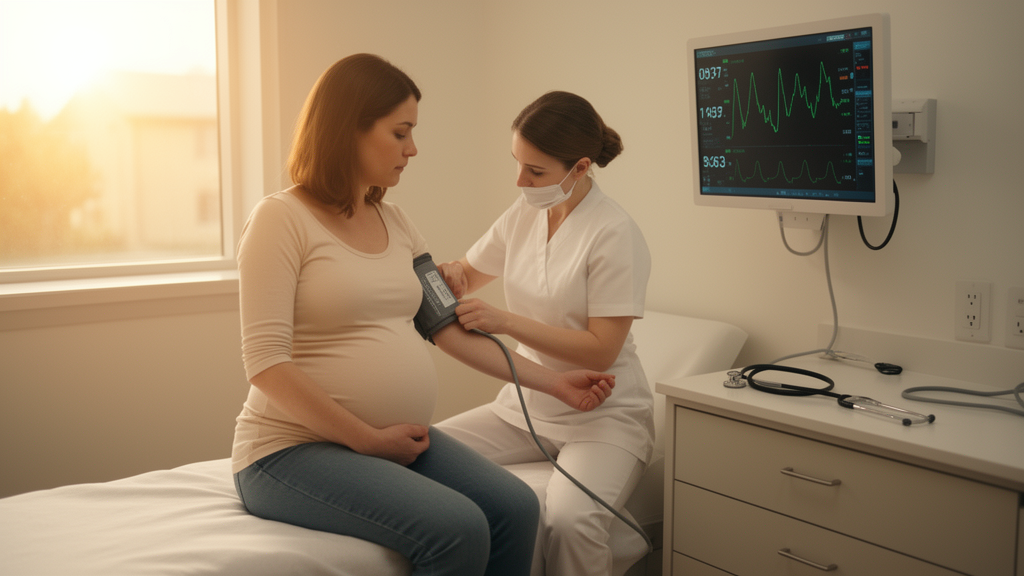
These findings underpin a growing role for 24-hour ambulatory blood pressure monitoring, which captures both average levels and circadian patterns and can differ from office readings by up to 12/6 mmHg in pregnant women. The European Society of Hypertension’s 2024 position statement holds that ambulatory monitoring offers superior prognostic value over office and home measurements for predicting pregnancy outcomes. Reflecting the physiological dip, the International Society for the Study of Hypertension in Pregnancy proposes a 24-hour ambulatory threshold of 127/76 mmHg at 18 to 22 weeks as a potential marker of increased risk, with reference values before 22 weeks of 126/76 mmHg or below for the 24-hour average. Home monitoring has a more mixed record: the BUMP-1 and BUMP-2 trials showed that self-monitoring alone neither improved the timing of hypertension diagnosis nor blood pressure control, although elevated home readings frequently preceded clinical diagnosis, suggesting value when integrated into structured care pathways with predefined thresholds and timely review.
Treatment thresholds have themselves been reshaped by two landmark trials. In the CHIPS trial, tighter control targeting a diastolic pressure of 85 mmHg did not increase adverse perinatal outcomes but substantially reduced severe maternal hypertension compared with less-tight control. The CHAP trial then demonstrated that among women with chronic hypertension, active treatment targeting blood pressure below 140/90 mmHg reduced a composite of adverse maternal and perinatal events without increasing fetal growth restriction. European guidance has moved toward earlier intervention, with the European Society of Hypertension supporting treatment initiation from 140/90 mmHg in chronic and mild gestational hypertension, and the 2025 European Society of Cardiology update recommending treatment for readings of 140 to 159/90 to 99 mmHg with a target below 140/90. ACOG has adopted the 140/90 threshold for chronic hypertension following CHAP but has not formally extended it to all non-severe gestational hypertension, and NICE, ISSHP, and SOGC now recommend treatment from around 140/90 mmHg. Low-dose aspirin, 75 to 150 mg daily, remains the only established pharmacological strategy for preventing preeclampsia in women at increased risk.
The stakes extend far beyond delivery. Hypertensive disorders of pregnancy affect roughly 10 percent of pregnancies worldwide and are estimated to cause 16 percent of maternal deaths. Postpartum hypertension affects up to 8 to 12 percent of women without antepartum hypertension and up to half of women with a history of preeclampsia within 6 to 12 weeks after delivery, yet it remains underrecognized. In a nationwide Danish cohort, the excess risk of chronic hypertension was 12- to 25-fold higher during the first postpartum year and remained approximately twofold higher even more than 20 years after delivery. A meta-analysis of more than 600,000 women found a 3.6-fold higher risk of chronic hypertension after hypertensive disorders of pregnancy, strongest after gestational hypertension, and preeclampsia is associated with a fourfold increased risk of heart failure. Encouragingly, structured follow-up may help: the POP-HT randomized trial showed that daily home monitoring with remote transmission and physician-guided titration produced better 24-hour ambulatory blood pressure control at about nine months postpartum and fewer hypertension-related readmissions within 14 days of discharge, 7 percent versus 27 percent, while the PICk-UP trial found that six months of enalapril after preterm preeclampsia improved diastolic function and cardiac remodeling. The review’s authors argue that recognizing this intermediate-risk blood pressure phenotype, before overt hypertension develops, offers a genuine window for closer surveillance and timely prevention.
Subject of Research: Blood pressure trajectories and circadian patterns across pregnancy and the postpartum period as early indicators of hypertensive disorders of pregnancy
Article Title: Blood pressure changes across pregnancy and postpartum: from physiological adaptations to pathological deviations
Article References: Cozzo, D., Gassmann, N., Dufey Teso, A., Ponte, B., & Socrates, T. (2026). Blood pressure changes across pregnancy and postpartum: from physiological adaptations to pathological deviations. Frontiers in Cardiovascular Medicine, 13, Article 1953409. https://doi.org/10.3389/fcvm.2026.1953409
Image Credits: AI Generated
DOI: 10.3389/fcvm.2026.1953409
Keywords: blood pressure, pregnancy, preeclampsia, hypertension, ambulatory blood pressure monitoring, postpartum, cardiovascular risk, nocturnal hypertension, gestational hypertension, CHAP trial, telemedicine, aspirin
News Source: Harold Sullivan. (October 28, 2026). Blood Pressure Trajectories in Pregnancy May Signal Hypertensive Risk Before Overt Disease. Scienmag.