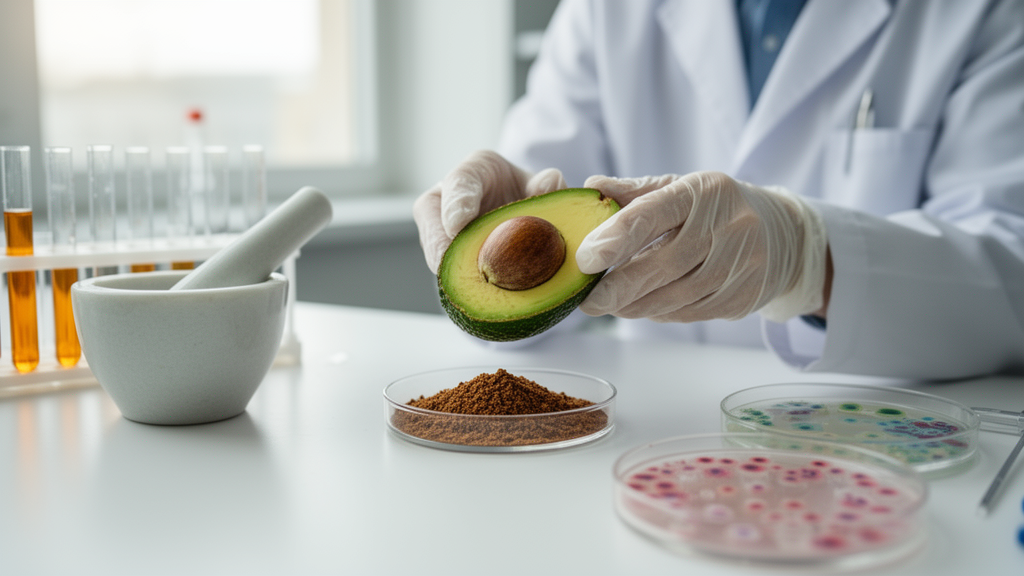
Seeds that most people throw away after eating an avocado may hold useful chemistry, according to a new study of locally cultivated avocado trees in Korogwe District, northern Tanzania. Researchers dried and ground ripe avocado seeds, extracted them with 70% ethanol, and tested the resulting extract against two common bacteria and for free-radical scavenging in the laboratory.
The antibacterial evaluation used the agar disc diffusion method against Escherichia coli, a Gram-negative bacterium, and Staphylococcus aureus, a Gram-positive one. The extract was tested at concentrations ranging from 25 to 100 mg/mL. Inhibition zones grew larger as the concentration increased, reaching a mean diameter of 19.6 mm against E. coli and 19.2 mm against S. aureus at the highest concentration tested.
Both bacterial species responded, meaning the extract showed activity against a Gram-negative and a Gram-positive organism. However, the zones of inhibition were significantly smaller than those produced by the standard antibiotic used for comparison, so the seed extract was weaker than conventional treatment in this assay.
The antioxidant side of the study relied on the DPPH free radical-scavenging assay, a laboratory test in which a sample's ability to neutralize a stable radical is measured. Scavenging activity rose with concentration, from approximately 49% at 1 × 10⁻⁴ mg/mL to approximately 95% at 1 mg/mL, a substantial concentration-dependent effect across the tested range.
The study was explicitly framed as preliminary. The authors note that avocado seeds are commonly discarded during fruit processing despite their high levels of bioactive compounds, and they position these results as early evidence supporting further investigation into potential applications in food preservation and natural product development.
Several limitations follow directly from the design. The work tested a single seed extract from one district against only two bacterial species using one antibacterial method, and DPPH is only one of several antioxidant assays. The authors themselves recommend that future studies include additional antioxidant tests such as ABTS, FRAP, and hydroxyl radical assays before drawing broader conclusions.
Because the experiments were conducted in vitro, the findings do not demonstrate any clinical benefit or safety in humans or animals. Disc diffusion results indicate whether a compound can slow bacterial growth on an agar plate, not whether the extract would work as a preservative in real food systems or as a medicine, both of which would require further testing.
The research also carries local significance. The avocado germplasm examined came from trees cultivated in northern Tanzania, a population the authors describe as understudied. Documenting the bioactivity of seeds from locally grown varieties could inform how processing waste from the region’s avocado harvest is valued, although any such application remains speculative until further studies are completed.
Its concrete contributions are the measured inhibition zones against E. coli and S. aureus, the quantified DPPH scavenging curve from roughly 49% to 95% over five orders of magnitude of concentration, and a documented baseline for a local Tanzanian avocado variety.
Subject of Research: Antibacterial and antioxidant activity of avocado seed extracts from locally cultivated avocados in northern Tanzania
Article Title: Antibacterial and antioxidant properties of local avocado (Persea americana Mill.) seeds grown in northern Tanzania
Article References: Hassani, A. A., & Yangaza, I. S. (2026). Antibacterial and antioxidant properties of local avocado (Persea americana Mill.) seeds grown in northern Tanzania. Discover Food. https://doi.org/10.1007/s44187-026-01328-7
Image Credits: AI Generated
DOI: 10.1007/s44187-026-01328-7
Keywords: avocado seeds, Persea americana, northern Tanzania, antibacterial activity, antioxidant, DPPH assay, Escherichia coli, Staphylococcus aureus, agar disc diffusion, food preservation, natural products, bioactive compounds
News Source: Alan Morgan. (October 27, 2026). Avocado Seeds from Northern Tanzania Show Antibacterial and Antioxidant Activity in Lab Tests. Scienmag.