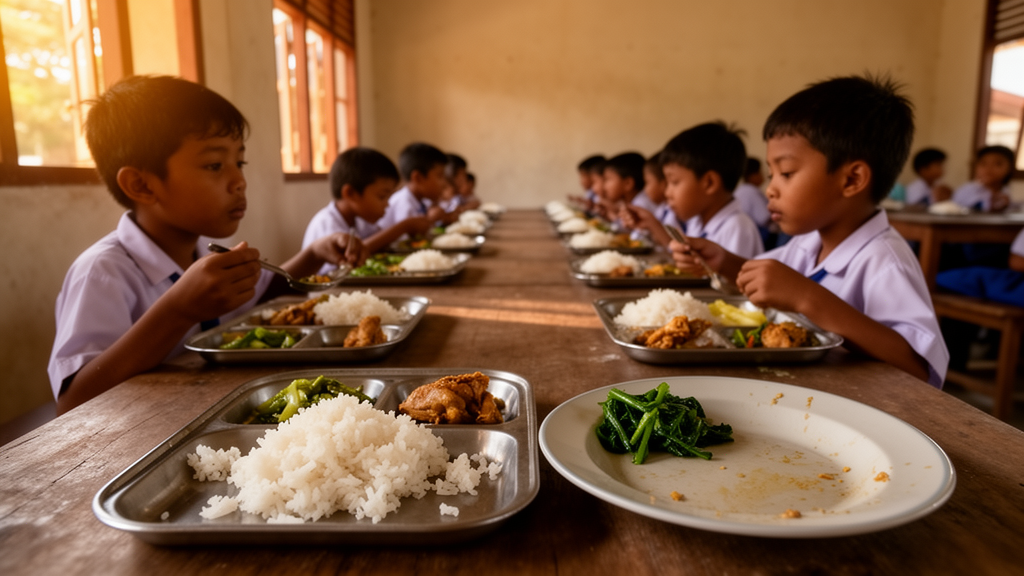
A new observational study at a public vocational high school in West Java, Indonesia, has found that meals served under the country’s Free Nutritious Meal Program, known locally as Makan Bergizi Gratis (MBG), fell well short of official portion and nutrient standards, and that students discarded large shares of the vegetables and plant-based side dishes on their trays.
In total, the portion and photographic dataset comprised 240 student or tray observations, with 12 trays documented per day.
This design allowed the researchers to link weighed portions, photographic waste estimates and preference ratings from the same individuals, enabling triangulation at the individual level before summarizing results by menu component.
The findings on nutrient delivery were striking. Served meals provided an average of 477 ± 94.0 kilocalories, which is only 66.9 percent of the 713 kcal lunch target set for the program. Protein came closest to its target at 19.9 ± 6.9 grams, or 94.8 percent of the standard, while fat fell furthest short at 10.3 ± 3.5 grams, just 44.8 percent of the target. Staple food portions averaged only 71.0 percent of the MBG standard, indicating that even the core carbohydrate component of the meals was routinely underserved.
Consumption patterns varied sharply by dish type, and the photographic waste data made those differences visible. The mean consumed proportion was highest for animal-source dishes at 90.6 percent and staple foods at 85.6 percent, but dropped to 45.7 percent for plant-based dishes and just 34.0 percent for vegetables. In other words, students left behind more than half of the vegetables and a substantial share of plant-based side dishes on their trays.
Student ratings mirrored these consumption patterns. Overall acceptability averaged 3.47 ± 0.58 on the five-point scale, with fruit scoring highest at 3.88 ± 0.90 and vegetables lowest at 3.20 ± 0.97.
Self-reported behavior added further context: 88.8% of students reported not finishing or not consuming MBG meals, and 72.5% added external condiments.
Based on the combined evidence, the study’s authors identified clear reformulation priorities. Vegetables and plant-based side dishes emerged as the components most in need of reformulation, because they combined lower acceptability, high portion variability and plate waste above 50 percent. Staple foods, by contrast, require portion standardization, since the shortfall against the MBG standard was the central problem rather than student rejection. Animal-source dishes performed well enough on both serving practice and consumption that the authors suggest they can serve as a benchmark for serving practices across the menu.
The study’s key contribution lies in its integrated design. Rather than relying on kitchen records or self-reports alone, the researchers took actual portions weighed before the meal as their starting point, used observed plate waste as the indicator of consumption, treated acceptability as the explanatory mechanism, and used NutriSurvey analysis as the basis for evaluating nutrient content. Because the weighing, photographic and preference data come from the same individuals, the triangulation can be performed at the individual level and then summarized by menu component.
Even so, the results offer a concrete, data-driven starting point for improving the MBG program: aligning served portions with official standards, standardizing staple amounts, and reformulating vegetable and plant-based dishes to raise both acceptability and actual consumption among students.
Subject of Research: Portion accuracy, plate waste and student acceptability in Indonesia's Free Nutritious Meal Program at a vocational high school
Article Title: Assessing served portions plate waste and student acceptability in the Indonesian Free Nutritious Meal Program at a vocational high school
Article References: Nurhayati, A., Muktiarni, M., Patriasih, R., Mahmudatusaadah, A., & Setiawati, T. (2026). Assessing served portions plate waste and student acceptability in the Indonesian Free Nutritious Meal Program at a vocational high school. Discover Food. https://doi.org/10.1007/s44187-026-01330-z
Image Credits: AI Generated
DOI: 10.1007/s44187-026-01330-z
Keywords: school meals, Indonesia, Makan Bergizi Gratis, plate waste, portion sizes, student acceptability, nutrition, vocational high school, menu reformulation, NutriSurvey, Visual Comstock, West Java
News Source: Daisy Hatcher. (October 27, 2026). Plate waste and small portions reveal gaps in Indonesia’s free school meal program. Scienmag.