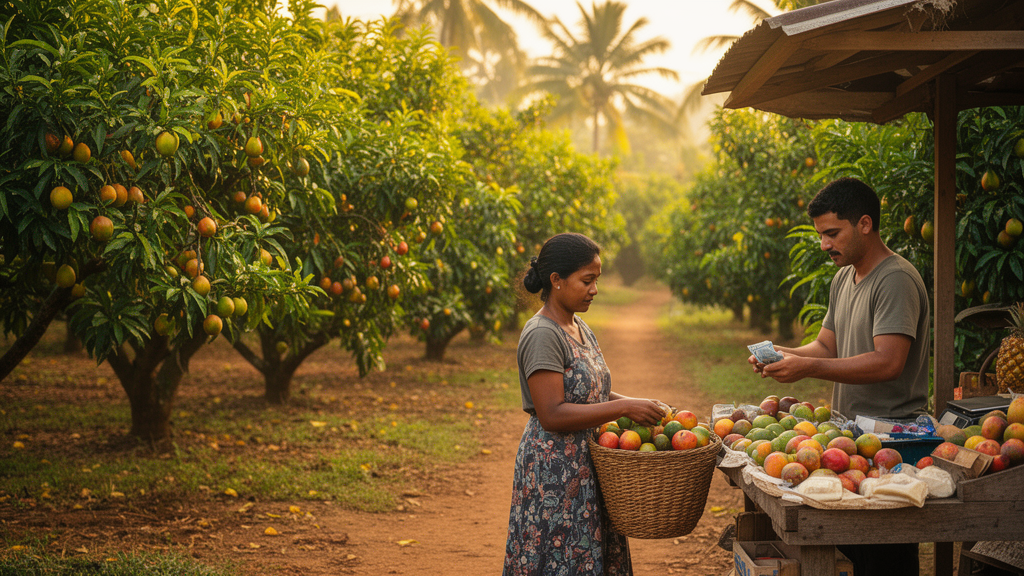
Women across the Global South contribute substantial labour, ecological knowledge and food provisioning to agroforestry systems, yet they rarely gain matching authority over land, trees, income or the benefits of development programmes. That is the central conclusion of a systematic review published in Agricultural and Food Economics, which synthesised 49 peer-reviewed empirical studies on gender and agroforestry. The authors, led by Giulia Costanzo-Talarico, argue that simply counting women’s participation in projects and meetings misses the point: presence does not equal power, and interventions built on participation metrics alone can leave intrahousehold power relations untouched while adding to women’s unpaid workloads.
The review followed the PRISMA 2020 guidelines for systematic reviews. The team searched Web of Science and Scopus between April and May 2025 using terms combining agroforestry system descriptors, including silvopasture, hedgerows, shelterbelts and riparian buffer strips, with gender, feminism and care vocabulary alongside biodiversity or food security terms. From 440 initially identified records, the researchers removed duplicates and screened titles, abstracts and full texts through three successive rounds, with at least two authors independently assessing each record. Forty-two articles were accepted outright and seven more were drawn from an uncertain pool, yielding the final corpus of 49 studies, all of which met the team’s quality threshold.
To organise this heterogeneous evidence, the authors developed a framework of six analytical dimensions: land ownership and rights, governance and decision-making, domestic responsibilities and invisible labour, access to financial resources and services, biodiversity management and ecological knowledge, and production and food security. An initial set of twelve guiding questions proved too broad during early coding, generating mostly descriptive or binary answers, so the team refined them iteratively into the six dimensions. The analysis also adopted an intersectional, multiscalar lens, treating gendered inequality as a relational process shaped by institutions and norms across households, communities, markets and policy arenas rather than treating women as a homogeneous category.
The evidence base itself is strikingly uneven. Empirical studies concentrate heavily in the Global South, particularly Sub-Saharan Africa, South Asia, Southeast Asia and Latin America, and no primary studies from high-income Global North regions were retrieved despite the deliberate inclusion of temperate search terms. Homegardens were the most frequently examined system type, appearing in 16 studies, followed by silvoarable cash-crop systems such as cacao and coffee in 12, while silvopastoral and agrosilvopastoral configurations were comparatively underrepresented. Publication volume has grown substantially since 2015, with 2021 alone accounting for 18 percent of the corpus.
On land and tree tenure, the review found that women’s constraints are often framed not merely as limited access but as weaker tenure security and narrower bundles of rights. Several studies show that use rights for cultivation can coexist with limited authority over tree planting decisions, harvesting rules, inheritance and revenue allocation. The temporal dynamics of agroforestry sharpen the problem: as trees mature and products gain commercial value, control can shift toward actors whose authority is more formally recognised, often men, reinforcing patterns of benefit capture in commercialising smallholder systems. Many studies, the authors note, conflate land access, meaning permission to cultivate, with land control, meaning authority to decide, exclude, transfer and capture benefits.
Governance findings point in the same direction. Women’s presence in groups, meetings or implementation activities does not necessarily translate into meaningful influence over strategic decisions such as species choice, land-use changes, harvesting, marketing or income use. In eastern Kenya, one reviewed study found that women often initiated restoration practices after attending agricultural workshops, but implementation still depended on spousal consultation and negotiation over labour, tree species and plot allocation. In Kenya’s Mara North Conservancy, women contributed labour to restoration activities but were excluded from direct payments and meaningful representation because benefits and membership were channelled through male landholders. Institutional rules, meeting schedules, literacy requirements, mobility constraints and norms of authority can systematically disadvantage women even where attendance figures look encouraging.
Time poverty emerges as a cross-cutting constraint. Agroforestry establishment and maintenance add short- to medium-term labour demands, including nursery work, planting, watering, pruning, harvesting and processing, which can intensify women’s time poverty when unpaid care burdens are not redistributed. Evidence from India on fodder banks framed such interventions as a dual strategy, reducing women’s labour in fodder collection while easing biomass extraction from surrounding forests, and a mixed-methods study in Indonesia documented how commercialisation interacts with gendered labour allocation. The authors caution that time use is inconsistently measured across the corpus, with many papers describing labour constraints qualitatively and fewer quantifying workload changes or testing whether increased labour inputs are matched by increased decision authority.
The biodiversity dimension resists simple narratives. Women are frequently documented as key actors managing diverse, multifunctional species portfolios, particularly in homegardens where food, medicinal, spice and culturally valued species support household needs, and gendered roles are closely associated with biodiversity-relevant management across system types. Yet the review explicitly does not support a universal relationship between women’s participation and ecological outcomes, because biodiversity indicators vary widely, from species counts to qualitative accounts, limiting comparability. Knowledge itself is unevenly distributed: in one reviewed case, men provided more specific information on ecological requirements and drew on a wider range of species, while women’s knowledge concentrated on species closer to the village, and elder women were described as the most knowledgeable group in some ethnobotanical contexts. The authors warn against essentialising women as natural environmental stewards, stressing that their contributions depend on rights, recognition, authority and institutional legitimacy rather than innate traits.
Food security findings follow a similar pattern of provisioning without power. Women’s labour underpins planting, maintenance, harvesting and processing, and their subsistence production repeatedly buffers seasonal shortages, but this does not automatically correspond to control over income or strategic decisions, especially where payments and producer-organisation membership flow through male headship. Commercialisation can even reconfigure control: where tree or crop products become higher-value, bargaining over harvesting and income allocation can intensify, potentially shifting control away from women. The review also identifies a critical blind spot, the near absence of engagement with gender-based violence and coercion, which very few agroforestry studies mention directly and none analyse systematically, even though violence and its threat can shape who attends meetings, travels to markets, controls income or speaks in public.
From this synthesis the authors derive three policy design principles. First, women’s land and tree rights should be treated as a foundational condition, with interventions supporting tenure security through formal or customary mechanisms that recognise women as legitimate rights-holders. Second, initiatives must account for time constraints and unpaid care, through labour-saving technologies, childcare, flexible training formats and men’s involvement in care work, rather than assuming gender-neutral availability. Third, market and financial inclusion strategies must specify who receives payments, who controls bank accounts and how membership is defined, since formalisation through contracts and cooperatives frequently channels revenue to registered male household heads while women remain in labour-intensive production stages. The authors add that interventions raising women’s visibility can expose them to heightened risks without safeguarding protocols, and they call for longitudinal, mixed-methods research, better gender-analytical literacy, intersectional study designs and, urgently, empirical work on gender and agroforestry in the Global North, where the evidence base is currently empty.
Subject of Research: Gendered constraints and agency in agroforestry systems, synthesised through a systematic review of 49 empirical studies
Article Title: Beyond participation. Gendered constraints and agency in agroforestry: a systematic review
Article References: Costanzo-Talarico, M., Buendía, L., Farhad, S., & Martínez, L. A. (2026). Beyond participation. Gendered constraints and agency in agroforestry: a systematic review. Agricultural and Food Economics, 14(1), Article 83. https://doi.org/10.1186/s40100-026-00522-6
Image Credits: AI Generated
DOI: 10.1186/s40100-026-00522-6
Keywords: agroforestry, gender equality, systematic review, land tenure, decision-making, time poverty, biodiversity, food security, women's empowerment, Global South, value chains, gender-based violence
News Source: Alan Morgan. (October 27, 2026). Women Do the Work but Men Reap the Rewards in Agroforestry, Review Finds. Scienmag.