Official electric vehicle range labels are not interchangeable, and a new study argues that machine learning can bridge them if the model knows which regulatory standard produced each number. In a paper published in Discover Vehicles, researcher Muhammad Zeeshan Younas presents a protocol-aware learning framework that harmonizes and translates official range labels issued under the United States Environmental Protection Agency (EPA) procedure, the Worldwide Harmonised Light Vehicle Test Procedure (WLTP), and the New European Driving Cycle (NEDC). The work does not attempt to predict how far an EV will actually drive on real roads. Instead, it tackles a narrower but consequential problem: the same vehicle can receive substantially different official range figures depending on the market and test protocol behind the label.
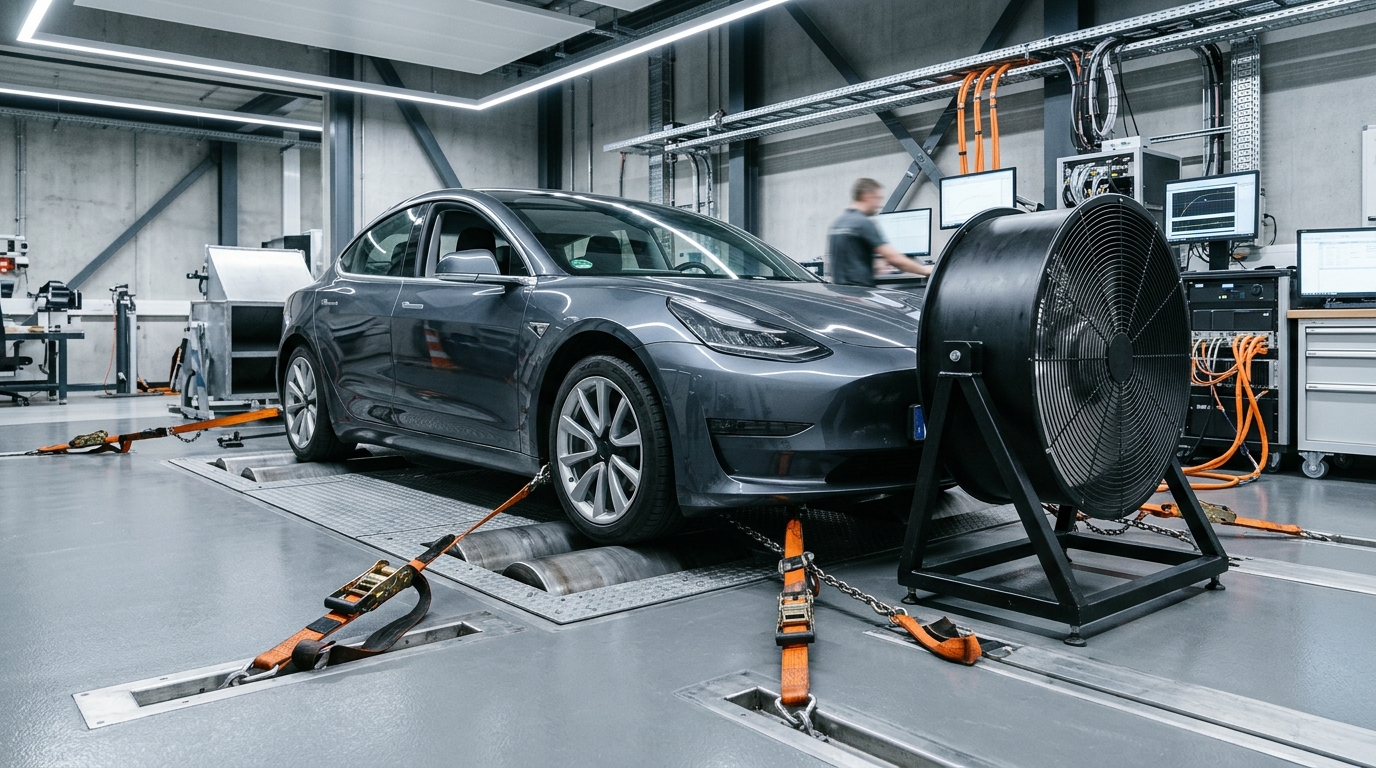
The reason lies in how each protocol measures range. The EPA procedure combines five cycles covering city, highway, high-speed, hot, and cold conditions, and applies a 0.7 adjustment factor to better approximate real-world driving. WLTP uses four phases, low, medium, high, and extra-high, conducted at 23 °C, and is generally considered 15 to 25 percent more conservative than the outdated NEDC cycle, which relies on unrealistic speeds and a single 20-minute test. Because of these procedural differences, an EPA-labeled vehicle and a WLTP-labeled vehicle cannot be compared directly without acknowledging the different test procedures. The new framework treats the reporting protocol as a modeling dimension in its own right, rather than as a fixed conversion factor.
To build the system, the study compiled a database of 319 battery electric vehicle configurations from publicly available specifications, with each record containing attributes such as battery capacity, nominal voltage, number of cells and modules, curb weight, drag coefficient, top speed, acceleration, and dimensional characteristics. Verified official range labels were available for 176 EPA, 88 WLTP, and 98 NEDC observations. Of the 319 configurations, 227 had at least one of these regulatory labels and contributed to the pooled supervised modeling tasks. Pairwise overlap was uneven: the EPA–NEDC pair had 93 matched configurations, EPA–WLTP had 37, WLTP–NEDC had 19, and only 14 configurations carried all three labels. The authors deliberately retained all verified labels rather than forcing equal sample sizes, which would have required discarding valid observations or imputing missing regulatory targets.
The framework evaluates a progression of tasks. It begins with single-standard models that predict EPA, WLTP, or NEDC labels separately from vehicle specifications, then moves to pooled regression that combines all labels into one target, first ignoring the protocol and then explicitly encoding it. A two-stage harmonization formulation follows, in which each official label is represented as a model-derived protocol-neutral latent baseline plus a protocol-specific residual correction. The latent baseline summarizes common structure learned from pooled official labels and vehicle specifications; the study is explicit that it is a statistical reference, not a measured physical range or an estimate of actual on-road driving range. Finally, the framework learns bidirectional translations among standards and predicts pairwise protocol gaps, such as WLTP-minus-EPA and NEDC-minus-EPA.
The headline result concerns the value of protocol information. In the primary held-out grouped split, the pooled model with protocol information achieved an RMSE of 43.20 kilometers and an R² of 0.925, compared with 54.21 kilometers and 0.882 when protocol identity was omitted. The two-stage model produced nearly identical performance, with an RMSE of 43.44 kilometers and an R² of 0.924. Because a single split can be favorable, the study repeated the comparison across 30 independent vehicle-grouped holdout splits. Mean RMSE decreased from 46.97 kilometers without protocol information to 32.14 kilometers with protocol information, with zero vehicle overlap between training and testing in every split. The repeated result indicates that the benefit of protocol encoding is not an artifact of one favorable partition.
Leakage control was central to the evaluation design. Because the same vehicle may appear under more than one protocol label, a conventional row-level train-test split could overestimate performance by allowing one protocol label of a vehicle to appear in training while another label of the same vehicle appears in testing. The study therefore split at the vehicle-configuration level: in the final grouped split, the training set contained 181 vehicle configurations and 286 long-format protocol-label rows, while the test set contained 46 configurations and 76 rows, with zero vehicle overlap. The protocol-wise test set included 39 EPA rows, 23 NEDC rows, and 14 WLTP rows. Candidate learners included linear and regularized-linear regression, Extra Trees, and histogram-based gradient boosting, combined in a stacking regressor with a ridge meta-learner fitted on out-of-fold predictions.
Single-standard baselines showed that static specifications contain substantial predictive information within each protocol, with test RMSE values of 25.81 kilometers for EPA, 24.90 kilometers for WLTP, and 16.25 kilometers for NEDC. The gap-prediction experiments found the strongest structure in the EPA–NEDC pair: the NEDC-minus-EPA gap, trained on 74 of 93 paired observations and tested on 19, achieved a test RMSE of 7.49 kilometers, an MAE of 4.31 kilometers, and an R² of 0.905 with an Extra Trees model. The WLTP-related gap tasks were harder, with RMSE values of 36.40 kilometers for WLTP-minus-EPA and 30.57 kilometers for NEDC-minus-WLTP, reflecting their much smaller paired samples.
Cross-standard translation results were more nuanced than the single-split errors alone might suggest. On the deterministic held-out sets, the smallest errors occurred for the EPA–NEDC pair, with EPA-to-NEDC achieving an RMSE of 4.84 kilometers and NEDC-to-EPA 6.30 kilometers, while EPA-to-WLTP and WLTP-to-EPA produced 21.03 and 36.20 kilometers respectively. The machine-learning configurations achieved the lowest RMSE in four of six translation directions and beat identity and median-ratio baselines in all six, but source-only linear regression performed slightly better for NEDC-to-WLTP, at 26.06 versus 27.69 kilometers, and for WLTP-to-EPA, at 35.26 versus 36.20 kilometers. Bootstrap resampling with 5,000 repetitions produced 95 percent RMSE intervals ranging from 0.00 to 7.32 kilometers for EPA-to-NEDC up to 20.32 to 49.00 kilometers for WLTP-to-EPA, and nested validation yielded more conservative RMSE values of roughly 17.15 to 31.79 kilometers across directions. The 19-vehicle WLTP–NEDC analyses are explicitly treated as exploratory diagnostics rather than validated conversion rules.
Interpretability and uncertainty analyses rounded out the framework. Permutation importance ranked battery capacity as the most influential input for the best pooled protocol-aware model, with protocol identity second, followed by body style, battery capacity per unit mass, top speed, voltage, materials, acceleration, and number of cells. Feature-group ablation confirmed that no single feature family matched the full model: the performance/design subset achieved the best compact result at 54.44 kilometers RMSE, while the geometry/packaging subset reached 85.92 kilometers, against 43.20 kilometers for the complete feature set. Partial-dependence analysis showed the clearest positive marginal relationship for battery capacity, a plateauing pattern for battery capacity per unit mass, and a weaker, partly saturating response for top speed, though these curves are model-based associations rather than causal effects. Out-of-group testing, which required the model to predict labels for entirely unseen categories, produced median RMSE values of 54.53 kilometers for market-level transfer, 66.13 kilometers for brand-level transfer, and 67.42 kilometers for body-style-level transfer, showing that accuracy can drop when the test set represents an unseen manufacturer or vehicle class.
Uncertainty was quantified with grouped split-conformal prediction in which vehicle configurations were mutually exclusive across training, calibration, and final testing. For a nominal 90 percent interval, the grouped procedure achieved 93.4 percent empirical coverage on held-out official labels, indicating mildly conservative rather than under-covering intervals. The intended applications are analytical rather than operational: researchers assembling multi-market EV datasets, regulatory and policy analysts comparing standards, manufacturers benchmarking vehicles across jurisdictions, and database developers integrating specifications reported under different test procedures. The study contains no measured on-road energy consumption or driving-range observations, and the authors note that type-approval and real-world performance can diverge because of test-cycle assumptions and operating conditions such as driving behavior, ambient temperature, traffic, trip length, and road grade. Until independent real-world telemetry is incorporated, the results should be read as a structured approach to regulatory-label harmonization and cross-market comparison, not as predictions of actual on-road EV range.
Subject of Research: Protocol-aware machine learning for harmonizing and translating official electric vehicle range labels across EPA, WLTP, and NEDC regulatory standards
Article Title: A protocol-aware learning framework for harmonizing and translating official electric vehicle range labels across regulatory standards
Article References: Younas, M. Z. (2026). A protocol-aware learning framework for harmonizing and translating official electric vehicle range labels across regulatory standards. Discover Vehicles, 2(1), Article 50. https://doi.org/10.1007/s44465-026-00053-w
Image Credits: AI Generated
DOI: 10.1007/s44465-026-00053-w
Keywords: electric vehicles, EV range labels, EPA, WLTP, NEDC, machine learning, regulatory standards, type approval, cross-standard translation, uncertainty quantification, battery capacity, harmonization
News Source: Denise Maddox. (November 5, 2026). AI learns to translate official EV range labels between EPA, WLTP and NEDC test standards. Scienmag.