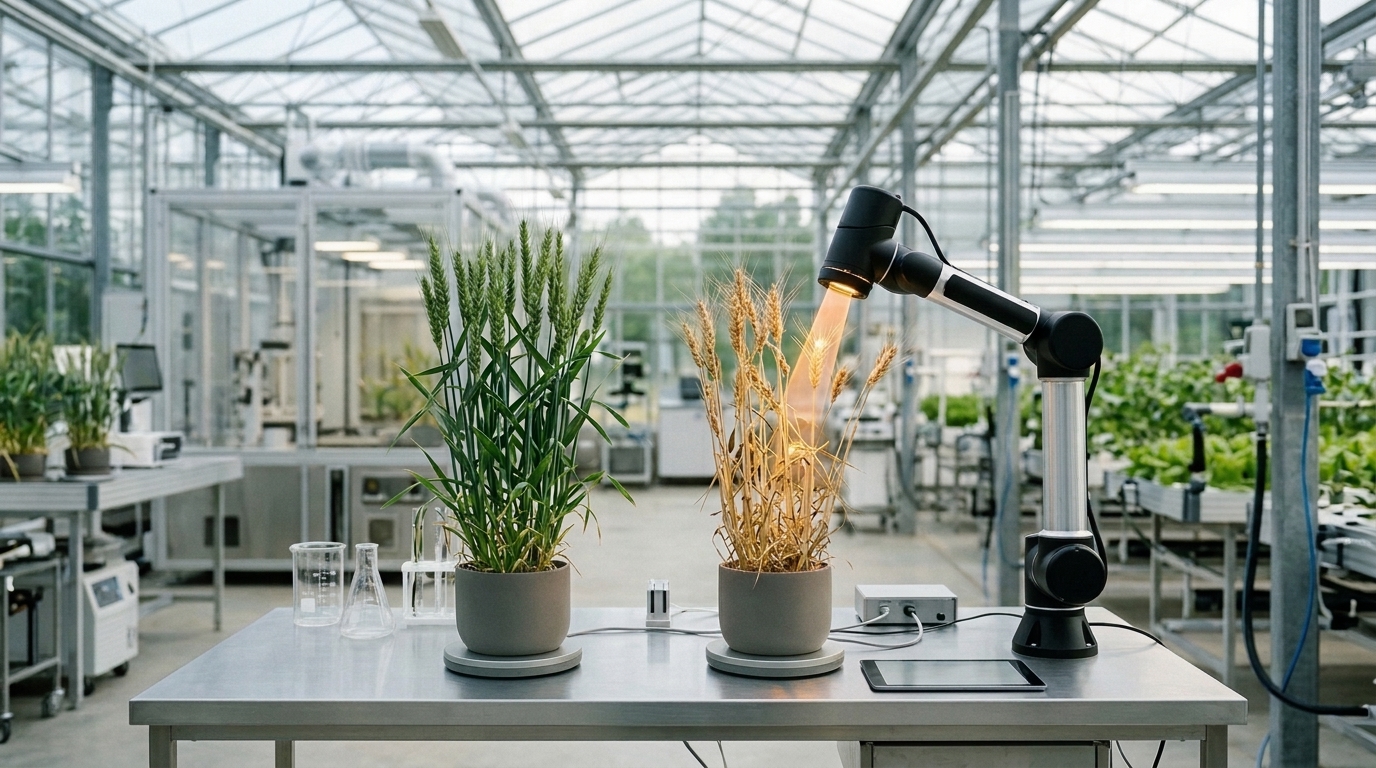
Climate change is not only shrinking harvests; it is quietly rewriting the chemistry of the food on our plates. Rising temperatures, elevated atmospheric carbon dioxide, and increasingly erratic seasons are altering the nutritional composition and sensory attributes of agricultural products, from the protein in wheat to the aroma compounds in tea. A new review published in Artificial Intelligence in Agriculture argues that no single research method can untangle this complexity alone, and proposes an artificial intelligence-centred framework that fuses three major approaches into one coordinated system for understanding how climate shapes the quality of agricultural products.
The review, led by Wenjie Yu and Liping Luo, synthesises decades of research across three methodological pillars: data-driven statistical and machine learning methods, process-based crop models, and controlled manipulation experiments. Each approach has distinct strengths. Data-driven methods excel at mining statistical relationships from large heterogeneous datasets, process-based models encode physiological mechanisms and enable regional extrapolation, and manipulation experiments establish causal links between specific climatic factors and quality traits. Yet the authors contend that these approaches have largely operated in parallel, leaving their integration pathways unexamined and limiting progress on one of agriculture’s most pressing questions.
The stakes are considerable. Modelling studies project that by mid-century, elevated carbon dioxide concentrations and rising temperatures could reduce concentrations of key nutrients such as protein, iron, and zinc in major staple crops by 5 to 30 percent. High-value commodity crops may fare worse still, with concentrations of flavour-relevant compounds including amino acids and volatile aromatics potentially dropping by more than 50 percent. Such declines would disproportionately threaten low-income populations that rely on staple grains, and would erode the economic value of crops like tea, coffee, and hops whose market appeal depends on flavour chemistry.
Data-driven methods have long served as the workhorse for detecting climate-quality relationships. Early studies relied on univariate regression: a meta-analysis reported that each 1 degree Celsius increase in night-time temperature reduced the amylose content of rice starch by approximately 2 percent, while an analysis of 48 years of European climate data found that a 1.4 degree Celsius warming would lower alpha-acid content in hops by 0.6 percent. Multivariate regressions later extended these analyses to multiple drivers simultaneously, revealing for instance that rainfall in the third week after wheat sowing had the greatest effect on gluten strength, and that wheat protein content in the Huang-Huai-Hai region increased by approximately 0.29 percent for each 1 degree increase of latitude.
Artificial intelligence has now pushed beyond these linear constraints. Machine learning and deep learning models can automatically extract features from high-dimensional data, capture non-linear relationships, and handle multicollinearity without requiring pre-specified functional forms. One hybrid framework combining random forests and neural networks predicted Egyptian wheat yield and grain protein, iron, and zinc concentrations with high accuracy across 2400 observations, achieving a coefficient of determination of 0.78. When extended to future climate scenarios, the framework revealed a potential nutrient dilution effect: warming could increase wheat yield and protein content while substantially reducing iron and zinc concentrations. Comparative studies consistently show that AI has outperformed linear regression in predicting quality traits and related outcomes.
Yet the black-box problem persists. Complex AI models often obscure the decision processes that link meteorological inputs to quality outputs, undermining mechanistic interpretability and trustworthiness. Explainable AI techniques such as Shapley Additive Explanations and Local Interpretable Model-agnostic Explanations are beginning to address this gap. An interpretable random forest model based on SHAP identified night-time temperature as the dominant driver of the proportion of premium grade rice in China and Japan, finding that each 1 degree Celsius increase reduced that proportion by 1.22 percent, with 18 degrees Celsius marking a critical threshold beyond which substantial declines occurred. Another study combining XGBoost with SHAP found that water supply was generally more important than temperature for eight winter wheat quality indicators in the North China Plain.
Process-based crop models such as DSSAT, APSIM, and WOFOST offer a complementary route by encoding photosynthesis, respiration, carbon and nitrogen transformations, and phenological regulation into mechanistic simulations. These models have been extended to quality traits: one study embedded a nutrition-quality module in CERES-Wheat to convert simulated grain nitrogen into protein content, while another introduced a response function into RiceGrow that linked cooling degree days to reductions in grain nitrogen uptake, improving predictions of rice protein accumulation. However, mainstream PBMs were originally built around crop growth and resource allocation, and their applications to quality modelling remain most developed for staple crops with traits closely tied to carbon and nitrogen metabolism. Flavour-related secondary metabolites in cash crops and quality responses in animal-source products remain largely beyond their reach.
Manipulation experiments provide the causal anchor. Controlled laboratory and field platforms, including greenhouses, growth chambers, open-top chambers, and free-air carbon dioxide enrichment facilities, allow researchers to isolate the effects of temperature, carbon dioxide, water, and radiation on quality traits. Exposing rice during grain filling to 38 degrees Celsius for 7 to 28 days inhibited the expression of starch branching enzyme and starch synthase, reduced starch granule size, and significantly decreased amylose and amylopectin contents. Multi-omics approaches layered onto these experiments are dissecting molecular pathways: a genome-wide association study of 525 rice accessions under heat stress identified three quantitative trait loci associated with grain appearance quality, while integrated transcriptomic and proteomic analyses showed that heat stress disrupted grain filling and starch synthesis in rice, markedly reducing the expression of key starch synthesis genes and increasing chalkiness.
The proposed framework positions AI not merely as a modelling tool but as the central orchestrator coordinating all three approaches across a six-step workflow. Multi-source data including meteorological records, remote sensing, soil, management, quality measurements, and multi-omics are first integrated and aligned using AI for temporal alignment, spatial resampling, and missing-value imputation. Hybrid models are then constructed by embedding empirical response functions into process-based models. Uncertainty quantification identifies priority targets for validation, and targeted manipulation experiments test model-derived causal hypotheses. Results feed back into iterative model updating, ultimately generating decision-support outputs such as management recommendations, cultivar screening suggestions, and risk zoning maps. An illustrative case applies this workflow to rice chalkiness, an appearance-quality trait, tracing the pathway from data integration through threshold identification to experimental validation and early-warning information for high-risk occurrence.
The authors are candid about remaining challenges. Most current AI models still rely primarily on black-box prediction, and even interpretable approaches mainly identify feature contributions rather than directly revealing causal pathways. Data bias further limits generalisability: studies remain heavily concentrated on major staple crops such as rice, wheat, and maize, and on indicators such as protein content, while cash crops, animal-source products, and more complex quality traits remain sparse. Samples collected under extreme heat, low temperature, drought, and compound stress conditions are scarce. The review calls for generalisability-evaluation frameworks that include climate-zone-based leave-group-out validation, extrapolation tests in extreme years, and independent validation across cultivars, alongside uncertainty reporting that includes prediction intervals and stratified errors. As a core tool for linking multi-source data and integrating cross-scale information, AI is moving data-driven approaches, manipulation experiments, and process-based models from parallel coexistence towards structural coordination, laying methodological groundwork for climate-adaptive management and precision quality regulation in agriculture.
Subject of Research: An AI-centred multi-source integration framework for studying climate change effects on the quality of agricultural products
Article Title: A multi-source artificial intelligence framework for understanding climate effects on quality of agricultural products and supporting sustainable food systems
Article References: Yu, W., Sun, Q., Guo, Y., Wang, Q., Guo, X., Wu, H., Li, Y., & Luo, L. (2026). A multi-source artificial intelligence framework for understanding climate effects on quality of agricultural products and supporting sustainable food systems. Artificial Intelligence in Agriculture. https://doi.org/10.1016/j.aiia.2026.11.002
Image Credits: AI Generated
DOI: 10.1016/j.aiia.2026.11.002
Keywords: artificial intelligence, agriculture, climate change, crop quality, process-based crop models, manipulation experiments, multi-omics, food security, machine learning, explainable AI, sustainable food systems, multi-source
News Source: Alan Morgan. (November 5, 2026). AI as Central Hub to Decode Climate Effects on Crop Quality. Scienmag.