• HOME
  • NEWS
  • EXPLORE
    • CAREER
      • Companies
      • Jobs
    • EVENTS
    • iGEM
      • News
      • Team
    • PHOTOS
    • VIDEO
    • WIKI
  • BLOG
  • COMMUNITY
    • FACEBOOK
    • INSTAGRAM
    • TWITTER
Thursday, November 5, 2026
BIOENGINEER.ORG
No Result
View All Result
  • Login
  • HOME
  • NEWS
  • EXPLORE
    • CAREER
      • Companies
      • Jobs
        • Lecturer
        • PhD Studentship
        • Postdoc
        • Research Assistant
    • EVENTS
    • iGEM
      • News
      • Team
    • PHOTOS
    • VIDEO
    • WIKI
  • BLOG
  • COMMUNITY
    • FACEBOOK
    • INSTAGRAM
    • TWITTER
No Result
View All Result
Bioengineer.org
No Result
View All Result
Home NEWS Science News Technology

Adapt-Ring Polymer Networks Reorganize and Strengthen Under Mechanical Stress

by
November 5, 2026
in Technology
Reading Time: 2 mins read
0
Adapt-Ring Polymer Networks Reorganize and Strengthen Under Mechanical Stress

Adapt-Ring Polymer Networks Reorganize and Strengthen Under Mechanical Stress

Share on FacebookShare on TwitterShare on LinkedinShare on RedditShare on Telegram

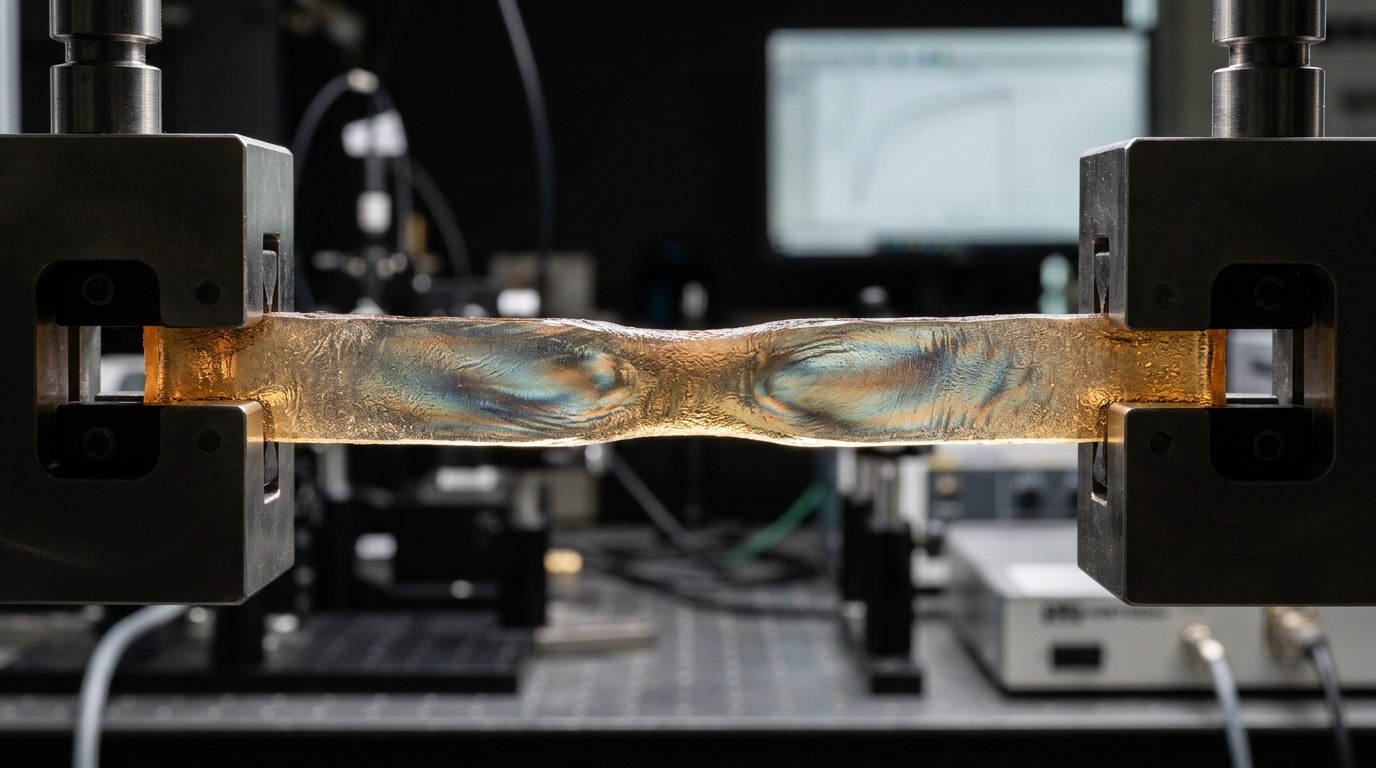
Researchers have developed adapt-ring networks that establish a design principle for adaptive polymer materials capable of autonomously remodeling and strengthening under mechanical stress. The material architecture couples a covalent polyethylene glycol network with reconfigurable α-cyclodextrin crystalline domains, addressing the typical inability of synthetic polymer networks to autonomously remodel and strengthen under applied load.

Under applied strain, the fragmentation, translocation, and alignment of the α-cyclodextrin crystalline domains form kinetically trapped architectures that encode local mechanical history. Mechanical training enhances the network’s Young’s modulus, tensile strength, fracture energy, and fatigue threshold by up to an order of magnitude, with full reversibility achieved through solvent-induced crystalline-domain reformation.

The system demonstrates spatially resolved adaptation and 3D printability, enabling gradient materials and customized architectures. In addition, incorporating polyethylene glycol side chains to form dangling-chain adapt-ring networks enables strain-controlled out-of-equilibrium growth through the threading and crystallization of external α-cyclodextrins, autonomously generating spatially self-organized, environment-fed stiffening conceptually analogous to biological reinforcement.

Subject of Research: Adaptive polymer networks

Article Title: Mechanical adaptation drives out-of-equilibrium network reorganization and self-strengthening in adapt-ring networks

Article References: Zheng, D., Yu, Z., Chen, Y., Smith, C. D., Bai, M., Tsai, E. H. R., Liu, J., Zhang, W., Lin, S., & Ke, C. (2026). Mechanical adaptation drives out-of-equilibrium network reorganization and self-strengthening in adapt-ring networks. Nature Materials. https://doi.org/10.1038/s41563-026-02795-0

Image Credits: AI Generated

DOI: 10.1038/s41563-026-02795-0

Keywords: polymer networks, adapt-ring networks, mechanical adaptation, polyethylene glycol, cyclodextrin, soft materials, hydrogels, self-strengthening, Mechanical, adaptation, drives, out-of-equilibrium

News Source: Neil Sanderson. (November 5, 2026). Adapt-Ring Polymer Networks Reorganize and Strengthen Under Mechanical Stress. Scienmag.

Tags: adapt-ring networksadaptationcyclodextrindriveshydrogelsmechanicalmechanical adaptationout-of-equilibriumpolyethylene glycolpolymer networksself-strengtheningsoft materials
Share12Tweet7Share2ShareShareShare1

Related Posts

CFS-DETR Framework Enhances Agglomeration Detection in Fiber Ultrastructure Microscopy

CFS-DETR Framework Enhances Agglomeration Detection in Fiber Ultrastructure Microscopy

November 5, 2026
Brain Networks May Sit at a Critical Edge That Shapes Thought, Seizures and Consciousness

Brain Networks May Sit at a Critical Edge That Shapes Thought, Seizures and Consciousness

November 5, 2026

Chaotic laser pulses and Raman controls reveal lead fingerprints in reservoir water

November 5, 2026

AI learns to steer EV charging, traffic and power grids as one system

November 5, 2026

POPULAR NEWS

  • Sensor suit tracks spinal motion to flag scoliosis without X-rays

    Sensor suit tracks spinal motion to flag scoliosis without X-rays

    29 shares
    Share 12 Tweet 7
  • China-Made Metformin XR Tablets Match German Ones in Healthy Adults

    29 shares
    Share 12 Tweet 7
  • CRISPR cuts at wheat centromeres rewrite the karyotype in a single generation

    29 shares
    Share 12 Tweet 7
  • Nerves and Mesodermal Cells Drive Segment Regeneration in Polychaete Annelids

    29 shares
    Share 12 Tweet 7

About

We bring you the latest biotechnology news from best research centers and universities around the world. Check our website.

Follow us

Recent News

Mapping the bioinformatics toolbox that tracks emerging viral outbreaks

Multi-Component Osmolyte-Based Solvents Tuned to Mimic Intracellular Environments

Sensor suit tracks spinal motion to flag scoliosis without X-rays

Subscribe to Blog via Email

Enter your email address to subscribe to this blog and receive notifications of new posts by email.

Join 86 other subscribers
  • Contact Us

Bioengineer.org © Copyright 2023 All Rights Reserved.

Welcome Back!

Login to your account below

Forgotten Password?

Retrieve your password

Please enter your username or email address to reset your password.

Log In
No Result
View All Result
  • Homepages
    • Home Page 1
    • Home Page 2
  • News
  • National
  • Business
  • Health
  • Lifestyle
  • Science

Bioengineer.org © Copyright 2023 All Rights Reserved.