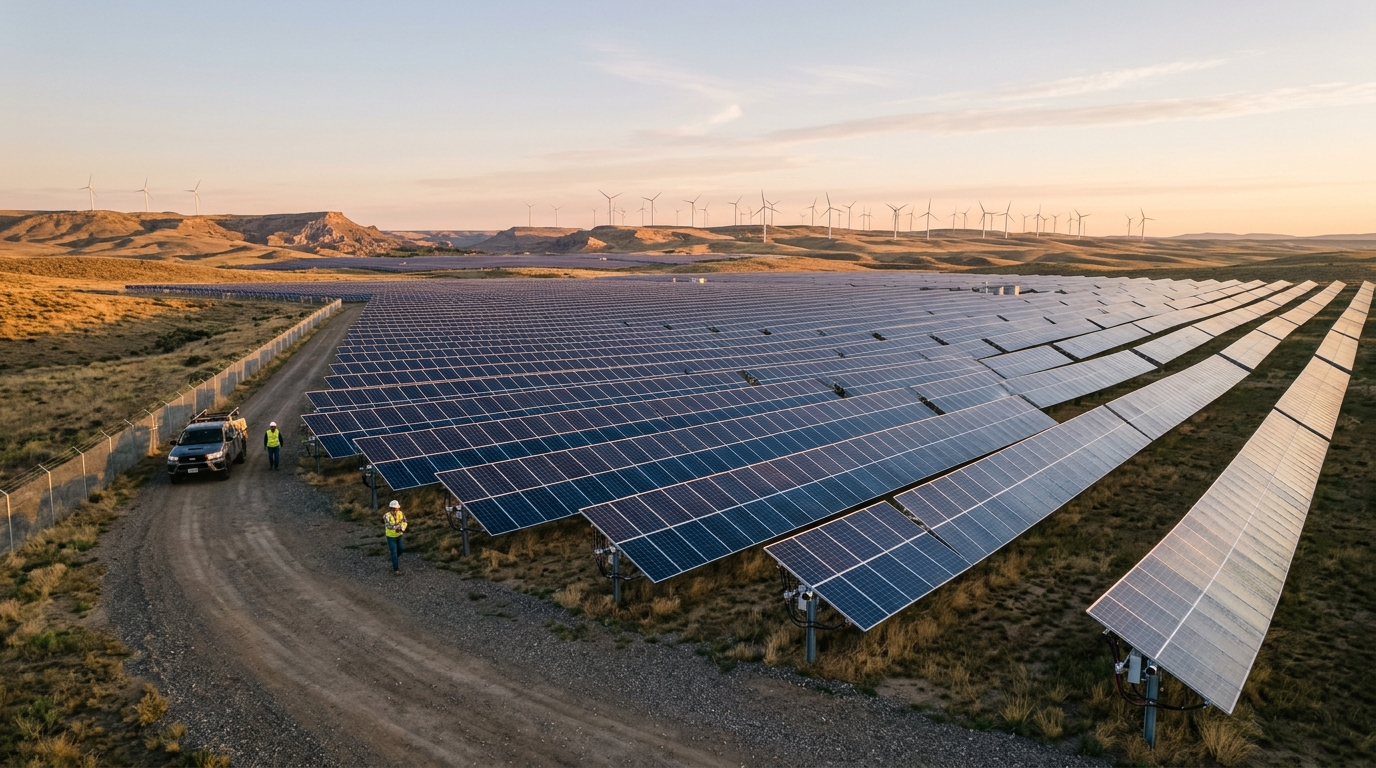
Green finance is the financial variable most consistently associated with renewable-energy transition across a new study of 50 European and African economies, according to research published on 4 November 2026 in Discover Energy. The study, a quantitative panel analysis of 25 European and 25 African countries covering 2000 to 2024, finds that green finance — measured as combined annual issuance of green bonds, sustainability bonds, and sustainability-linked bonds — is positively and statistically significantly associated with renewable energy consumption in every major specification the authors employed, while other financial and structural relationships prove far more fragile.
The research team, led by Efe-Eyefia Oghenechoja with co-authors including Clinton Emmanuela Nneka, Abdulgaffar Muhammad, and Maryam Isyaku, assembled a balanced panel of 1,250 country-year observations. Low-carbon transition was measured primarily as renewable energy consumption as a percentage of total final energy consumption, drawn from the World Bank’s World Development Indicators, with renewable electricity output used as an alternative outcome. Data came from the World Development Indicators, the Worldwide Governance Indicators, and sustainable-bond issuance records compiled from Refinitiv, country authorities, and IMF staff calculations.
Methodologically, the study layers four complementary approaches. A two-way fixed-effects model with Driscoll–Kraay standard errors provides the baseline, chosen because the panel exhibits heteroskedasticity, serial correlation, and significant cross-sectional dependence. Dynamic System GMM estimation addresses persistence and potential endogeneity, panel threshold regression tests whether the green finance relationship changes across institutional-quality regimes, and a country-grouped XGBoost model with SHAP interpretation assesses predictive relationships. The authors are explicit that these estimators address distinct empirical dimensions and are not interchangeable estimates of a single causal effect.
In the baseline fixed-effects model, green finance carries a positive and highly significant coefficient (β = 0.130, p < .001), meaning that, holding covariates and country and year effects constant, higher green-finance activity is associated with a higher renewable share of final energy consumption. Capital allocation efficiency, measured as the inverse incremental capital–output ratio, is positive but statistically insignificant (β = 0.467, p = .159), and financial development, proxied by domestic credit to the private sector by banks, is positive and significant (β = 0.036, p < .001). The green finance result survives the dynamic System GMM specification (β = 0.074, p = .021), where the lagged dependent variable indicates substantial persistence in renewable energy shares over time.
The most striking result concerns institutional quality. In the panel threshold regression, the estimated threshold for regulatory quality is 0.237, and the green finance coefficient is substantially larger below that threshold (β = 0.640) than above it (β = 0.076), though it remains positive and significant in both regimes. This contrasts with the continuous interaction models, where the green finance × institutional quality term is positive and significant, suggesting that the marginal association of green finance increases with regulatory quality within a linear framework. The authors stress that these specifications impose different functional forms and that the threshold finding does not mean weaker institutions are inherently more conducive to transition; the aggregate renewable-consumption measure can reflect very different energy compositions across countries.
The alternative-outcome analysis provides targeted reassurance. When renewable electricity output replaces renewable energy consumption as the dependent variable, using 958 country-year observations from 49 countries over 2000–2021, green finance remains positive and significant (β = 0.218, p = .001). However, several other relationships do not survive the change: financial development becomes negative and insignificant, economic development loses significance, and industrial structure is insignificant. The authors conclude that the positive green finance association is comparatively stable, while financial development, economic development, and industrial structure are sensitive to how transition is operationalised.
That sensitivity extends across the full set of specifications. Economic development, measured as the logarithm of GDP per capita, is positive and significant in the fixed-effects and System GMM models but turns negative and significant in the threshold model (β = −11.209, p = .012), a reversal the authors attribute partly to the very high correlation between institutional quality and economic development (r = .885). Industrial structure is negatively associated with the renewable share in the principal models but insignificant elsewhere. The authors interpret these pooled coefficients as average conditional relationships rather than causal effects, and the System GMM diagnostics — including a non-significant AR(2) test, a non-significant Hansen test, and an instrument count below the number of countries — support the model’s specification without proving causality.
The machine-learning component adds a cautionary note about generalisability. Using nested country-grouped cross-validation, in which entire countries are held out of training, XGBoost achieves an out-of-fold R² of 0.509 with an RMSE of 21.384 and an MAE of 15.877 — materially lower than the 0.846 obtained under an earlier time-series split. The out-of-fold SHAP analysis ranks economic development as the largest predictive contributor (63.0% of total importance), followed by financial development (18.5%), while green finance contributes only 2.7%. The authors emphasise that SHAP importance measures contribution to nonlinear prediction, not coefficient direction, statistical significance, or causality, and that the low predictive ranking of green finance does not contradict its significant econometric coefficient.
Further complicating any simple policy reading, the Pesaran–Yamagata slope-homogeneity tests strongly reject homogeneous slopes across the 50 countries, both before and after adjustment for common cross-sectional components. This means the estimated relationships vary across countries, and the pooled coefficients should not be applied mechanically to any single economy. The diagnostics also confirm significant cross-sectional dependence (Pesaran CD = 11.843, p < .001), heteroskedasticity, and serial correlation, justifying the robust inference used throughout.
The study’s limitations are acknowledged by the authors themselves. The green finance measure captures bond issuance only, omitting green loans, climate funds, and concessional finance; the institutional measure is limited to regulatory quality; and the principal outcome measure may blend traditional and modern renewable sources, particularly in African economies where hydropower and traditional biomass can dominate final energy use. Within these boundaries, the conclusion is measured: green finance is the most consistent financial correlate of renewable-energy-based transition in the sample, but its transmission operates within heterogeneous financial, institutional, and structural conditions, and the evidence establishes robust conditional associations rather than proof that expanding issuance alone will cause renewable-energy deployment to rise uniformly across countries.
Subject of Research: The association of green finance, capital allocation efficiency, and financial development with renewable-energy transition across European and African countries
Article Title: Green finance as a policy transmission channel for low carbon transition in Europe and Africa and the role of capital allocation efficiency and financial development
Article References: Oghenechoja, E.-E., Emmanuela Nneka, C., Muhammad, A., Chidi, E. N., Odiase, B. O., Bugaje, I. B., Rafi, B. A., & Isyaku, M. (2026). Green finance as a policy transmission channel for low carbon transition in Europe and Africa and the role of capital allocation efficiency and financial development. Discover Energy, 6(1), Article 102. https://doi.org/10.1007/s43937-026-00216-6
Image Credits: AI Generated
DOI: 10.1007/s43937-026-00216-6
Keywords: green finance, renewable energy, low-carbon transition, panel data, institutional quality, financial development, capital allocation efficiency, System GMM, XGBoost, SHAP, Europe, Africa
News Source: Faith Mcneil. (November 5, 2026). Green finance shows the most consistent link to renewable energy across Europe and Africa. Scienmag.