


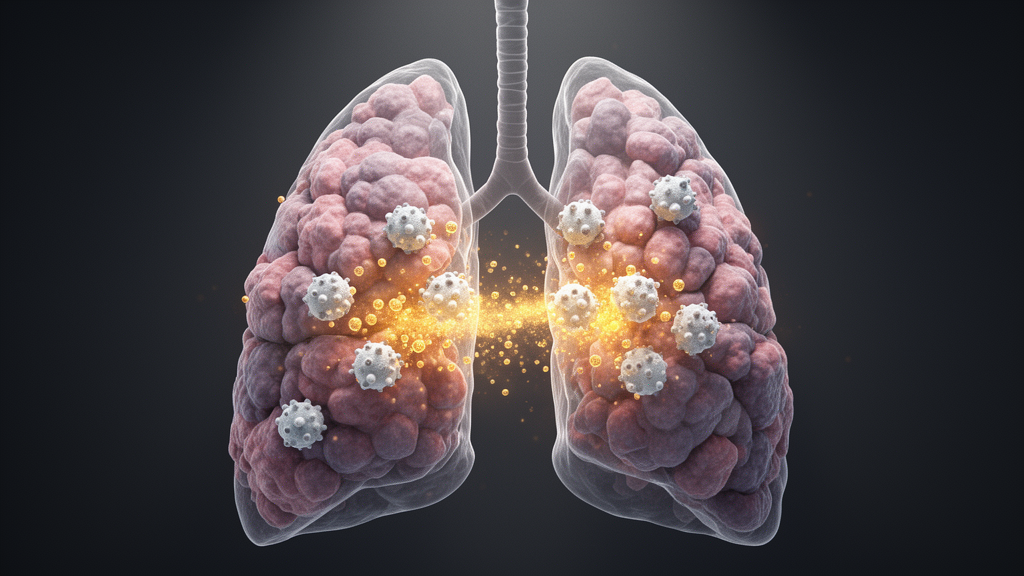
Immune checkpoint inhibitors have transformed treatment of advanced non-small cell lung cancer, yet many patients do not respond, and others acquire resistance over time. A new open-access study published in Cancer Immunology, Immunotherapy points to one potential contributor: a specific state of tumor-associated neutrophils driven by tumor-derived TNF-α. The research, released as a peer-reviewed accepted article with a permanent DOI ahead of final versioning, combined clinical data from 496 NSCLC patients treated with immunotherapy, public single-cell and spatial transcriptomic datasets, and laboratory experiments on human neutrophils.
The clinical signal centered on neutrophils themselves. High pretreatment peripheral blood neutrophil levels were independently associated with non-response to immunotherapy and with shorter progression-free and overall survival. Single-cell RNA sequencing analysis identified a subset the authors call Neutrophil_2_CCL4, marked by high CCL4 expression and carrying features of tumor-associated neutrophils. This subset was enriched in tumors classified as stable disease—non-responding lesions—and its presence was associated with shorter progression-free survival.
Mechanistically, the study links this neutrophil state to tumor-cell signaling. Pseudotime, regulon, cell-communication, and spatial transcriptomic analyses connected the CCL4-high subset to a TNF/TNF receptor-dependent activation of the NF-κB pathway in neutrophils adjacent to tumor cells. In laboratory work, conditioned medium from A549 and PC-9 lung cancer cell lines, as well as recombinant TNF-α, increased phosphorylated p65 and PD-L1 protein and raised mRNA levels of CCL3, CCL4, CXCL8, and CD274 in peripheral blood neutrophils. Infliximab, a chimeric anti-TNF-α monoclonal antibody, attenuated these effects, implicating TNF-α as the driver of the observed neutrophil changes.
The functional consequence appeared in coculture experiments: neutrophils conditioned into this tumor-associated-like state suppressed interferon-γ production by CD8⁺ T cells, the cytotoxic arm that checkpoint inhibitors rely on. This provides a plausible route by which such neutrophils could blunt immunotherapy effectiveness, though the finding comes from in vitro systems rather than direct measurement within patients’ tumors.
To translate the biology into a potential tool, the researchers built an eight-gene tumor-associated neutrophil-related signature (TANRS) derived from the CCL4⁺ neutrophil features. The signature was prognostic in public NSCLC cohorts and was associated with response, progression-free survival, and overall survival in an independent institutional cohort of ICI-treated patients. Notably, it stratified neither response nor survival in an institutional chemotherapy-treated comparator cohort, suggesting specificity to the immunotherapy setting. The authors position TANRS as a candidate blood-accessible biomarker—prognostic and outcome-associated in ICI-treated NSCLC—while the evidence remains associative, and the early-release version is subject to further editorial revision before the final record of publication.
Subject of Research: Tumor-derived TNF-α-driven CCL4-positive tumor-associated neutrophils and their association with immunotherapy resistance in non-small cell lung cancer.
Article Title: Tumor-derived TNF-α promotes CCL4⁺ tumor-associated neutrophil formation and immunotherapy resistance in non-small cell lung cancer
Article References: Xia, Y., Zhang, N., Yuan, S., Wu, S., & Zhou, D. (2026). Tumor-derived TNF-α promotes CCL4⁺ tumor-associated neutrophil formation and immunotherapy resistance in non-small cell lung cancer. Cancer Immunology, Immunotherapy. https://doi.org/10.1007/s00262-026-04614-6
Image Credits: AI Generated
DOI: 10.1007/s00262-026-04614-6
Keywords: non-small cell lung cancer, immune checkpoint inhibitors, tumor-associated neutrophils, TNF-alpha, CCL4, NF-kB, PD-L1, immunotherapy resistance, biomarker, single-cell RNA sequencing, infliximab, CD8 T cells
News Source: Nathaniel Bowman. (October 30, 2026). Tumor TNF-α Drives CCL4-Producing Neutrophils Linked to Immunotherapy Resistance in Lung Cancer. Scienmag.



