


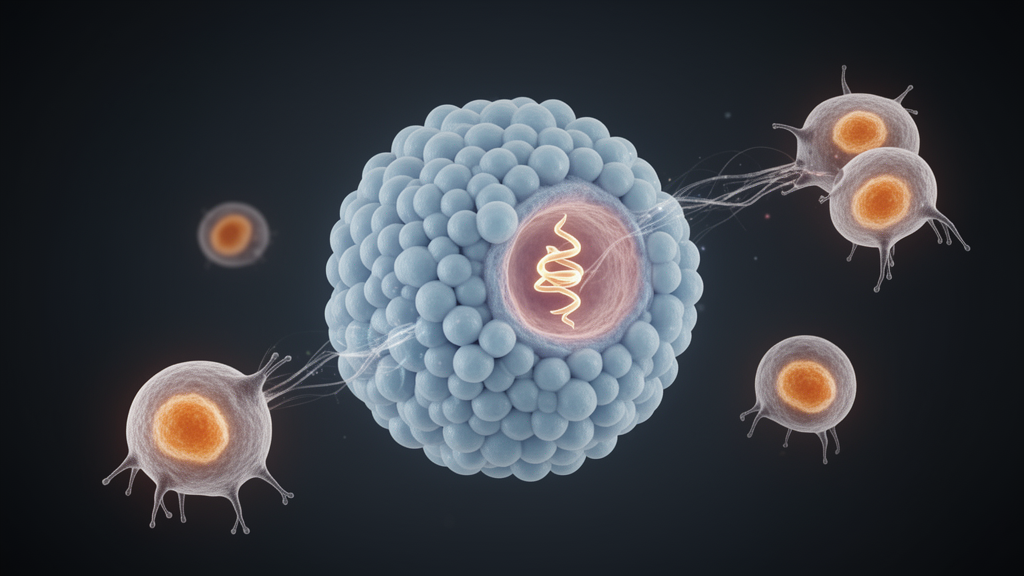
A recurrent mutation in the chromatin-regulating gene CREBBP appears to do more than fuel lymphoma cells directly: according to a new study published in Cell Communication and Signaling, the CREBBP Y1503C mutation also reshapes the tumor microenvironment of diffuse large B-cell lymphoma (DLBCL), driving dysfunction in CD8+ T cells through a NOTCH-STAT1-LGALS9 signaling axis.
The research, published online on 29 October 2026 as an open-access article, focused on the Y1503C change in CREB binding protein, a mutation the authors describe as frequently found in DLBCL. Using biomedical, enzymatic and computational analyses, the team showed that the mutant protein loses its acetyltransferase activity toward the histone marks H3K18 and H3K27, an effect attributed to structural destabilization and conformational alteration compared with the wild-type protein.
Mechanistically, the study reports that loss-of-function mutation of CREBBP reduces the expression of FBXW7. This reduction results in sustained activation of NOTCH signaling, which the authors found promotes tumor growth and impairs CD8+ T cell activation.
The immune dimension of the work emerged from analysis of tumor-immune cell communication. According to the study, CREBBP mutant-driven NOTCH activation in malignant B cells increases STAT1-dependent expression of LGALS9, a molecule that engages TIM3 and PD-1 on exhausted CD8+ T cells, contributing to an immunosuppressive tumor microenvironment.
Collectively, the authors conclude that the CREBBP Y1503C mutation not only promotes DLBCL cell growth but also drives CD8+ T-cell dysfunction. They suggest that these findings support targeting the NOTCH-STAT1-LGALS9 axis as a strategy to overcome epigenetically mediated immune evasion and tumor development.
The findings place epigenetic mutation at the center of a two-sided mechanism in DLBCL: the same genetic lesion that alters chromatin acetylation inside malignant B cells also appears to program how those cells communicate with immune cells around them. By linking loss of CREBBP acetyltransferase activity to FBXW7 downregulation, sustained NOTCH signaling, STAT1-dependent LGALS9 expression and engagement of exhaustion receptors on CD8+ T cells, the study proposes a single signaling chain connecting an epigenetic mutation to T-cell dysfunction.
It should be noted that the published article is being shared early as a peer-reviewed, accepted manuscript, citable with a permanent DOI, and is subject to further edits before the final Version of Record appears. The reported findings derive from the study’s biomedical, enzymatic, computational and cell-communication analyses as described in its abstract, and the authors frame the NOTCH-STAT1-LGALS9 axis as a target to be pursued rather than a validated therapeutic approach.
Subject of Research: How a recurrent CREBBP mutation reshapes the tumor immune microenvironment in diffuse large B-cell lymphoma
Article Title: CREBBP mutation promotes tumor growth and CD8+ T-cell dysfunction in DLBCL via NOTCH-STAT1-LGALS9 signaling
Article References: Liu, R., Nian, Q., Tu, G., Zhang, Y., Li, J., Zhang, R., & Li, G. (2026). CREBBP mutation promotes tumor growth and CD8+ T-cell dysfunction in DLBCL via NOTCH-STAT1-LGALS9 signaling. Cell Communication and Signaling. https://doi.org/10.1186/s12964-026-03339-4
Image Credits: AI Generated
DOI: 10.1186/s12964-026-03339-4
Keywords: CREBBP, DLBCL, NOTCH signaling, LGALS9, CD8+ T cells, epigenetics, tumor microenvironment, STAT1, immune evasion, lymphoma, mutation, promotes
News Source: Nathaniel Bowman. (October 29, 2026). CREBBP mutation drives lymphoma growth and T-cell exhaustion via NOTCH pathway. Scienmag.



