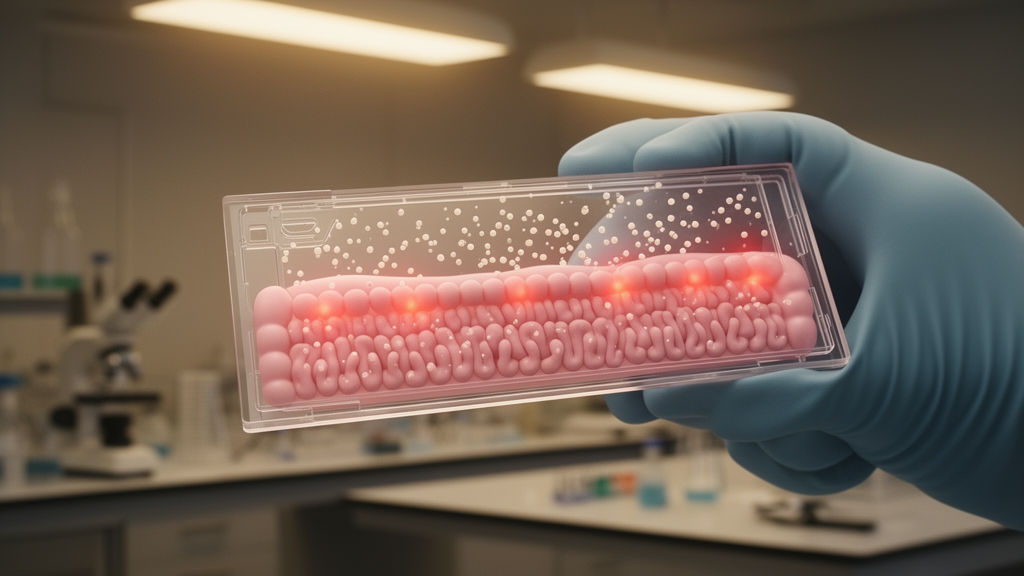
Microplastics shed from food packaging have become an emerging food safety concern, and a new study suggests they may contribute to intestinal inflammation. Researchers report that 20 nm polystyrene nanoplastics (PS-NPs) can trigger oxidative, inflammatory, and epithelial-associated alterations in a laboratory model of the human gut lining, using a platform that combines Caco-2-derived spheroids with a self-developed microfluidic organ-on-a-chip system.
The study, published in npj Science of Food, employed three-dimensional Caco-2-derived spheroids grown within the chip to recreate key features of the intestinal epithelial microenvironment. Rather than relying on flat cell layers, the team systematically examined how the 20 nm PS-NPs affected oxidative stress and functional homeostasis in this 3D setting, exposing the model to concentrations of 40 μg/mL and 400 μg/mL.
To characterize the cellular response, the researchers measured oxidative stress markers, antioxidant capacity, inflammatory factors, and indicators of epithelial function. Immunofluorescence staining was used to evaluate the expression of Villin and ZO-1, proteins associated with epithelial identity and barrier integrity. The results demonstrated that both tested concentrations of the nanoplastics could induce oxidative, inflammatory, and epithelial-associated alterations in the model.
Beyond the direct exposure experiments, the study incorporated computational and bioinformatic analyses. The team performed metabolomic analysis on the chip effluents, the fluid flowing out of the organ-on-a-chip device, to capture the metabolic output of the exposed tissue model. They also conducted styrene-based computational target prediction and exploratory molecular docking, identifying ALOX5 as a computational candidate for further investigation.
As an additional exploratory step, the researchers independently analyzed a public inflammatory bowel disease (IBD) single-cell RNA-sequencing dataset, applying in silico ALOX5 perturbation. This analysis was explicitly framed as exploratory, and the authors describe ALOX5 as a computational candidate rather than a confirmed mechanism, reflecting the limits of what docking predictions and secondary dataset analyses can establish.
The authors state that this is the first study to integrate Caco-2-derived spheroids with organ-on-a-chip technology for nanoplastic toxicity evaluation. They position the platform as a novel experimental system and theoretical basis for investigating potential mechanisms underlying nanoplastic toxicity and for risk assessment of food-related nanoplastics.
Several caveats apply to the findings. The model is built from a single human cell line, Caco-2, and does not capture the full complexity of the living intestine, including the immune system, microbiome, and vasculature. The tested concentrations of 40 μg/mL and 400 μg/mL are laboratory exposure levels, and the study does not establish that typical dietary exposures to nanoplastics produce the same effects in humans. The molecular docking and ALOX5 perturbation results are computational and exploratory in nature.
The authors note that the platform provides a basis for future risk assessment of food-related nanoplastics, while the specific mechanisms linking PS-NPs to intestinal inflammation remain candidates for further experimental validation.
Subject of Research: Mechanisms of intestinal inflammation induced by 20 nm polystyrene nanoplastics studied with Caco-2-derived spheroids and organ-on-a-chip technology
Article Title: Caco-2-derived spheroids and organ-on-a-chip for food safety risk assessment: mechanisms of intestinal inflammation induced by 20 nm polystyrene nanoplastics
Article References: Lu, Z., Yuan, X., Zeng, X., Feng, Q., Li, L., Lv, W., Han, W., Deng, Q., Yang, X., Chen, M., Bao, X., Du, C., Wu, Y., Liu, L., Yang, X., Lu, S., & Ma, P. (2026). Caco-2-derived spheroids and organ-on-a-chip for food safety risk assessment: mechanisms of intestinal inflammation induced by 20 nm polystyrene nanoplastics. npj Science of Food. https://doi.org/10.1038/s41538-026-01218-3
Image Credits: AI Generated
DOI: 10.1038/s41538-026-01218-3
Keywords: nanoplastics, polystyrene, food safety, intestinal inflammation, organ-on-a-chip, Caco-2 spheroids, oxidative stress, microfluidics, ALOX5, metabolomics, gut barrier, risk assessment
News Source: Alan Morgan. (October 29, 2026). Gut-on-a-chip reveals how 20 nm nanoplastics may inflame intestinal cells. Scienmag.