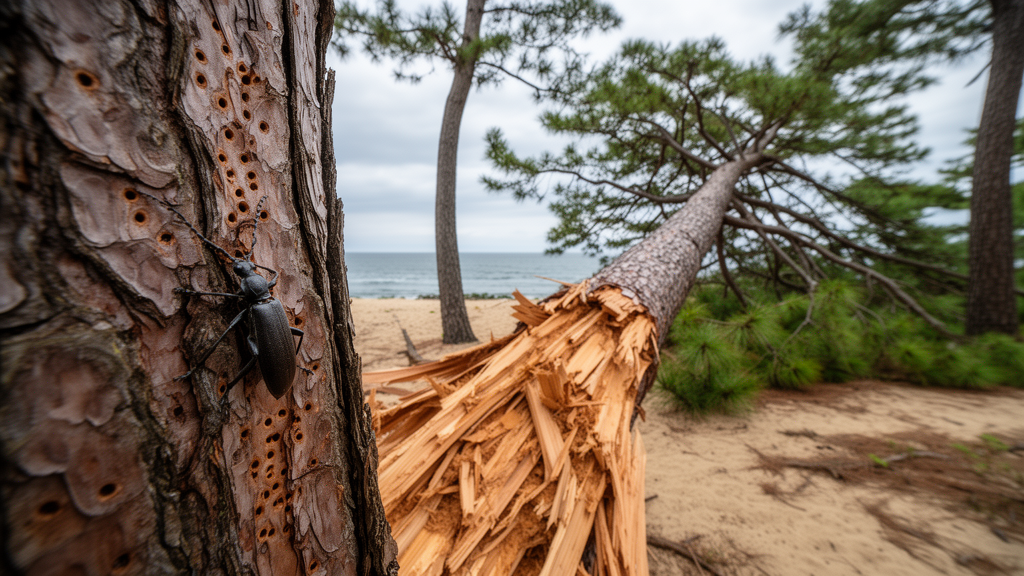
In the coastal forests of Niigata City, Japan, a native longhorn beetle is quietly undermining the trees that were planted to replace pines lost to disease. A field study published in Annals of Forest Science reports that the wood-boring beetle Eupromus ruber (Dalman, 1817) preferentially oviposits on Machilus thunbergii, an evergreen Lauraceae tree now widely planted in temperate coastal forests following the decline of pines caused by pine wilt disease. The study found that oviposition and larval boring by the beetle significantly increased the risk of bole breakage in its preferred host, while a co-occurring Lauraceae species, Neolitsea sericea, showed no signs of infestation at all.
Coastal forests serve as protective buffers against wind-blown sand, strong winds, erosion, and tsunamis. In Japan, these forests were historically dominated by Pinus thunbergii, but extensive mortality from pine wilt disease, caused by the pine wood nematode Bursaphelenchus xylophilus, has driven large-scale changes in forest composition. Following pine decline, many coastal stands have shifted toward Lauraceae species such as M. thunbergii and N. sericea, both through natural succession and deliberate planting to restore coastal protection functions. These plantations are now widespread and often form relatively homogeneous stands, which are known to be more vulnerable to pest outbreaks than mixed-species forests.
Eupromus ruber is widely distributed in East Asia, including Japan, South Korea, and China, and primarily infests Lauraceae trees. Larval feeding has been confirmed on M. thunbergii, Machilus japonicus, and Cinnamomum japonicum. Until the early 2000s, the beetle in Japan was mainly distributed west of the Kanto region on the Pacific side and in the Hokuriku and more western regions on the Sea of Japan side, but additional records have since been reported from central and eastern Kanto, southern Tohoku, and Niigata Prefecture including Sado Island. The movement and planting of Lauraceae seedlings and ornamental trees have been suggested as potential factors contributing to this apparent range expansion. Adult beetles are observed from May to June, feeding on host branches and leaves and laying eggs on old branches; eggs hatch within 7 to 10 days, and larvae feed on woody tissues before pupating and emerging the following summer.
The study was conducted during 2011 and 2012 in the coastal forests of Niigata City, where the mean annual temperature between 1980 and 2020 was 13.9 degrees Celsius and mean annual precipitation was 1826 millimeters. A first survey from May to October 2011 examined signs of E. ruber damage on M. thunbergii along a coastal forest zone stretching from Mt. Kakuda to Sekiya, subdivided into four sites, plus two urban parks. Adult females create distinctive elliptical oviposition scars by peeling bark, larvae expel frass through discharge holes, and newly emerged adults exit through 7 to 8 millimeter diameter holes; in Japan, E. ruber is the only insect known to leave such distinctive signs on living Lauraceae trees. In 2011, signs of beetle activity were found on M. thunbergii in Site A (6 of 6 trees damaged), Sakata Park (35 of 35), and Uwasekigata Park (5 of 5), while no damage was detected in Sites C and D (0 of 18 and 0 of 56 trees).
A follow-up survey on 4 July 2026, using the same damage indicators, covered Sites A through D, Sakata Park, and Niigata University, examining 128 M. thunbergii trees in total. Signs of E. ruber activity were found in Site A (28 of 28 trees), Site B (1 of 1), Sakata Park (19 of 19), and Niigata University (1 of 8), while Sites C and D again showed no signs (0 of 12 and 0 of 60). The authors note that these observations do not provide sufficient evidence to confirm a range expansion of the beetle, but indicate its presence at a small number of locations where infestation had not been detected earlier. Further systematic surveys are needed to determine whether these findings represent recent expansion or previously undetected occurrences, particularly because surveys focused on forest edges and accessible areas and targeted trees taller than roughly 3 meters, potentially overlooking infestations in interior stands and on smaller saplings.
The detailed damage assessment took place from August to October 2012 at a roughly 16.7-hectare stand at the foothills of Mt. Kakuda, where succession following pine wilt disease was progressing and Lauraceae species were becoming increasingly dominant. Researchers surveyed all Lauraceae trees at least 1.3 meters tall without bole breakage, a total of 399 trees comprising 253 M. thunbergii and 146 N. sericea, measuring diameter at breast height and climbing taller trees to inspect higher sections. Damage, including oviposition scars, frass discharge holes, and expelled frass, was observed on 50.6 percent (128 of 253) of M. thunbergii trees, including every tree with a DBH of 5 centimeters or more and 29.4 percent (52 of 177) of trees below 5 centimeters DBH. In contrast, none of the 146 N. sericea trees, which ranged from less than 5 centimeters to nearly 35 centimeters DBH, showed any signs of infestation.
Oviposition behavior showed clear patterns. A total of 316 newly formed oviposition scars on 93 M. thunbergii trees were measured, and linear regression showed that scar positions were significantly higher on trees with larger DBH (coefficient 2.51, p < 0.001), with oviposition shifting from boles to branches as trees grew larger. Oviposition was most frequent on branches and boles 2 to 4 centimeters in diameter, with no new scars on substrates larger than 8 centimeters, suggesting that diameter matters more than whether the substrate is bole or branch. Negative binomial generalized linear models on 110 trees taller than 3 meters showed that the number of scars on boles increased with higher relative photosynthetic photon flux density (rPPFD, coefficient 0.045, p < 0.001) and decreased with tree height (coefficient -0.431, p < 0.001), while scars on branches increased with tree height (coefficient 0.594, p < 0.001), crown ratio (coefficient 0.029, p < 0.001), rPPFD (coefficient 0.026, p < 0.01), and forest-edge location (coefficient 0.468, p < 0.05). The authors suggest the preference for sun-exposed trees may reflect positive phototaxis, reliance on visual cues for locating hosts, and faster larval development in warmer wood.
The structural consequences were stark. Among 138 M. thunbergii trees taller than 3 meters, 110 (79.7 percent) were healthy, 27 (19.6 percent) had suffered bole breakage, and one (0.7 percent) was dead. Every tree with bole breakage showed evidence of E. ruber damage, with both oviposition scars and holes present on 92.6 percent of damaged areas. Logistic regression confirmed that bole breakage was significantly positively associated with the extent of E. ruber damage (coefficient 0.78, p < 0.01) and rPPFD (coefficient 0.05, p < 0.01), and negatively associated with tree height (coefficient -0.62, p < 0.01). Fruit bodies of Pleurotaceae fungi were found on five non-broken trees, emerging from oviposition scars or exit holes created by the beetle, highlighting its role in facilitating fungal colonization and subsequent decay. Larvae consume between 7 and 17 grams of dry wood before maturity, and their boring weakens structural integrity by forming cavities.
The observed bole breakage rate of 19.6 percent was substantially higher than the 2.7 percent reported in other Japanese coastal forests affected by the beetle. The authors attribute this discrepancy partly to snowfall: the average maximum snow depth at the study site (35.8 centimeters, 1980 to 2020) was nearly eight times that in the earlier study area (4.3 centimeters over the same period), and the study area recorded a maximum snow depth of 81 centimeters in 2010. Because evergreen broadleaf trees such as M. thunbergii retain their foliage in winter, they are more susceptible to snow accumulation, and trees weakened by beetle infestation may have sustained additional damage from heavy snow loads. The single dead tree observed showed no signs of injury other than xylem galleries caused by E. ruber larvae, but the authors caution that the data are insufficient to determine whether infestation contributed to its mortality.
The authors emphasize that this is a small-scale study conducted in a limited section of a single coastal forest stand, and that caution is warranted when extrapolating to broader landscapes. Branch dieback and branch breakage were not specifically surveyed, although larval boring into branches and adult feeding on young branches may increase such risks. Signs of oviposition and boring were also observed on Cinnamomum japonicum, though the sample was extremely limited, while no infestation was detected on N. sericea or Laurus nobilis. Because M. thunbergii has been planted in coastal forests even beyond the beetle’s known range, the authors recommend regular inspections for oviposition scars, especially on thin branches, early removal of infested parts, increased tree species diversity, adjusted stand density, and prioritized monitoring in bright, edge environments where the beetle is most active. Physical control methods such as bole wrapping or targeted pruning have not yet been evaluated for this species and require further research.
Subject of Research: Host selection and structural damage caused by the longhorn beetle Eupromus ruber in Lauraceae-dominated coastal forests in Japan
Article Title: Host selection and structural consequences of Eupromus ruber (Dalman, 1817) (Coleoptera: Cerambycidae) in Lauraceae-dominated coastal forests
Article References: Asano, R., Nakata, M., Nakamura, A., & Yoshida, T. (2026). Host selection and structural consequences of Eupromus ruber (Dalman, 1817) (Coleoptera: Cerambycidae) in Lauraceae-dominated coastal forests. Annals of Forest Science, 83(1), Article 44. https://doi.org/10.1186/s13595-026-01363-5
Image Credits: AI Generated
DOI: 10.1186/s13595-026-01363-5
Keywords: Eupromus ruber, longhorn beetle, Machilus thunbergii, coastal forests, Lauraceae, pine wilt disease, bole breakage, oviposition, forest pests, Niigata, Japan, integrated pest management
News Source: Alan Morgan. (October 29, 2026). Wood-boring beetle raises bole breakage risk in Japan’s coastal forests. Scienmag.