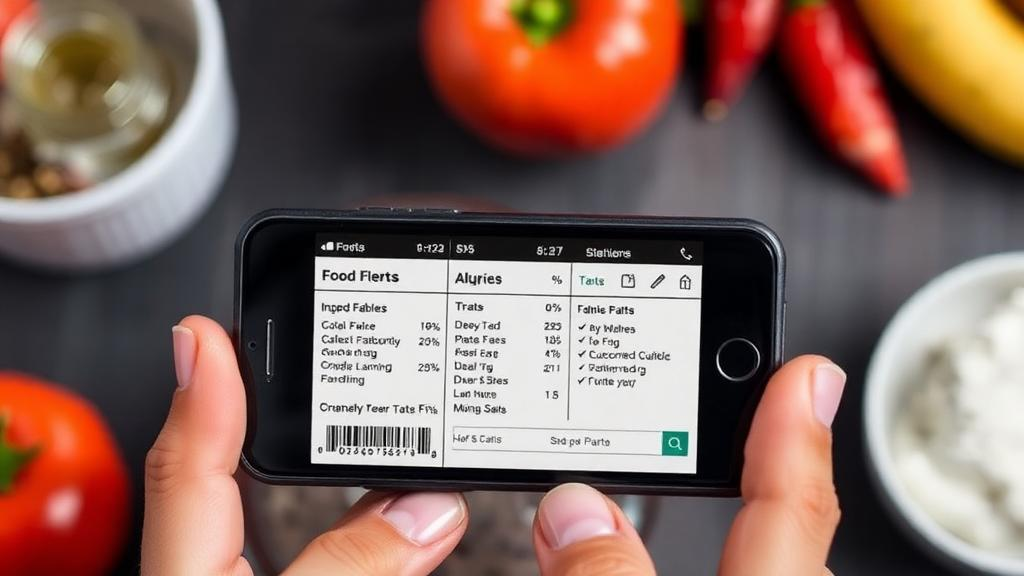
A peer-reviewed study published in Discover Food presents IntellectSnacks, an integrated framework that analyzes packaged-food labels from a smartphone photograph to help users identify ingredients, additives, and potential allergens. The system, described by Amol C. Adamuthe, Vijay H. Kalmani, and Pooja Bagane, chains together several computational steps: image preprocessing, optical character recognition (OCR), text normalization, approximate string matching based on Levenshtein distance, token-based entity processing, and retrieval of supplementary information from external sources.
The evaluation rested on 983 recoverable food-label images, with a fixed subset of 50 images used for a controlled comparison of two OCR engines, RapidOCR and Tesseract, each tested on original and Otsu-preprocessed images. RapidOCR combined with Otsu preprocessing recorded the lowest median OCR processing time of the four configurations, at 909.30 milliseconds, and produced no OCR failures within the 50-image subset. The team also measured processing latency, output consistency, and sensitivity to controlled image-quality perturbations.
Robustness testing revealed an uneven picture. Output remained relatively stable under moderate brightness changes, but mild blur and image downscaling caused noticeably greater reductions in output consistency, a practical concern for a workflow that depends on users photographing labels under real-world conditions.
The authors are explicit about the limits of their evidence. Because independently verified reference annotations were unavailable, the revised evaluation did not recalculate OCR accuracy, character error rate, word error rate, or ingredient-level precision, recall, and F1-score. The findings therefore characterize the computational behavior and image-quality sensitivity of the pipeline rather than demonstrating real-world effectiveness. The study highlights the need for larger annotated datasets, independent ground-truth evaluation, device-level benchmarking, user-centered studies, and clinical validation before any health outcomes can be established. The article was published open access on 17 October 2026 and shared early as a citable, peer-reviewed accepted manuscript.
Subject of Research: A smartphone-based OCR framework for processing food labels and recognizing ingredients, additives, and potential allergens.
Article Title: An intelligent framework for food label processing and ingredient recognition
Article References: Adamuthe, A. C., Kalmani, V. H., & Bagane, P. (2026). An intelligent framework for food label processing and ingredient recognition. Discover Food. https://doi.org/10.1007/s44187-026-01297-x
Image Credits: AI Generated
DOI: 10.1007/s44187-026-01297-x
Keywords: food labels, OCR, ingredient recognition, allergens, image preprocessing, RapidOCR, Tesseract, Levenshtein distance, smartphone application, food informatics, intelligent, framework
News Source: Alan Morgan. (October 29, 2026). Smartphone framework reads food labels to flag ingredients and allergens. Scienmag.