


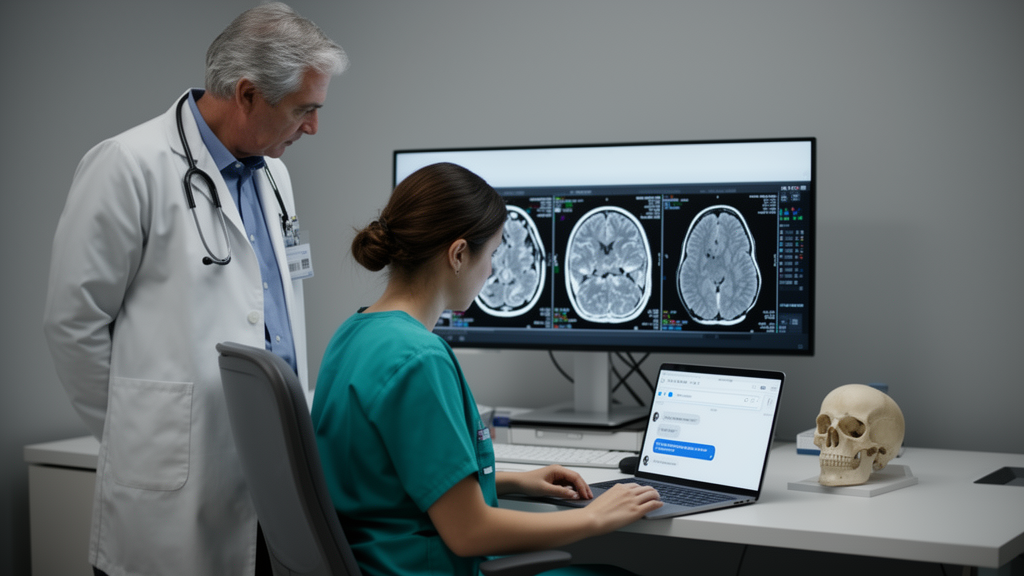
Junior doctors training in neurosurgery made markedly better decisions in emergency scenarios when they could consult ChatGPT-4, according to a prospective simulation study published in BMC Medical Education. Across ten validated emergency vignettes, overall decision-making accuracy rose from 58.0% without assistance to 81.0% with AI support, a difference the authors report as highly significant, with a large effect size of Cohen’s d = 1.6.
The study used a within-subject design: the same 55 frontline trainees completed the vignettes twice, once unaided and once with ChatGPT-4 as a decision-support tool, with a 48-hour washout period between the two conditions. Accuracy was scored against expert consensus. Secondary outcomes included domain-specific accuracy, response completeness, and self-reported confidence, analyzed with paired statistical tests and mixed-effects subgroup interaction testing.
Improvements appeared across every domain examined. The authors report significant gains in emergency management, imaging selection, and pharmacology, each with p < 0.001, with pharmacology showing the largest improvement at 26.2 percentage points. Response completeness increased from 71% to 92% of required elements, and residents’ self-rated confidence on a five-point Likert scale rose from 2.8 to 4.1. The authors state they found no evidence of overconfidence or ceiling effects.
The most striking result was the difference between training levels. Junior residents improved from 45.8% accuracy to 83.0%, an absolute gain of 37.2 percentage points, while senior residents improved from 68.2% to 80.0%, a gain of 11.8 points. The interaction between AI assistance and training level was statistically significant (p = 0.003), indicating that the benefit was concentrated among the least experienced trainees.
The context matters for interpreting these numbers. The authors note that junior residents in neurosurgery often show suboptimal decision-making because of limited structured exposure and supervision, a problem amplified in low- and middle-income countries where workforce shortages place disproportionate responsibility on frontline trainees. Large language models such as ChatGPT-4 have shown promise in clinical reasoning tasks, but evidence on their role as real-time decision-support tools in neurosurgical training had remained limited before this study.
Several caveats should temper enthusiasm. This was a vignette-based simulation, not a study of real patients or real clinical outcomes, so the results demonstrate improved performance on written emergency scenarios rather than proven patient benefit. The published record is also an early-access version, shared ahead of the final Version of Record and subject to further edits. Confidence was self-reported, and the washout design, while standard for within-subject comparisons, cannot fully exclude carry-over effects between conditions.
The authors themselves frame the findings cautiously. In their conclusions, they describe structured and supervised integration of AI tools as a potential way to accelerate competency acquisition and improve patient safety in resource-limited settings, but they emphasize that responsible deployment requires AI literacy training, robust governance, and what they call a “scaffold-and-wean” approach, so that AI augments rather than replaces independent clinical reasoning.
For now, the study’s contribution is a measured one: in a controlled simulation of 55 trainees, real-time access to a large language model narrowed the experience gap in neurosurgical emergency decision-making. Whether such gains translate to supervised clinical practice, and whether they persist once the scaffold is withdrawn, remain questions for future research.
Subject of Research: AI-assisted decision support for neurosurgical emergency training among residents
Article Title: AI-augmented decision support in neurosurgical emergencies: a prospective study of resident performance
Article References: Sharma, T., Sharma, L., Agarwal, M., & Dhakre, G. (2026). AI-augmented decision support in neurosurgical emergencies: a prospective study of resident performance. BMC Medical Education. https://doi.org/10.1186/s12909-026-10696-8
Image Credits: AI Generated
DOI: 10.1186/s12909-026-10696-8
Keywords: ChatGPT-4, neurosurgery, medical education, residents, decision support, simulation, large language models, LMICs, clinical reasoning, emergency vignettes, AI-augmented, decision
News Source: Courtney Benton. (October 29, 2026). ChatGPT-4 Boosts Neurosurgery Residents’ Emergency Decision Accuracy in Simulation Study. Scienmag.



