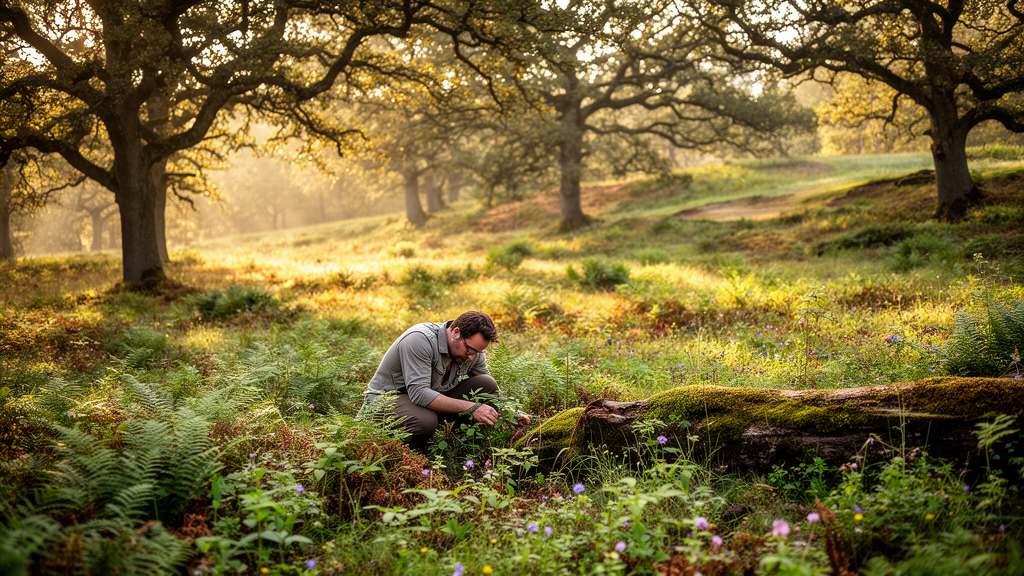
Managed oak forests in southwestern Poland still support a striking range of natural forest communities, and the plant species they contain are governed far more by habitat and surrounding landscape than by how old the trees are. That is the central finding of a new field study published in Annals of Forest Science, in which researchers surveyed all vascular plants across 100 circular plots in oak-dominated stands aged 41 to 180 years in the Bory Stobrawskie Forests. Despite decades of regular timber management, the stands hosted four distinct forest types corresponding to natural communities, from nutrient-poor acidophilous oak forests to species-rich riparian floodplain forests.
The study, led by Natalia Mazurek, Ewa Stefańska-Krzaczek and Zygmunt Kącki, set out to answer two questions: how variable the vegetation is across managed oak stands spanning nearly 140 years of age, and what impact stand age, habitat and landscape variables have on species composition. Each selected stand had to contain at least 50 percent oak, either pedunculate oak (Quercus robur) or sessile oak (Quercus petraea), cover at least 0.03 hectares within a large contiguous forest area, and have no direct spatial contact with other selected stands. Within each stand, the team established a single circular plot with a radius of 10 metres, covering 314 square metres, and recorded every vascular plant in five vegetation layers, from the upper tree canopy down to the herb layer.
Using Two-Way Indicator Species Analysis, the researchers assigned the plots to forest types and identified four: acidophilous oak forests belonging to Agrostio-Quercion petraeae and Quercion roboris, oak-hornbeam forests of Carpinion betuli, and alder-ash and oak riparian forests of Alnion incanae. In total, 250 vascular plant species were recorded. The flora was overwhelmingly native, with alien species making up only 7.6 percent, or 19 species. Notably, 58 ancient forest species, plants that thrive in continuously wooded habitats and are considered indicators of long forest continuity, accounted for 23.2 percent of the species list, a sign that managed stands can retain considerable natural value.
The four forest types differed clearly in structure as well as composition. Agrostio-Quercion petraeae forests showed high cover of the upper tree and herb layers. Carpinion betuli forests featured tall trees with large diameters and a well-developed lower tree layer, while Alnion incanae forests stood out for high species richness, abundant shrub layers and a rich herb layer. Of the 250 species, 49 formed 14 groups of coexisting species, identified through statistical associations quantified with the phi coefficient. One group, centred on Oxalis acetosella, consisted exclusively of ancient forest species and was clearly associated with the oak-hornbeam forests, confirming earlier findings that such forests are important reservoirs for forest-interior plants.
The species groups also tracked measurable environmental preferences. In both acidophilous oak forest types, coexisting species groups correlated positively with light availability, and the Vaccinium myrtillus group appeared in both. The oak-hornbeam forests were distinguished by groups most strongly associated with soil moisture, including Maianthemum bifolium and Oxalis acetosella, while the riparian floodplain forests were dominated by species positively correlated with soil reaction, fertility and temperature indices, such as the Acer platanoides and Brachypodium sylvaticum groups.
To quantify what drives this variation, the team used Canonical Correspondence Analysis and variation partitioning, two ordination techniques that relate species composition to environmental gradients. The explanatory variables together constrained 21.5 percent of total species variation, with an adjusted explained variation of 10.7 percent. Within that constrained fraction, habitat variables, including elevation, soil fertility, soil moisture and groundwater depth, explained roughly 33 percent, and landscape variables, measured within a 1000-metre buffer around each plot, explained about 31.5 percent. A substantial shared habitat-landscape component accounted for roughly 26 percent, reflecting how closely local site conditions and the wider landscape are intertwined.
Stand age, by contrast, contributed only about 4 percent of the explained variation, and its unique partial effect, roughly 1.5 percent, was not statistically significant after Bonferroni correction for multiple testing. Among individual variables, soil fertility emerged as the strongest independent determinant of species composition, followed by the proportions of oak stands and deciduous stands in the surroundings of each plot. Elevation, the proportion of coniferous stands nearby, soil moisture and stand age were also significant in conditional effects, though stand age lost significance once corrections for multiple comparisons were applied.
The spatial patterns were ecologically coherent. Acidophilous oak forests occurred where groundwater was deeper and where coniferous stands, which dominate the poorest lowland sites in the region, featured prominently in the plot surroundings. Riparian and oak-hornbeam forests occupied areas with higher groundwater availability and greater soil fertility, with the lowest-lying river valley positions favouring the floodplain communities. Interestingly, the total proportion of oak or deciduous stands nearby mattered more than the connectivity of those patches, suggesting that a mosaic of forest habitats collectively maintains the spatial continuity of the forest microclimate rather than fragmentation breaking it apart.
The authors caution that the restricted age range of the studied stands, 41 to 180 years, may partly explain the small contribution of stand age, since a broader gradient including younger and older developmental stages could reveal stronger age-related patterns. Managed oak stands are typically harvested at around 120 to 160 years, before they ever reach the decay phase of natural forest succession. Still, the results indicate that after roughly 50 to 60 years of tree growth, once a forest microclimate forms under the canopy, habitat and landscape conditions take over as the dominant filters of species composition.
For forest conservation, the implications are practical. Because the studied managed stands correspond to natural forest communities and harbour ancient forest species, management aimed at maintaining variation in species composition should consider multiple interacting factors across spatial and temporal scales, protecting habitat quality, particularly soil fertility, and the composition of the surrounding forest mosaic, rather than focusing on stand age alone. The authors also note that leaving oaks standing longer in fertile oak-hornbeam forests offers both ecological and economic benefits, since stand age did prove crucial for the species composition of those forests specifically.
Subject of Research: Drivers of plant species composition in managed temperate oak forests
Article Title: Habitat and landscape outweigh stand age as drivers of species composition in managed temperate forests dominated by Quercus robur L. and Quercus petraea (Matt.) Liebl
Article References: Mazurek, N., Stefańska-Krzaczek, E., & Kącki, Z. (2026). Habitat and landscape outweigh stand age as drivers of species composition in managed temperate forests dominated by Quercus robur L. and Quercus petraea (Matt.) Liebl. Annals of Forest Science, 83(1), Article 43. https://doi.org/10.1186/s13595-026-01361-7
Image Credits: AI Generated
DOI: 10.1186/s13595-026-01361-7
Keywords: oak forests, species composition, forest management, habitat variables, landscape ecology, stand age, soil fertility, Quercus robur, Quercus petraea, variation partitioning, Poland, biodiversity
News Source: Margaret Porter. (October 29, 2026). Habitat and Landscape, Not Stand Age, Shape Plant Life in Managed Oak Forests. Scienmag.