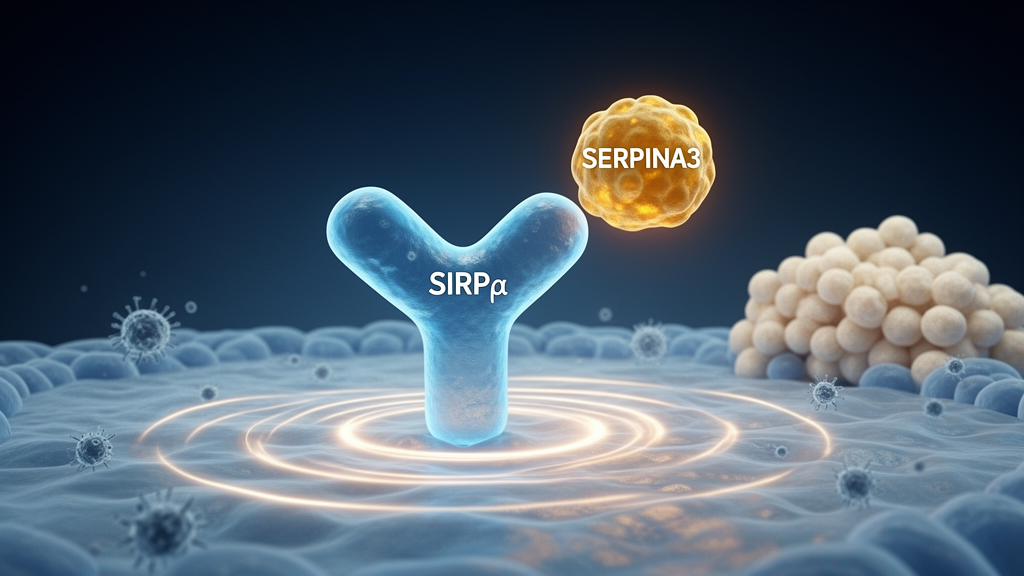
A protein long known mainly as a protease inhibitor has a second identity with major implications for immunology. In a study published in Nature Immunology, researchers report that human serine protease inhibitor A3 (SERPINA3) and its mouse ortholog SERPINA3k act as soluble ligands that bind and activate SIRPα, an inhibitory immune receptor whose canonical ligand is the well-known
The newly identified interaction adds a second axis to the SIRPα signaling system. Until now, CD47 has been regarded as the canonical ligand for this inhibitory receptor, which delivers “don’t eat me” and related suppressive signals to myeloid cells. The study, led by Yufei Hou, Lei Huang and senior author Yong-Guang Yang, together with colleagues, demonstrates that SERPINA3 in humans and SERPINA3k in mice can also serve as soluble binders and activators of SIRPα. According to the authors, engagement of SIRPα by SERPINA3(k) suppresses the functions of several SIRPα-expressing immune cell types, including macrophages, neutrophils, dendritic cells and natural killer cells.
Consistent with this immunosuppressive activity, the researchers report that administering SERPINA3(k) alleviated lipopolysaccharide-induced pneumonia in experimental models and ameliorated both experimental autoimmune encephalomyelitis, a standard model of multiple sclerosis, and rheumatoid arthritis. These preclinical findings suggest that a soluble SIRPα ligand could, in principle, be harnessed to dampen excessive inflammatory and autoimmune responses, although the work remains at the animal-model stage and has not yet been tested as a therapy in patients.
The protein’s role is not uniformly protective, however. Wild-type SERPINA3 provoked inflammation in cardiomyocytes and in brain vascular endothelial cells, indicating that systemic deployment of the molecule could carry tissue-specific risks. To address this, the team carried out functional domain mapping to identify the region of SERPINA3 responsible for binding SIRPα. From this work they derived a mutant, SERPINA3D2, which the authors report abolishes the adverse effects in cardiomyocytes and brain vascular endothelial cells while retaining the molecule’s full SIRPα-mediated inhibitory capacity. Such an engineered variant could, if validated, separate the desired immunosuppressive activity from the unwanted proinflammatory effects in these cell types.
The findings also carry implications for cancer immunotherapy. The study reports that cancer cells secrete large amounts of SERPINA3(k), with levels exceeding those of CD47, the receptor’s better-known ligand. This high-level secretion suggests that the protein may contribute to an immunosuppressive tumor microenvironment by engaging SIRPα on infiltrating immune cells. In support of a therapeutic angle, antibodies directed against SERPINA3(k) inhibited tumor growth in multiple preclinical models, both when used alone and in combination with blockade of the programmed cell death 1 receptor and its ligand, PD-L1, a checkpoint-inhibitor strategy already established in clinical oncology. Combining anti-SERPINA3(k) antibodies with established checkpoint blockade is presented by the authors as a potentially promising direction, though again the evidence comes from preclinical tumor models rather than clinical trials.
The paper, published on 22 October 2026 in Nature Immunology, is organized around a series of figures that trace the argument from molecular identification to therapeutic testing. Early figures establish that mouse SERPINA3k is a ligand of mouse SIRPα with a higher affinity than mouse CD47, and that SERPINA3k inhibits the functions of SIRPα-positive immune cells. Subsequent figures document the reduction of proinflammatory and autoimmune pathogenesis following SERPINA3k administration, map the expression pattern and tumor-promoting effects of SERPINA3k in cancers, and identify the SERPINA3k domain that binds SIRPα. The final figures extend the work to the human protein, showing that human SERPINA3 functions as a ligand for human SIRPα and evaluating its potential as a therapeutic target for human autoimmune diseases and cancers.
Taken together, the work positions SERPINA3 as a dual-faced molecule: a soluble suppressor of innate and adaptive immune cells that can be exploited to calm inflammation and autoimmunity, and simultaneously a tumor-secreted factor whose blockade may release the brakes on antitumor immunity. The authors frame the identification of this potent soluble SIRPα ligand as offering effective therapeutic strategies for inflammatory and autoimmune diseases and a promising target for cancer immunotherapy, with the SERPINA3D2 mutant and anti-SERPINA3(k) antibodies representing the two principal translational leads emerging from the study.
Subject of Research: SERPINA3 as a soluble SIRPα ligand with immunosuppressive, anti-inflammatory and tumor-promoting roles
Article Title: Serine protease inhibitor A3 is a soluble SIRPα ligand that suppresses inflammation and antitumor immunity
Article References: Hou, Y., Huang, L., Jin, C., Li, X., Chen, Y., Sun, L., Wang, F., Zhang, Y., Wang, Y., Zou, M., Xu, Q., Wang, Z., Jin, T., Zhai, N., Xu, F., Liu, W., & Yang, Y.-G. (2026). Serine protease inhibitor A3 is a soluble SIRPα ligand that suppresses inflammation and antitumor immunity. Nature Immunology, 27(11), 2252-2266. https://doi.org/10.1038/s41590-026-02682-5
Image Credits: AI Generated
DOI: 10.1038/s41590-026-02682-5
Keywords: SERPINA3, SIRPα, CD47, immunotherapy, autoimmune disease, macrophages, natural killer cells, cancer immunology, experimental autoimmune encephalomyelitis, rheumatoid arthritis, Nature Immunology, Serine
News Source: Nathaniel Bowman. (October 28, 2026). Newly identified soluble SIRPα ligand SERPINA3 dampens inflammation and shields tumors. Scienmag.