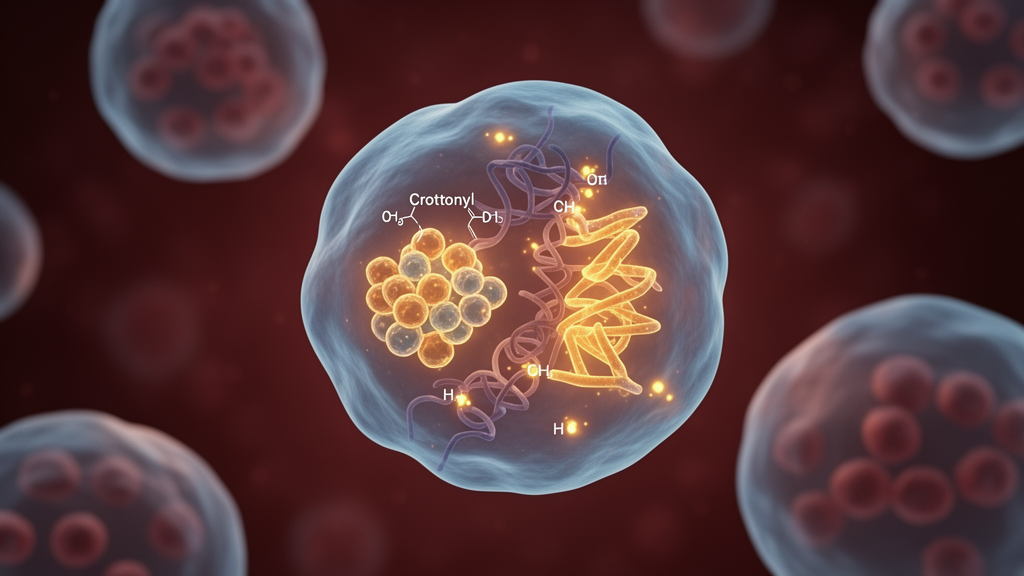
Hypoxia is a well-known driver of aggressive behavior in prostate cancer, prompting tumor cells to rewire their metabolism to survive low-oxygen conditions. A new study published in BMC Molecular and Cell Biology examined whether a metabolic enzyme called enoyl-CoA hydratase 1, or ECHS1, is connected to a chemical modification known as lysine crotonylation on the glycolytic enzyme phosphoglycerate kinase 1, or PGK1, and to malignant traits in prostate cancer models. The work, led by Xiangfu Meng, Song Zhang, Maoli Sun, Wencai Zhang and Chuang Li, was published as an open-access article on 15 October 2026.
The researchers first turned to The Cancer Genome Atlas to assess ECHS1 expression and its relationship with patient prognosis. They found that ECHS1 mRNA levels were higher in prostate tumors than in normal tissue, and that high expression of the gene was associated with shorter disease-free survival. This bioinformatic evidence set the stage for laboratory experiments probing what ECHS1 might be doing under hypoxic conditions.
In the experimental work, the team used two prostate cancer cell lines, PC-3 and LNCaP, and exposed them to 1 percent oxygen for up to 24 hours to mimic hypoxia. They measured protein crotonylation, ECHS1 and PGK1 using immunoblotting and immunoprecipitation, and also examined gene expression, lactate production, stemness-associated markers, migration and invasion. To test function, they used a PGK1 K131R construct, in which the lysine at position 131 was changed to arginine, as well as ECHS1 knockdown, and they evaluated xenografts established from ECHS1-depleted PC-3 cells in vivo.
The results pointed to a coordinated hypoxic response. Hypoxia increased a prominent 83-kDa signal detected by pan-crotonylation antibodies in whole-cell lysates and raised ECHS1 expression, but it reduced PGK1-associated crotonylation without materially changing total PGK1 protein. When the researchers introduced the K131R construct, which showed lower PGK1 crotonylation, the cells displayed lower lactate output and reduced readouts for the glycolytic genes HK2, LDHA and MCT4, along with lower levels of the stemness markers CD44, CD133 and Oct4. Those cells also showed fewer migrating and invading cells than the hypoxia control group.
Manipulating ECHS1 itself produced a strikingly different picture. When the team knocked down ECHS1, PGK1-associated crotonylation increased and HIF1A mRNA decreased relative to hypoxic conditions. In the in vivo experiments, xenografts established from ECHS1-depleted cells had smaller endpoint tumor volumes than control xenografts. Taken together, the authors conclude that ECHS1 was associated with hypoxia-responsive PGK1 crotonylation and with glycolytic and invasive phenotypes in these models, and that genetic ECHS1 depletion increased PGK1-associated crotonylation while reducing xenograft growth, supporting a functional contribution of ECHS1 within the tested systems.
Subject of Research: The role of ECHS1 in hypoxia-associated PGK1 crotonylation and malignant phenotypes in prostate cancer models
Article Title: ECHS1 modulates hypoxia-associated PGK1 crotonylation and malignant phenotypes in prostate cancer models
Article References: Meng, X., Zhang, S., Sun, M., Zhang, W., & Li, C. (2026). ECHS1 modulates hypoxia-associated PGK1 crotonylation and malignant phenotypes in prostate cancer models. BMC Molecular and Cell Biology. https://doi.org/10.1186/s12860-026-00605-8
Image Credits: AI Generated
DOI: 10.1186/s12860-026-00605-8
Keywords: prostate cancer, ECHS1, PGK1, crotonylation, hypoxia, glycolysis, The Cancer Genome Atlas, xenograft, HIF1A, lactate, cell migration, invasion
News Source: Nathaniel Bowman. (October 28, 2026). ECHS1 Linked to Hypoxia-Driven PGK1 Crotonylation in Prostate Cancer Models. Scienmag.